
AMOS DOOLITTLE
Amos Doolittle (b. Wallingford, Conn., 18 May 1754; d. New Haven, Conn., 30 Jan. 1832) was an engraver. It is not known that Doolittle was an active musician, but he engraved many tunebooks, and he is listed with important Connecticut musicians such as Daniel Read and Simeon Jocelin as copublisher of musical works which name no author.
Bio-bib, DAB, Metcalf. Also Doolittle 1901, p. 239ff.
Note on Amos Doolittle as an Engraver
Beginning early in the 1780s and continuing over the next two decades, Amos Doolittle was active in New Haven as an engraver of musical publications. Doolittle signed several works: Jocelin's The Chorister's Companion (1782; 2d edition, 1788), Langdon's The Select Songster (1786), Jocelin's A Collection of Favorite Psalm Tunes (1787), Read's The Columbian Harmonist No. 1 (1793), Jenks's The New-England Harmonist (1799) and his The Musical Harmonist (1800). He may not have engraved Jenks's The Delights of Harmony (1804) with his own hand, but it bore the colophon: 'Engravd & Printed for the Author: at the Office of A. Doolittle New-Haven.' Amos Doolittle was also copublisher with Daniel Read of The American Musical Magazine (1786-87), and though it is unsigned, he probably engraved that too. Moreover, since he and Read were collaborators in 1786, he may well have been the engraver of the plates for Read's The American Singing Book, published a year earlier (1785). Carrying inference further, it would have been natural for Doolittle to have engraved the Supplement to the Chorister's Companion (1792), since he signed other works in which he had a publisher's or author's stake. And having signed No. 1 of Read's The Columbian Harmonist as engraver, he perhaps also did No. 2 (1794) and its Additional Music of 1798 and 1801, as well as No. 3 (1795). No other engravers of music are documented in eighteenth-century New Haven. Taking that fact together with all of the circumstantial evidence noted, there is good reason to suspect that Doolittle had a hand in engraving all collections published in New Haven during the period.
The engraving in the tunebooks signed by Doolittle shows that attribution on the basis of style is no cut-and-dried matter, for differences abound. Two are most striking: the differences in calligraphy of the texts to which the tunes are sung, and the stemming of notes. In all of the collections signed by Doolittle except the last two (Jenks 1800 and Jenks 1804), the text is underlaid in Roman characters; in Jenks it is written in italics. As for stemming, Doolittle's earlier works show the modern convention of putting upward stems on the right and downward stems on the left-hand side of the notehead, while in both Jenks items all stems are on the right.
Other differences can also be seen. In the signed Jocelin and Read items, tune titles are written in Roman upper case and lower case, while in Jenks 1800, titles appear variously in italics (p. 18), full Roman caps (p. 20), and open-face caps (p. 33ff.). (In Jenks 1804 tune titles are in full Roman caps, except on p. 57, 60, and 64, where they are in italics.) Two distinctly different ways of making a sharp-sign are found: in the Jocelin items, the upright lines are carefully drawn perpendicular to the staff; in all other items, they are sketched in less carefully, at an approximate 45-degree angle.
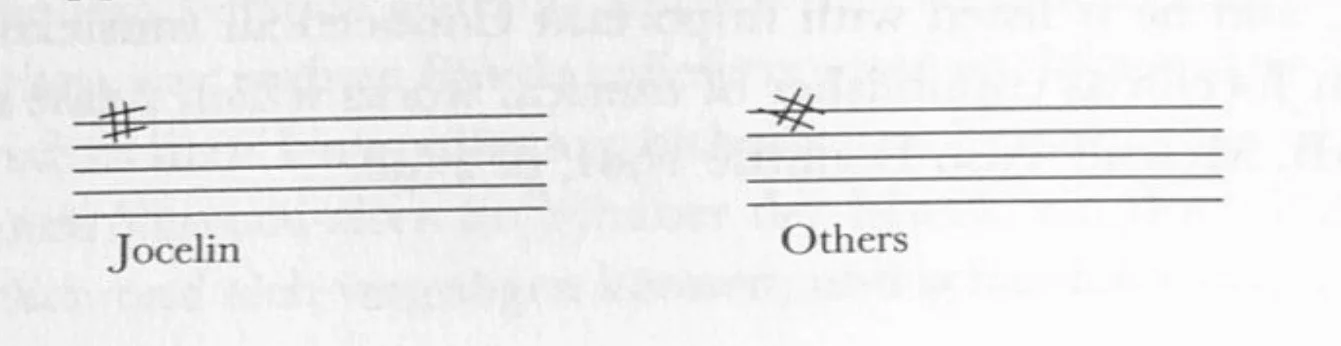
There is also considerable variation in general neatness. The Jocelin items, especially The Chorister's Companion, 2d ed. (1788), maintain a very high standard of clarity and elegance, but Read's The Columbian Harmonist No. 1 (1793) falls short of that standard, especially in its rather crabbed text.
Some of the variations may be the result of the different editors' preferences rather than Doolittle's engraving style. For example, Jocelin and Read may have preferred Roman text for its legibility while perhaps Jenks expressed nó particular preference. (To note but one instance where editorial preference differed: Jocelin seems to have liked the repeat sign with a slash [:8:], while Read preferred it without [:S:].) Or perhaps they insisted on the alternating note stems, overriding Doolittle's preference for stemming only on the right-hand side-a short-cut for the engraver. Haste or illness or other factors might also have influenced the engraving quality. But whatever the reasons, even the signed items display considerable variation; the Jocelin and the Jenks tunebooks do not look like the product of the same hand.
The point of scrutinizing Doolittle's engravings closely is to decide whether he engraved other New Haven tunebooks that he did not sign-in other words, whether internal evidence supports the circumstantial evidence cited above. Read's The American Singing Book (1785) shares the roundness of notes and general neat appearance of The Chorister's Companion (1782). Some pages of The American Musical Magazine (1786-87) have a more careless appearance than anything Doolittle signed. However, that might be the result of the larger page size, which required the engraver to enlarge his scale, thereby magnifying irregularities. And it may also be that the text was punched rather than drawn onto the plates, which would account for some of the irregular spacings and the occasional nonalignment of letters. The italic hand that Doolittle was to use later appears in The American Musical Magazine for certain performance directions. (See, e.g., p. 17.)
The year 1786 saw the appearance of another New Haven collection, Langdon's Beauties of Harmony. Its notes have the clean roundness of the Jocelin and Read books, but they are all stemmed on the right-hand side, a trait not found in a signed Doolittle item until 1800. In addition, both Langdon's work and The American Musical Magazine lack a trait shared by all collections signed by Doolittle and all of the other suspected Doolittle engravings except for Jenks 1804: the sign for duple meter, whether in forward or reverse position, shows a little flourish at the top, as if drawn from bottom to top and finished off with a quick turn of the wrist. (See example.)
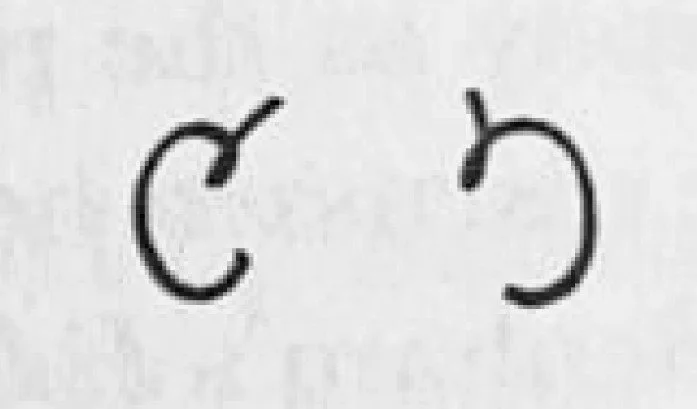
It is as if this trait, found in early, middle, and late Doolittle engravings, was set aside in 1786-87 and then reassumed.
The next engraved New Haven collection, Benham's Federal Harmony (1790), bears little resemblance to Doolittle engravings in works such as Jocelin and Read. However, Benham's book, with its stemming of notes on the right-hand side, its tune titles and attributions in italics, and its occasional if not consistent flourishes on some common-time meter signatures, looks quite similar to Jenks's The Musical Harmonist (1800). One major difference, however, is that the text was apparently punched onto the plates in Roman characters and bears a cramped appearance. Benham's work can be attributed to Doolittle with less assurance than most of the others.
The Supplement to Jocelin's The Chorister's Companion (1792) resembles in every detail the rest of that work. The high quality of engraving in this and the other items Jocelin published suggests that he was a demanding client; certainly he brought out the best in Doolittle as an engraver. Read's The Columbian Harmonist No. 2 is less elegant than The Chorister's Companion, though it retains some of the earmarks of No. 1, which Doolittle did sign. The awkwardness of the half-title and index - especially the indecisive execution of the italic portions - the angularity and lack of grace in the note-shapes, the crookedness of many bar lines, and the general untidiness suggest the work of an engraver less skilled than Doolittle who was attempting to reproduce his style. (These traits may also show Doolittle's own work at low ebb.) Finally, Woodruff's Devotional Harmony (1801), with its notes stemmed on the right-hand side and its italic text underlay, looks identical to Jenks's The Musical Harmonist, which Doolittle did sign, and Jenks's The Delights of Harmony, a product of his office. Steel 1982 suggests of the last item 'the possibility that one or more subordinates, possibly including the engraver's sons Amos B. Doolittle (1786-1809) and the precocious Horace Doolittle (1792-1811), had a hand' in engraving it (p. 49).
When the circumstantial and internal evidence are taken together, the possibility remains strong that Amos Doolittle engraved all of the collections mentioned here, except for Read's The Columbian Harmonist Nos. 2 and 3, and Benham's Federal Harmony. It is true that large stylistic differences can be seen between the works. Yet the period covered is more than two decades, which is a long time to expect a style to remain static. It must be remembered, as well, that as an engraver Doolittle was an employee of the compiler. It may be significant that the collections with the note-stems all on the right-hand side were works by young men: the Yale student Chauncey Langdon, the recently-deceased teenager Merit N. Woodruff, and the itinerant compiler Stephen Jenks, not yet thirty. When he worked for these men, Doolittle was already an experienced engraver of music and may have been inclined to take shortcuts. However, when he worked for Read and Jocelin, men closer to his own age and experience and both substantial permanent citizens of New Haven, he may have felt more strongly compelled to work with more care.
Doolittle is listed in this bibliography as the probable engraver of those New Haven imprints he did not sign but which are discussed here, and as the possible engraver of The Columbian Harmonist Nos. 2 and 3 and Benham's Federal Harmony.
THE AMERICAN MUSICAL MAGAZINE, 1786-87
This work was issued in twelve numbers. Because copies of individual numbers have not been found, the twelve are here treated as a single unit.
ASMI 170
The American Musical Magazine. Published in monthly numbers; intended to contain, a great variety of approved music; carefully selected from the works of best American and foreign masters. Vol. I. New-Haven: published & sold by Amos Doolittle & Daniel Read.
49, [1] p., printed covers. 24 x 20.5 cm. p. 1-49, [1] engraved [probably by Amos Doolittle]. See note above, under Doolittle. p. 35 wrongly numbered 38.
[1786-87.] New Haven Chronicle, 9 May 1786, advertises first number as just published. Back cover of MWA copy dated New-Haven, 15 Aug. 1786. New Haven Chronicle, 12 Sept. 1786, advertises that four numbers had been published. New-Haven Gazette, 6 Sept. 1787, advertises completion of first volume (twelve numbers), with nothing said about continuing publica-tion. Front cover recto, subscription notice; verso blank; p. [1], t-p.; p. [2] blank; p. 3-49, music; p. [50], 'Contents of Vol. I'; back cover recto blank; verso, notice of another musical publication. 'Subscriptions for this Magazine are taken in by the Publishers, at Two-Thirds of a Dollar per Year, provided One Half the Money is paid at the Time of subscribing, and the other Half at the Time of Publishing the Twelfth Number; and those who subscribe for Six Setts shall have a Seventh Gratis.' (Extract from subscription notice on front cover.) 'Now In Press, and will be Published, and Ready for Sale by next Commencement, at D. Bowen's Printing-Office . . . The Select Songster . . . New-Haven, August 15, 1786.' (Extract from notice on back cover.)
34 compositions, incl. 3 anthems, 1 set-piece, 4 secular songs, & 1 instrumental minuet, the sacred music set for 4 voices; full text. Attribs. to 'taken from Adams' (3), G. W. Adams, 'taken from Anonymous,' Atwell, 'taken from Billings' (4), Bunnel, Canfield, Carpenter, Fisher, Gillet, Harris, Read (7), W. Read, Seaver, 'taken from Thomas' (3), Williams. Secular music attrib. to Arne (2), Mr. Dwight, Fischer, Hook. 17 1st pr. identified (AUTUMN, CONDESCENSION, CONTEMPLATION, CRUSIFIXION, DANBURY, DEVOTION, GREENWICH, HOPEWELL, JERUSALEM, MEDFIELD, NEW MILFORD, ODE FOR CHRISTMAS, RUSSIA, SOUTHWELL, STONINGTON, UNITY, WINDSOR), also 2 1st Am. pr. (Anthem: When the Lord turned; VERNON). 1 25 American sacred compositions, 4 non-American (24 attrib. Americans, 1 traced; 4 attrib. non-Americans).
2 Core Repertory (1st pr. GREENWICH, RUSSIA).
Not in Evans (no copy on Readex). CtY (lacks front and back covers), ICN (lacks t-p., all after p. 48), MH, MWA*.
NOTE: The secular and instrumental pieces are omitted from the tabulation of the music above.
A facsimile reprint has been issued by Annemarie Schnase (Scarsdale, N.Y., 1961), and the work is included in University Microfilms, American Periodical Series, 18th Century, Carton 6.
ASMI pp. 249-253