
ANDREW LAW
Andrew Law (b. Milford, Conn., 21 March 1749; d. Cheshire, Conn., 13 July 1821) was a compiler, singing master, and clergyman. In 1772 he established a singing school at Rhode Island College (Brown University) in Providence, where he was enrolled as a student in the Class of 1775. After graduation he studied theology and in 1787 was ordained as a minister in the Congregational and Presbyterian churches. By 1778, however, he had launched a career as a compiler and teacher, which he followed for the rest of his life. After 1783, attempting to spread his influence southward, he traveled mostly outside New England, teaching from his tunebooks and hiring others to do the same. Declaring a preference for European music in 1793, he organized his publications into a comprehensive vocal method, The Art of Singing, and worked to promote this method in New England (to 1798) and Philadelphia (1798-1802). Law devised a staffless shape notation (1803), published tunebooks using it, and worked towards its acceptance, mostly from Philadelphia, where he lived from 1806 until 1813. He then resumed his travels and continued to teach and publish until his death. He was perhaps the most-traveled American musician of his age and the most prolific compiler. The William L. Clements Library owns a large collection of Law's personal papers.
Amerigrove, Baker's, Bio-bib, DAB, Grove, Metcalf, Sonneck-Upton. Also Lowens 1964, ch. 4; Crawford 1968; Law Papers.
THE ART OF PLAYING THE ORGAN AND PIANOFORTE, 1809
This item has no music, nor is it specifically directed at sacred music making. It is included here because Law devoted his musical life entirely to psalmody, and in this pamphlet he explained and justified the staffless shape-note system in which all of his sacred collections after 1801 were printed.
ASMI 314
The Art of Playing the Organ and Piano Forte, or Characters Adapted to Instruments. By Andrew Law. Philadelphia: printed by Jane Aitken, No. 71 North Third Street.
8 p. 13 x 22.5 cm.
[1809.] Copyright granted, 19 May 1809, District of Pennsylvania, to Law as author. p.
[1], t-p.; p. [2], copyright notice; p. [3], 'Preface'; p. 4, 'Introduction'; p. 4-5, 'The New Plan Compared With The Old'; p. 6-8, examples & explanations. 'The system which I have brought forward to public view, has not been the creature of accident, nor the offspring of a day. It has been a subject of reflection from the time I was at school learning the first rudi-ments of the art, and before I had ever seen a printed music book of any kind. I then had an idea of representing musical sounds by characters without lines, but did not form any regular system for the purpose till after I became a teacher of the art. In the year 1785 I attended more particularly to it, and in the beginning of 1786 I prepared it for publication, and showed it to many of my friends, numbers of whom are still living, and are ready to give their testimony to the truth of it. But the impossibility of procuring a type for the purpose, and the want of health, at that time prevented the publication. [New par.] I have since procured a type and obtained a patent which embraces four kinds of characters, and also seven. [New par.] At that time I was convinced, upon a full view of the subject, that for vocal music four characters were preferable to seven. From a view of it as applied to instruments, I believed seven would be preferable. From a review of it, when I first published it I was fully convinced that my first position of the business was correct, and that the plan with four characters is more congenial with the principles of the art, and better calculated to lead the pupil to a perfect knowledge of the science of music than seven. Vocal music being my principal object in the work, I thought it best to publish first with four characters. Several persons have objected to the plan upon the ground that it is not applicable to instruments. To convince the public mind therefore that it is not only applicable to instru-ments, but much easier than the old method; as well as to gratify the wishes of such as have been habituated to the use of seven syllables in singing, I have procured an additional type for the purpose of printing with seven characters. I have placed a dot directly over or under these three characters, to wit, or which will always be the next below the. [New par.] All music printed upon this plan may be sung and played from the same copies, upon the plan of four characters with four syllables, or upon the plan of seven characters with four or seven syllables. [New par.] Every one may therefore follow his own inclination respecting the number of syllables he uses in singing. I should recommend the use of four only; yet if any one should prefer seven, he can take mi faw sol law bo do ro, or any others. [New par.] Four syllables are a sufficient variety to render the frequent repetition of them agreeable, and it is a false idea that syllables lead to the true sounds of musical notes. It may be that some syllables are more contracted than others, but not more acute or grave, higher or lower. If it were, as some suppose, that there are acute and grave syllables, then all such tunes as are sung to different hymns must be altered every time they are sung, and frequently in every verse of the same hymn. If the syllable be be more acute than ba, then the first syllable of the word before, must be half a tone higher than the second. The first note of Denmark should then be sharped. There are almost innumerable instances of the same nature. The admission of the principle would involve many difficulties far greater than any that are overcome by the adoption of the principle were it just. The semitones are a difficult part of performance, but can never be obtained by that method. They must be learned by the aids of a good ear, and an able and accurate teacher. The syllables which are used in singing ought to be such as form the organ for good and agreeable sounds.' (Preface, almost in full.) 'The new plan has only one scale for all the parts and all the keys in music; which scale is composed of seven simple characters. The old plan has at least two scales for the parts, and seven for the keys, and these scales are each of them compounded by fourteen complicated characters, such as notes, lines and spaces; here are three parts to every char-acter, the note, the line and the space, and all of them gain no advantage over the one simple note in the new plan. The stave must include a ledger line above and below, making seven lines and seven spaces for each part; the two parts bass and treble together, making at least twenty eight characters. To this must be added seven different keys of the same extent as the first, making on the whole seven times twenty eight, or one hundred and ninety six. The comparative view is then, as seven to a hundred and ninety six, or as one to twenty eight. But this difference will apply only to vocal music. In instrumental music, the difference will consist principally in the scale of the first key, which is as seven to twenty eight, or one to four, having four times the number of characters to learn in the first instance. The difficulty of shifting the keys on the instrument being about the same in the new method as in the old; I believe it will not be more difficult in the new than in the old; but allowing the difficulty to be double, still one half is gained, it will then be on the whole as one to two; then a saving will be made of one half the time, labour, trouble and expence of learning. A child can learn the piano forte in one year as perfectly, as she could from the old method in two years. This must be an object of some importance to the public. [New par.] But the comparative view as it respects vocal music is of vast importance, not only from the great advantages gained by the new plan (which has already been shewed is as one to twenty eight) but from a view of the number who learn vocal music compared with the number of those who learn instrumental. For it may be asserted with truth that there are a hundred who learn vocal music to one who learns instrumental of any kind. If therefore it should appear, that no gain is made in instrumental music, still the gain must be vastly great in a full view of the subject. [New par.] The new plan has likewise a great advantage over the old, in respect of transposition. The musician can perform any piece written in the new notes, without sharp or flat at the beginning, with two sharps, as easily as if it were written with two sharps; if it be written with one sharp, he can play it with three sharps, or if it be written with three he can play it with one. And any piece may be played in any key the performer shall chuse as easily as if written in so many different keys.' (Extract from The New Plan Compared With The Old.)
No music.
S17900 (MWA). CtY (2; 1 b.w. The Musical Magazine, 1805, &, No. 2, [1810]; 1 b.w. Harmonic Companion, [1807], & The Musical Magazine, 1805), ICN (b.w. Harmonic Companion, [1807]), MSaE (b.w. other items as Musical Miscellany No. 1), MWA* (b.w. Harmonic Companion, [1807]).
THE ART OF SINGING, 1794-1810
The Art of Singing is a general title covering a three-part work Law first published in 1794 and reissued several times and in various forms thereafter. The three Parts of the work are The Musical Primer, The Christian Harmony, and The Musical Magazine. Each Part has two title-pages, one identifying it as a portion of The Art of Singing, the other giving its specific title. Each Part was available separately; each was also bound with other Parts. The aim here is to describe all combinations of various Parts of The Art of Singing that survive in contemporaneous bindings. However, individual Parts found only in combination with other Parts or items are described separately.
It is essential to remember that both The Musical Primer and The Musical Magazine were printed separately before 1794 (see Nos. 345, 347, 351), and not until then did they become Parts of The Art of Singing. One more potentially confusing fact is that Law designated as fourth and fifth editions of The Art of Singing issues that were actually the third and fourth.
The genesis of Law's The Art of Singing is described in Crawford 1968, p. 111-20, and a bibliography appears on p. 269-82. Law's own description of the projected Art of Singing appears in Part II, The Christian Harmony, Vol. 1 (1794), q.v. (No. 316).
The Art of Singing, Part 1, 1794
ASMI 315
The Art of Singing; in three parts: viz. I. The Musical Primer, II. The Christian Harmony, III. The Musical Magazine. By Andrew Law, A.M. Author of the Select Harmony, Rudiments of Music, &c. Published according to act of Congress. Part I. Cheshire; Connecticut: M.DCC.XCIV.
[2d t-p.] The Musical Primer; or The First Part of the Art of Singing: containing the rules of psalmody, newly revised and improved; together with a number of practical lessons and plain tunes: designed expressly for the use of learners. By Andrew Law, A.M. Second edition. Price, 25 cents single-20 cents by the dozen.
32 p. 12 x 21 cm. p. 17-32 engraved. Letter of 11 March 1794, Samuel Andrew Law to Andrew Law, in Law Papers, notes the hiring of Samuel Doolittle to engrave The Art of Singing. All Parts appear to have been engraved by the same hand, and Doolittle signed Part III, The Musical Magazine (q.v.).
Copyright granted 4 April 1794, District of Connecticut, to Andrew Law as author. On 18 Aug. 1794 Law deposited two books with the Secretary of State: The Art of Singing and The Musical Primer. (See Lowens 1959, p. 154-57; see also Crawford 1968, p. 123n.). p. [1], t-p.; p. [2] blank; p. [3], 2d t-p.; p. [4], 'Advertisement'; p. [5]-6, 'Preface'; p. [7]-13, 'Introduction'; p. 13-16, 'Essay on Time and Mode'; p. 17-24, 'Scale of Rules'; p. 25-32, music. The introductory material is essentially the same as in the 1st ed., 1793, q.v. (No. 351). Quotations here reflect Law's transformation of The Musical Primer from a separate introduction to psalmody into the first Part of The Art of Singing, a comprehensive graded vocal method. 'N.B. Purchasers, who desire it, may have this First Part of the Art of Singing, bound with Part Second, or the Christian Harmony.' (Extract from Advertisement.) 'In com-piling this First Part of the Art of Singing, I have made it my express object, to prepare a little book, that might furnish and assist Singing-Schools, and all learners during the first As to the Tunes introduced into the Primer, they are stages of their improvement. principally of a kind, the most simple, plain and easy: Calculated, not to entertain the accomplished performer, who is delighted with nothing short of refined and delicate airs; but to take the bewildered learner, and conduct him along a smooth and gradual ascent in his way towards the summit of taste and graceful performance.' (Extract from Preface.)
Engraved portions printed from same plates as The Musical Primer, 1793 (No. 351).
14 compositions for 4 voices; full text. No attribs. No 1st pr. identified. 15 tunes traced to non-American sources (BERLIN, DUBLIN, MARYLAND, NEW LONDON, WINDSOR), 9 unidentified.
1 Core Repertory.
Not in Evans (MWA copy b.w. The Art of Singing on Readex E27204). CtHi, CtY, MWA*.
NOTE: There is a strong possibility that Law himself composed some or all of the unidentified tunes. See Crawford 1968, p. 108-10. Documents in the Law Papers show that The Musical Primer, Part I of The Art of Singing, was printed in Cheshire by William Law. (See Crawford 1968, p. 123-25.)
ASMI 315A
The Art of Singing . . . Part I. Cheshire; Connecticut: M.DCC.XCIV.
[2d t-p.] The Musical Primer . . . Second edition.
40 p. p. 17-32 engraved. . . .
[1798-1800.] The added pages show the issue to be later than the 32-page Part I, and the 1794 t-p. marks it as earlier than the 48-p. '3d ed.' The music on p. 33-40 is the earliest Law had printed from type. No font of music type is known to have existed in Connecticut before 1812, so this portion must have been printed elsewhere. It is likely that Law had p. 33-40 printed by John M'Culloch in Philadelphia between the time he arrived there to teach on 3 Dec. 1798 (see Crawford 1968, p. 139) and the autumn of 1800, when the new edition of the The Art of Singing appeared. M'Culloch owned a font of music type. Law hired him in Nov. 1801 to print the The Musical Magazine, No. 6 (No. 326). That typographical printing strongly resembles the type style used for p. 33-40 of The Musical Primer. Contents same as main entry, except: p. 25-40, music. Music on p. 25-32 printed from same plates as main entry.
28 compositions for 4 voices; full text. No attribs. 113 1st Am. pr. identified (CANTON, CARLISLE, CHESTER, CHINA, DOVER, EPPING, HAMPTON, HOLLIS, LANCASTER, MILAN, PORTUGAL, PRINCETON, READING). 16 tunes traced to non-American sources (BERLIN, DUBLIN, MARYLAND, NEW LONDON, TRUMPET, WINDSOR), 22 unidentified.
No Core Repertory.
Not in Evans (no copy on Readex). CtY*, NjPT. Both b.w. The Art of Singing, Pts. I, II, & III, [1796].
ASMI 315B
The Art of Singing . . . Part I. Cheshire; Connecticut: M.DCC.XCIV.
[2d t-p.] The Musical Primer
40 p. p. 17-40 engraved. Second edition
[1798-1800.] P. 33-40 carry the same tunes, engraved, as the corresponding pages in the previously-described variant, typeset. It is not known which issue was printed first, although the CtHC copy of this issue is bound with other Parts of The Art of Singing, including a version of Part II, The Christian Harmony, with a 1799 t-p. date (No. 316A). Contents same as main entry through p. 32; then: p. 33-40, music. p. 17-32 printed from same plates as main entry.
Music same as variant just described (No. 315A).
Not in Evans or Shaw-Shoemaker (no copy on Readex). CtHC* (b.w. The Art of Singing, Pts. I, II, & III), MH.
The Art of Singing, Part II, Vol. I, 1794
ASMI 316
The Art of Singing; in three Parts: viz. I. The Musical Primer, II. The Christian Harmony, III. The Musical Magazine. By Andrew Law, A.M. author of the Select Harmony, Rudiments of Music, &c. Part II. Cheshire; Connecticut: printed and sold by William Law, M,DCC,XCIV.
[2d t-p.] The Christian Harmony; or The Second Part of the Art of Singing: comprising a select variety of psalm and hymn tunes; together with a number of airs and anthems: calculated for schools and churches. By Andrew Law, A.M. In two volumes. Vol. I. Price, 66 cents single-52 cents by the dozen.
64 p. 12 x 21 cm. p. 9-64 engraved.
Copyright granted, 4 April 1794, District of Connecticut, to Andrew Law as author. On 17 Aug. 1794 Law sent copies of The Christian Harmony to a bookseller, according to a memorandum of that date in the Andrew Law Papers. It is likely that Vol. I of The Christian Harmony was included in the copy of The Art of Singing Law deposited in the Secretary of State's office, 18 Aug. 1794. (See Lowens 1959, p. 154-57; see also Crawford 1968, p. 123n.) The New Haven Connecticut Journal, 3 Sept. 1794, advertises it as 'directly from the Press.' p. [1], t-p.; p. [2], undated copyright notice; p. [3], 2d t-p.; p. [4], 'Advertisement'; p. [5]-6, 'Description of the Whole Work'; p. 6, 'Miscellaneous Remarks'; p. [7], 'Index of Metres'; p. [8], 'Index Of Tunes'; p. 9-64, music. The second Part of the Art of Singing is composed of the Christian Harmony in two volumes. The first volume is here completed. It presents to worshiping assemblies a variety of tunes adapted to solemn and social praise. To Singing Schools, it presents an assortment of music proper for practice, as soon as they have attended to the rules and lessons comprised in the Musical Primer. In the meantime, purchasers may procure this volume and the Primer separately; or they may have them both bound together; - or lastly, those who are already acquainted with Music, may if they choose, take this volume to the exclusion of the Primer, and avoid the expense of repurchasing the rules, the ABC of their art.' (Advertisement in full.) "The Art of Singing will consist of three leading parts, the Musical Primer, the Christian Harmony, and the Musical Magazine. The second part, or the Christian Harmony will be further divided into two vols. and the third part, or Magazine, into a course of numbers. At their first appearance, all the different divisions of the work will be published separately; but in preparing them for the press, the unity of the main work will be steadily pursued; so that in the end, the several parts and divisions may all be collected into a single book, and form one consistent whole. The work, thus completed, is designed to furnish an assortment of music large enough for the generality of singers to possess. It is in short, to comprise the elements, or rules of the science, together with a regular gradation of the best sacred music, from the plainest tunes up to the nicest airs and anthems. [New par.] The rules will be mostly contained in the first part of the Art of Singing, or the Musical Primer; and indeed the prime object of the Primer will be, to furnish and assist singing schools and all learners during the first stages of their improvement. Hence the tunes that are introduced into the Primer, are principally of a kind, the most simple, plain and easy: calculated, not to entertain the skilful performer, who is delighted with nothing short of refined and delicate airs, but to take the bewildered learner and conduct him forward along a smooth and gradual ascent towards the summit of improvement. As soon however as learners have paid sufficient attention to the rules and tunes in the Primer, and are in want of other music, they may find a supply in the 1 vol. of the Christian Harmony. Indeed it is a part of the original plan, that such volume should be expressly calculated for use next after the Musical Primer; for it is the Christian Harmony in 2 vols. that is to compose the second part of the Art of Singing. [New par.] The first volume is already complete. The music, which it contains, forms a considerable variety, not of long pieces, but of short tunes; not of nice and complicated performance, but in general, rather plain, and in very few instances, difficult to be learnt. To a large proportion of music of this description, preference has been given, and the tunes themselves have been suited to an uncommonly great variety of metres, on purpose that the book might the better be calculated for answering two very important objects. Firstly, that it might be suitable for singing-schools and all learners immediately after having used the Musical Primer, and secondly, that it might be rendered extensively serviceable to all christian Churches in the solemn exercises of humble and devotional praise.' (Extract from Description.)
63 compositions, incl. 3 set-pieces, for 3 & 4 voices; full text. Attribs. to Chandler (3), Mr. Gillet (8), Mr. Handell, Mr. Lyon, Mr. Madan, T. Olmstead (5). 19 1st pr. identified (AMENIA, BABYLON, GRANBY, HATFIELD, PSALMS 50, 63, 84, TROY, WETHERSFIELD), also 16 1st Am. prs. (AFRICA, BETHLEM, CAROLINA, ESSEX, HADDAM, LORRAIN, MANSFIELD, MIDDLESEX, NEWBERN, NEWTON, ORANGE, ROCK-BRIDGE, SAYBROOK, SOUTHBURY, SUFFOLK, WOODBURY). 20 American compositions, 32 non-American, 11 unidentified [AFRICA, CAROLINA, ESSEX, GROTON, MIDDLESEX, NEWBERN, NEWTON, ORANGE, SAYBROOK, SUFFOLK, WINCHESTER] (17 attrib. Americans, 3 traced [GEORGIA, GOSHEN, UNION]; 2 attrib. non-Americans, 30 traced).
16 Core Repertory.
E27205 (MWA). CtHi, CtY, InGo, MB (b.w. Law, The Musical Primer, 1793, & The Musical Magazine), MH, MiU-C*, MWA, NRU-Mus.
ASMI 316A
The Christian Harmony: or The Second Part of the Art of Singing: comprising a select variety of psalm and hymn tunes: together with a number of airs and anthems: calculated for schools and churches. By Andrew Law. In two volumes. Vol. I. 1799.
[4], 9-64 p. p. 9-64 engraved.
P. [1], t-p.; p. [2] blank; p. [3] blank; p. [4], 'Index Of Tunes' covering p. 9-64; p. 9-64, music. p. 9-64 printed from same plates as main entry.
Music same as main entry.
Not in Evans (no copy on Readex). CtHC* (b.w. Law, The Art of Singing, Pts. I, II, & III).
The Art of Singing, Part II, Vol. 2, [1796]
ASMI 317
The Art of Singing; in three Parts: viz. I. The Musical Primer, II. The Christian Harmony, III. The Musical Magazine. By Andrew Law, A.M. Author of the Select Harmony, Rudiments of Music, &c. Part II. Published as the act directs. Cheshire; Connecticut: printed and sold by William Law, M,DCC,XCIV.
[2d t-p.] The Christian Harmony; or The Second Part of the Art of Singing: comprising a select variety of psalm and hymn tunes; together with a number of airs and anthems: calculated for schools and churches. By Andrew Law, A.M. In two volumes. Vol. II.
56 p. 112 x 21 cm. p. 9-56 engraved.
[1796.] Advertisement dated Salem, Mass., 4 July 1796. Copyright granted, 8 Sept. 1796, District of Connecticut, to Andrew Law as author. Copy deposited with Secretary of State's office, 7 March 1797. The 1794 date on the t-p. is erroneous. (See Lowens 1959, p. 154-57.) p. [i], t-p.; p. [ii] blank; p. [iii], 2d t-p.; p. [iv], 'Advertisement'; p. v, 'Observations'; p. vi, 'Notes'; p. vii, 'Index Of Tunes'; p. [viii] blank; p. 9, rudiments of rhythmic notation; p. 9-56, music. 'The First Volume of the Christian Harmony was published two years ago. The Second Volume is here completed. (Extract from Advertisement.) 'In publishing the Art of Singing, I have made it an object, that the music should be written, or represented Still further to advance the to the eye, with greater simplicity than what is usual. simplicity of writing music, I have, in this Volume, ventured to revive and introduce the Breve, as the measure note of double-common time. Hence, the same notes will be uniformly marked by the same number of beats, in the three kinds of time principally used in psalmody; to wit, in single-common, double-common and triple time. In all these, the breve, wherever it occurs, will be marked by four beats, the semibreve by two, the minim by one, the crotchet by half a beat, the quaver by a quarter, &c.... The labor of the learner and of the performer will therefore be lessened; and, it is believed, a solid advantage, without its opposite, will be obtained.' (Extract from Observations.)
31 compositions, incl. 7 set-pieces, for 3 & 4 voices; full text. Attrib. to Mr. Gillet. 1 1st pr. identified (PLAINFIELD), also 21 1st Am. pr. (all the remaining except BRAB-ROOK, EASTER, EPSOM, GREENWICH, HABAKKUK, PELHAM, STRATHAM, SURRY, WAKEFIELD). 11 American composition, 28 non-American, 2 unidentified [ASIA, DOXOLOGY] (1 attrib. American; 28 traced to non-American sources).
1 Core Repertory.
E30680 (NBUG). NHi; other copies, incl. MWA* and NBuG, b.w. The Art of Singing, Parts I, II & III, q.v.
The Art of Singing, Part III, [1794-96]
PREFATORY NOTE: The Musical Magazine was issued as Part III of The Art of Singing, though, unlike the other Parts, it was not given a general title-page. Part III is comprised of The Musical Magazine Nos. 1-4, each sixteen pages long. The first two numbers were issued in 1792 and 1793 respectively, before the plan for The Art of Singing had been formulated. When The Musical Magazine became part of The Art of Singing in 1794, the first two numbers were incorporated under that leading title. The third number of The Musical Magazine was published in 1794 and the fourth in 1795. In 1796 Law had the four numbers indexed as a single volume.
ASMI 318
The Musical Magazine; containing a variety of favorite pieces. A periodical publication. By Andrew Law, A.M. Number first. Cheshire: Connecticut. Printed and sold by William Law. A.D. 1792.
2 p.l., 64 p. p. 1-64 engraved; p. 64 signed by Samuel Doolittle.
[1796.] A receipt in the Law Papers, 1 Oct. 1796, shows that Law was billed on that date by Thomas C. Cushing, Salem printer, for indexes covering the combined Musical Magazine (Nos. 1-4). (See Crawford 1968, p. 126). 1st p.l. recto, t-p.; verso, undated copyright notice; 2d 1. recto, 'Index for the Musical Magazine'; verso blank; p. 1-64, music. Music on p. 1-16 printed from same plates as The Musical Magazine, No. 1 (No. 345); on p. 17-32 from same plates as The Musical Magazine, No. 2 (No. 347); on p. 33-48 from same plates as The Musical Magazine, No. 3 (No. 319); on p. 49-64 from same plates as The Musical Magazine, No. 4 (No. 320).
16 compositions, incl. 9 set-pieces, for 3 & 4 voices; full text. Attribs. to Dr. Dwight, Handel, Mr. Madan (3), Olmstead. No 1st pr. identified. 2 American compositions, 14 non-American (2 attrib. Americans; 5 attrib. non-Americans, 9 traced to non-American sources).
2 Core Repertory.
Not in Evans (MWA copy b.w. The Art of Singing on Readex E27204). NBuG*.
The Art of Singing, Part III, No. 1, 1792
[The Art of Singing, Part III, No. 1]
See Law, The Musical Magazine, No. 1 (No. 345).
The Art of Singing, Part III, No. 2, 1793
[The Art of Singing, Part III, No. 2, 1793]
See Law, The Musical Magazine, No. 2 (No. 347).
The Art of Singing, Part III, No. 3, 1794
ASMI 319
The Musical Magazine; being The Third Part of the Art of Singing; containing a variety of favorite pieces. A periodical publication. By Andrew Law, A.M. Published as the act directs. No. III. Cheshire; Connecticut: M,DCC.
1 p.l., 33-48 p., 1 1.1 12.5 x 21.5 cm. p. 33-48 engraved. T-p. of copy described mutilated at bottom.
[1794.] Advertisement dated 30 Sept. 1794. Copyright granted, 9 Oct. 1794, District of Connecticut, to Andrew Law. Copies were in the hands of booksellers by 11 Nov. 1794, according to a memorandum in the Law Papers. (See Lowens 1959, p. 155; also Crawford 1968, p. 125n.) New Haven Connecticut Journal, 26 Nov. 1794, prints copyright notice. p.l. recto, t-p.; verso blank; p. 33-48, music; recto 1. blank; verso, advertisement. 'Every Four Numbers of the Magazine will form a convenient octave volume; and with Number Fourth, an elegant set of Title Pages and an Index will be presented; that purchasers, who desire it, may collect the Numbers and have them bound together.' (Extract from Advertisement.)
6 compositions, incl. 2 set-pieces, for 3 & 4 voices; full text. Attribs. to Handel, Olmstead. 1 1st pr. identified (GRANVILLE), also 4 1st Am. pr. (CUMBERLAND, DELAWARE, HAVERHILL, WINDHAM). 11 American composition, 5 non-American (1 attrib. American; 1 attrib. non-American, 4 traced).
1 Core Repertory.
E27206 (no copy on Readex). CtHT-W*, NBuG (p.l. mutilated; lacks 1. at end).
The Art of Singing, Part III, No. 4, 1795
ASMI 320
[The Musical Magazine . . . No. IIII . . . 1795.]
49-64 p. Engraved throughout; p. 64 signed by Samuel Doolittle.
Copyright granted, 24 April 1795, District of Connecticut, to Andrew Law as author. Copies were in circulation by 9 June 1795. (See Lowens 1959, p. 155; also Crawford 1968, p. 125n.)
p. 49-64, music.
3 compositions, incl. 2 set-pieces, for 3 & 4 voices; full text. No attribs. 2 1st Am. pr. identified (ASCENSION, FRANKLIN). 3 compositions traced to non-American sources.
No Core Repertory.
E28955 (MWA copy b.w. The Art of Singing on Readex E27204). All known copies, incl. NBuG*, b.w. The Art of Singing, Parts I, II, & III, q.v.
The Art of Singing, Parts I & II, [1794]
ASMI 321
The Art of Singing . . . Part I . Cheshire; Connecticut: M.DCC.XCIV.
[2d t-p.] The Musical Primer . . . Second Edition.
[3d t-p.] The Art of Singing . . . Part II. Cheshire; Connecticut: printed and sold by William Law, M,DCC,XCIV.
[4th t-p.] The Christian Harmony . . . Vol. I.
32, 64 p. p. 17-32, 9-64 engraved.
[1794.] Parts I and II were both in print by early September, 1794. The binding could have taken place any time after that. Contents of Part I same as issue described above (No. 315); contents of Part II same as issue described above (No. 316). Engraved portions printed from same plates as previously described issues.
Music of both Parts same as in previously described issues (Nos. 315, 316)
Not in Evans (no copy on Readex). MiU-C*.
The Art of Singing, Parts II and III, [1795]
ASMI 322
The Art of Singing . . . Part II. . . . Cheshire; Connecticut: printed and sold by William Law, M,DCC, XCIV.
[2d t-p.] The Christian Harmony . . . Vol. I . . .
[3d t-p.] The Art of Singing . . . Part II. . . . Cheshire; Connecticut: printed and sold by William Law, M,DCC,XCIV.
[4th t-p.] The Christian Harmony . . . Vol. II .
64, 56, 64 p. p. 9-64, 9-56, 1-64 engraved.
[1795.] p. 49-64, 3d group, are The Musical Magazine, No. 4, published in the spring of 1795, so the issue was bound after that time. Contents of p. 1-64 same as Part II, Vol. I, 1794 (No. 316); of p. 1-56 same as Part II, Vol. II, 1796 (No. 317); contents of p. 1-64 same as Part III [1796] (No. 318), without front matter. Engraved portions printed from same plates as previously described issues (Nos. 316, 317, 318).
Music same as in previously described issues.
Not in Evans (no copy on Readex). NN*.
The Art of Singing, Parts I, II, & III, [1796]
ASMI 323
The Art of Singing . . . Part I. Cheshire; Connecticut: M.DCC.XCIV.
[2d t-p.] The Musical Primer . . . Second edition.
[3d t-p.] The Art of Singing . . . Part II. Cheshire; Connecticut: printed and sold by William Law, M,DCC, XCIV.
[4th t-p.] The Christian Harmony . . . Vol. I.
[5th t-p.] The Art of Singing . . . Part II . . . Cheshire; Connecticut: printed and sold by William Law, M,DCC,XCIV.
[6th t-p.] The Christian Harmony . . . Vol. II.
[7th t-p.] The Musical Magazine . . . . Number first. Cheshire: Connecticut. Printed and sold by William Law. A.D. 1792.
32, 64, 56 p., 21., 64 p. 1 p. 17-32, 9-64, 9-56, 1-64 engraved; last p. 64 signed by Samuel Doolittle.
[1796.] By 1 Oct. 1796 the 64 p. The Musical Magazine, the last component of Law's The Art of Singing, 1st ed., was in print. From that time on purchasers could buy the complete work bound, as here, in a single volume, as well as in separate Parts. p. [1], t-p.; p. [2] blank; p. [3], 2d t-p.; p. [4], 'Advertisement'; p. [5]-6, 'Preface'; p. [7]-13, 'Introduction'; p. 13-16, 'Essay on Time and Mode'; p. 17-24, 'Scale of Rules'; p. 25-32, music; p. [1], 3d t-p.; p. [2], undated copyright notice; p. [3], 4th t-p.; p. [4], 'Advertisement'; p. [5]-6, 'Description of the Whole Work'; p. 6, 'Miscellaneous Remarks'; p. [7], 'Index of Metres'; p. [8], 'Index Of Tunes'; p. 9-64, music; p. [i], 5th t-p.; p. [ii] blank; p. [iii], 6th t-p.; p. iv, 'Advertisement'; p. v, 'Observations'; p. vi, 'Notes'; p. vii, 'Index Of Tunes'; p. [viii] blank; p. 9, rudiments of rhythmic notation; p. 9-56, music; 1st 1. recto, 7th t-p.; verso, undated copyright notice; 2d 1. recto, 'Index for the Musical Magazine'; verso blank; p. 1-64, music. Engraved portions printed from same plates as original issues of the individual Parts.
124 compositions, incl. 19 set-pieces, for 3 & 4 voices; full text. Attribs. to Mr. Chandler, Chandler (2), Dr. Dwight, Mr. Gillet (9), Mr. Handell (2), Mr. Lyon, Mr. Madan (4), Olmsted, T. Olmsted (5). No 1st pr. identified. 23 American compositions, 79 non-American, 22 unidentified [AFRICA, ALBANY, ASIA, CAROLINA, DANBURY, DERBY, DOXOLOGY, ESSEX, GROTON, GUILFORD, HEBRON, LITCHFIELD, MIDDLEBURY, MIDDLESEX, NEWBERN, NEWTON, ORANGE, OXFORD, SAYBROOK, SUFFOLK, WINCHESTER, WOODBRIDGE] (20 attrib. Americans, 3 traced [GEORGIA, GOSHEN, UNION]; 6 attrib. non-Americans, 73 traced).
19 Core Repertory.
E27204 (MWA). Ct, DLC, MSaE (2), MWA*, NBuG.
NOTE: In the NBuG copy the seventh title-page imprint reads: 'Printed by William Law. Cheshire, A.D. 1792.'
ASMI 323A
The Art of Singing Part I. Cheshire; Connecticut: M.DCC.XCIV. [The other 6 t-p's. A.D. 1792. are the same as main entry]
40, 64, 56 p., 21., 64 p. p. 17-32, 9-64, 9-56, 1-64 engraved.
[1798-1800.] The 8 typeset pages (33-40) added to Part I suggest this date. See The Art of Singing, Pt. 1 [1794] (No. 315A). Contents same as main entry through p. 32; then: p. 33-40, music; thereafter contents same as main entry. Engraved portions printed from same plates as original issues of the individual Parts.
138 compositions, incl. 19 set-pieces, for 3 & 4 voices; full text. Attribs. same as in main entry. No 1st pr. identified. 23 American compositions, 80 non-American, 35 unidentified [see The Art of Singing, 2d ed., 1800 (No. 324), for list] (20 attrib. Americans, 3 traced; 6 attrib. non-Americans, 74 traced).
20 Core Repertory.
Not in Evans or Shaw-Shoemaker (no copy on Readex). CtY*, NjPT, PPL.
NOTE: In the NjPT copy the seventh title-page reads: "The Musical Magazine... Number first. Printed by William Law. Cheshire, A.D. 1792.
ASMI 323B
The Art of Singing . . . Part I . . . A.D.1792. Cheshire; Connecticut: M.DCC.XCIV. [The other 6 t-p's. are the same as main entry]
40, 64, 56 p., 2 l., 64 p. p. 17-40, 9-64, 9-56, 1-64 engraved.
[1798-1800.] p. 33-40 are engraved. Whether this signature preceded the typeset p. 33-40 is not known. However, since these plates were used, but renumbered, for The Art of Singing of 1800, it is possible that the typeset version was only a stopgap that Law had run off in Philadelphia to supply his singing school there; then, when he decided to reissue the entire Art of Singing, he had the pages engraved in Connecticut. These pages are unsigned but in the same hand as the rest, which were signed by Samuel Doolittle. See also The Art of Singing, Pt. I (1794), No. 315B. Contents same as variant No. 323A. Except for p. 33-40, engraved portions printed from same plates as original issues of the individual Parts.
Music same as No. 323A.
Not in Evans or Shaw-Shoemaker (no copy on Readex). ICN*.
ASMI 323c
The Art of Singing . . . Part I. Cheshire; Connecticut: M.DCC.XCIV.
[2d t-p.] The Musical Primer . . . Second edition . . .
[3d t-p.] The Christian Harmony: or the Second Part of the Art of Singing . . . By Andrew Law. In two volumes. Vol. I. 1799.
[4th t-p.] The Art of Singing . . . Part II . . . [The remaining 2 t-p's. are the same as the last 2 in the main entry.]
40 p., 2 1., 9-64, 56 р., 21., 64 р. р. 17-40, 9-64, 9-56, 1-64 engraved.
[1799.] T-p. date of The Christian Harmony indicates earliest possible date of issue. Contents same as Part I, 1794, through p. 32; then: p. 33-40, music; 1st 1. recto, 3d t-p.; verso blank: 2d 1. recto blank; verso, 'Index of Tunes'; p. 9-64, music; contents thereafter same as main entry. p. 17-32, 9-64, 9-56, 1-64 printed from same plates as original issues of the individual Parts.
Music same as No. 323A.
Not in Evans or Shaw-Shoemaker (no copy on Readex). CtHC*.
NOTE: A copy in RPB is also paged 40, 64, 56 p., 2 1., 64 p., but it has not been examined to see if it agrees with any of the variants described.
The Art of Singing, [2d ed.], 1800
PREFATORY NOTE: The second edition of The Art of Singing was printed almost entirely from plates used in the first (No. 323), with the page numbers changed for continuous paging. The Musical Primer was enlarged by eight pages; in The Christian Harmony and The Musical Magazine, the order of the music was somewhat rearranged, but except for the removal of Dwight's PSALM 92, the music remained the same. (See Table 12 for details. See also Crawford 1968, p. 148f. and p. 322.) Blended together and paged continuously, Parts II & III, unlike Part I, were no longer sold separately. Samuel Andrews of Cheshire was the printer of this edition. (See Crawford 1968, p. 147-48.)
Table 12
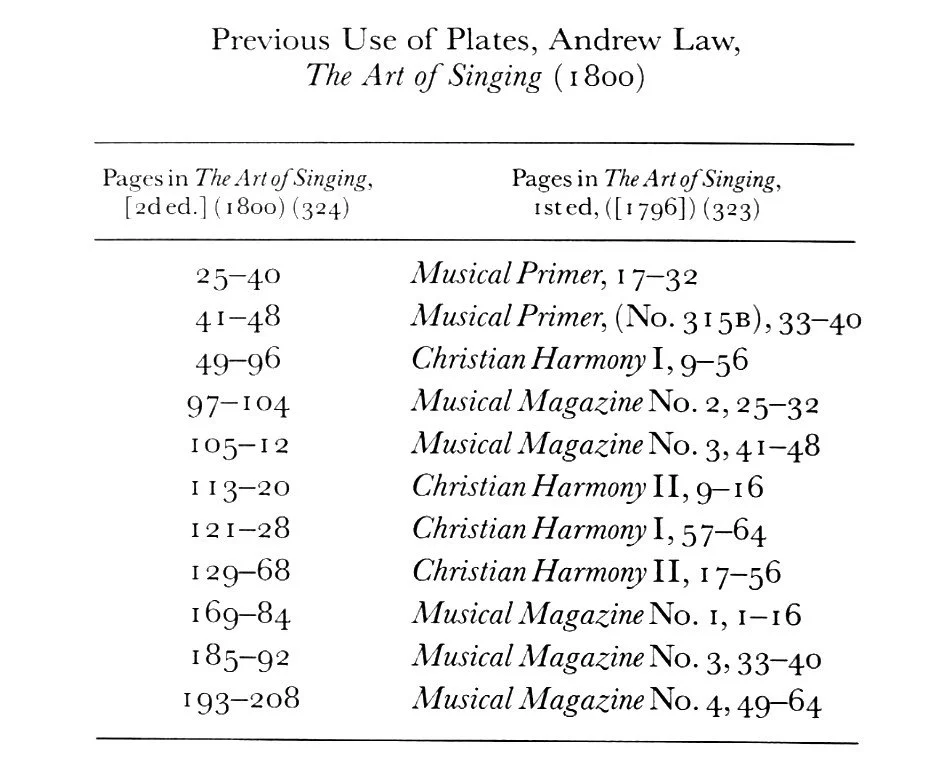
ASMI 324
The Art of Singing; in three Parts: viz. I. The Musical Primer, II. The Christian Harmony, III. The Musical Magazine. By Andrew Law. Published according to act of Congress. Part 1. Cheshire; Connecticut: M,DCCC.
[2d t-p.] The Musical Primer; or The First Part of the Art of Singing: containing the rules of psalmody, newly revised and improved; together with a number of practical lessons and plain tunes: designed expressly for the use of learners. By Andrew Law. Third edition.
208 p. 1 p. 25-208 engraved; p. 208 signed by Samuel Doolittle.
A receipt in the Law Papers, 3 Dec. 1800, records that The Art of Singing, 2d ed., was completed. The Hartford Connecticut Courant, 8 Dec. 1800, advertised the work for sale. p. [1], t-p.; p. [2] blank; p. [3]-4, 'Dedication'; p. [5], 'Advertisement'; p. [6] blank; p. [7], 2d t-p.; p. [8] blank; p. [9]-10, 'Preface'; p. 11-17, 'Introduction'; p. 18-21, 'Essay on Time and Mode'; p. 21, 'Miscellaneous Remarks'; p. 22-23, 'Index Of Tunes'; p. 24, 'Index Of Metres'; p. 25-32, 'Scale of Rules'; p. 33-48, music; p. 49-112, 'Part II', music; p. 113, rudiments of rhythmic notation; p. 113-169, music of Part II continued; p. 169-208, 'Part III', music. "To the Ministers of the Gospel, and the Singing-Masters, Clerks and Choristers throughout the United States. Gentlemen, The following work is addressed to you. It claims your candid and thorough perusal. It exhibits an Introductory Treatise and an Elemetary [sic] Scale, possessing, it is believed, improvements of real and permanent worth; and it also presents specimens of that chaste and sober, that sublime and solemn Psalmody, which the friends of religion and virtue, as well as the friends of sacred song, would rejoice to see more generally improved in worshipping assemblies. [New par.] It will not, perhaps, have escaped the observation of any one of you, that very much of the music in vogue is miserable indeed. Hence the man of piety and principle, of taste and discernment in music, and hence, indeed, all, who entertain a sense of decency and decorum in devotion, are oftentimes offended with that lifeless and insipid, or that frivolous and frolicksome succession and combination of sounds, so frequently introduced into churches, where all should be serious, animated and devout: and hence too, the dignity and the ever-varying vigor of Handel, of Madan, and of others, alike meritorious, are, in a great measure, supplanted by the pitiful productions of numerous composuists, whom it would be doing too much honor to name. Let any one acquainted with the sublime and beautiful Compositions of the great Masters of Music, but look round within the circle of his own acquaintance, and he will find abundant reason for these remarks. [New par.] The evil is obvious. Much of the predominating Psalmody of this Country is more like song-singing, than like solemn praise. It rests with you, Gentlemen, to apply the remedy. The work of reformation is arduous, but not impracticable, and the more difficult the task, the more praise-worthy the accomplishment. [New par.] I will further add, that, there are no descriptions of citizens in the community, who have it in their power to do half as much, as you, towards correcting and perfecting the taste in music, and towards giving to devotional praise its due effect upon our lives and conversation. [New par.] The cause of religion and virtue has therefore a claim upon your exertions. What remains then, but that every one who is convinced of the want, begin the work? Individual exertions, rendered unexceptionable, become universal, and the business is ended. [New par.] That you may criticise with the keenness and candor of real masters of music, and correct with the courage and conduct of irresistable reformers, is all that the fondest friends of sacred music would ask or wish; and if the following Book be found but an individuals' mite, towards promoting so noble an undertaking as that, of improving the religious praise of a rising Empire, it will never become a subject of regret to one, who has devoted up the greater part of his life to the cultivation of Psalmody.' (Dedication almost in full.) 'The divisions of the following work were firstly published in detached parts. They have been since collected, and, in pursuance of the original design, are, in this edition, calculated to form a consistent whole. The second part, or the Christian Harmony, has been heretofore subdivided into two Volumes; but that division, ceasing to be necessary, is discontinued. Additional numbers of the Magazine may hereafter be published as occasion may require. [New par.] A Book that may be obtained with little expence, and be suitable for learners at their first setting out, is frequently called for: Such an one is the Musical Primer, the first part of the art of Singing, independent of the rest of the work. Singing-Schools and others applying, may therefore still procure it in a Pamphlet by itself.' (Extract from Advertisement.) Engraved portions printed from plates used for 1st ed., renumbered as shown in Table 12 below.
137 compositions, incl. 18 set-pieces, for 3 & 4 voices; full text. Attribs. to Mr. Chandler, S. Chandler (2), Mr. Gillet (9), Mr. Handell, Mr. Lyon, Mr. Madan (4), Mr. Olmsted (2), T. Olmsted (4). No 1st pr. identified. 22 American compositions, 80 non-American, 35 unidentified [AFRICA, ALBANY, ASIA, CANTON, CARLISLE, CAROLINA, CHESTER, CHINA, DANBURY, DERBY, DOVER, DOXOLOGY, EPPING, ESSEX, GROTON, GUILFORD, HAMPTON, HEBRON, HOLLIS, LANCASTER, LITCHFIELD, MIDDLEBURY, MIDDLESEX, MILAN, NEWBERN, NEWTON, ORANGE, OXFORD, PORTUGAL, PRINCETON, READING, SAYBROOK, SUFFOLK, WINCHESTER, WOODBRIDGE] (19 attrib. Americans, 3 traced [GEORGIA, GOSHEN, UNION]; 5 attrib. non-Americans, 75 traced).
20 Core Repertory.
Not in Evans (no copy on Readex). CtHi (lacks all after p. 198), CtY*.
The Art of Singing, 3d [i.e., 2d] ed., Part I, [1800]
ASMI 325
The Musical Primer; or The First Part of the Art of Singing: containing the rules of psalmody, newly revised and improved; together with a number of practical lessons and plain tunes: designed expressly for the use of learners. By Andrew Law. Third edition.
1 p.l., [9]-48 p. p. 25-48 engraved. Copy complete despite apparent gap in pagination.
[1800.] This is The Musical Primer, 3d ed., designed for circulation separate from the 208-p. Art of Singing [2d ed.]. Missing are The Art of Singing t-p., the Dedication, and the Advertisement linking The Musical Primer to the larger work. This issue can be dated, however, from an Advertisement, p. [5] in the complete work (No. 324), advising that The Musical Primer, 'independent of the rest of the work,' might still be purchased 'in a Pamphlet by itself.'
p.l. recto, t-p.; verso blank; p. [9]-10, 'Preface'; p. [11]-17, 'Introduction'; p. 18-21, 'Essay on Time and Mode'; p. 21, 'Miscellaneous Remarks'; p. 22-23, 'Index Of Tunes' covering p. 33-208; p. 24, 'Index Of Metres'; p. 25-32, 'Scale of Rules'; p. 33-48, music. p. 25-48 printed from same plates as the corresponding pages in No. 324, The Art of Singing, 2d ed. (1800).
28 compositions for 4 voices; full text. No attribs. No 1st pr. identified 16 tunes traced to non-American sources (BERLIN, DUBLIN, MARYLAND, NEW LONDON, TRUMPET, WINDSOR), 22 unidentified.
No Core Repertory.
E49106 (MWA). MWA*.
The Art of Singing, [2d ed.], Pt. III, No. 6, 1801
ASMI 326
The Musical Magazine: containing a number of favourite pieces, European and American. By Andrew Law. Number sixth. Published as the act directs. November, 1801.
[209]-24 р.
Copyright granted, 17 Nov. 1801, District of Pennsylvania, to Andrew Law as proprietor.
p. [209], t-p.; p. 210-24, music.
8 compositions, incl. 2 set-pieces, for 4 voices; full text. Attrib. to Mr. Coleman. 15 1st Am. pr. identified (AVON, JERSEY, KEDRON, MALTA, MILLVILLE). 11 American composition, 6 non-American, 1 unidentified [JERSEY] (1 attrib. American ['Coleman' is really William Billings]; 6 traced to non-American sources).
1 Core Repertory.
S802 (MWA copy b.w. The Art of Singing on Readex E37787). NHi*; all other known copies b.w. The Art of Singing, 2d ed., Pts. I, II, & III, q.v.
The Art of Singing, [2d ed.], Pts. I, II, & III, & Pt. III, No. 6, [1801]
ASMI 327
The Art of Singing . . . M,DCCC.
[2d t-p.] The Musical Primer . . . Third edition.
[3d t-p.] The Musical Magazine . . . Number Sixth . . . November, 1801.
224 p. p. 25-208 engraved; p. 208 signed by Samuel Doolittle.
Issued in Nov. 1801 or later, when The Musical Magazine, No. 6, was printed. Contents same as 2d ed., Pts. I, II, & III (No. 324), except: p. [209], 3d t-p.; p. 210-224, music.
p. 25-208 printed from same plates as 2d ed. (No. 324).
145 compositions, incl. 20 set-pieces, for 3 & 4 voices; full text. Attribs. to Mr. Chandler, S. Chandler (2), Mr. Coleman, Mr. Gillet (9), Mr. Handell, Mr. Lyon, Mr. Madan (4), Mr. Olmsted (2), T. Olmsted (4). No 1st pr. identified. 23 American compositions, 86 non-American, 36 identified [AFRICA, ALBANY, ASIA, CANTON, CARLISLE, CAROLINA, CHESTER, CHINA, DANBURY, DERBY, DOVER, DOXOLOGY, EPPING, ESSEX, GROTON, GUILFORD, HAMPTON, HEBRON, HOLLIS, JERSEY, LANCASTER, LITCHFIELD, MIDDLEBURY, MIDDLESEX, MILAN, NEWBERN, NEWTON, ORANGE, OXFORD, PORTUGAL, PRINCETON, READING, SAYBROOK, SUFFOLK, WINCHESTER, WOODBRIDGE] (20 attrib. Americans, 3 traced [GEORGIA, GOSHEN, UNION]; 5 attrib. non-Americans, 81 traced).
20 Core Repertory.
E37787 (MWA). Ct, DLC, MWA, MiU-C*, NRU-Mus, RPB.
The Art of Singing, 4th [i.e., 3d] ed., Part I, 1803
PREFATORY NOTE: Erroneously claimed as the fourth edition, the third edition of The Art of Singing is printed from a staffless shape notation invented by Law.
ASMI 328
The Art of Singing; in three Parts: to wit, I. The Musical Primer, II. The Chistian Harmony [sic], III. The Musical Magazine. By Andrew Law. Fourth Edition with additions and improvements. Printed upon a new plan. Published according to act of Congress. Printed at Cambridge, by W. Hilliard. 1803.
[2d t-p.] The Musical Primer; or The First Part of the Art of Singing: containing the rules of psalmody newly revised and improved; together with a number of practical lessons and plain tunes; designed expressly for the use of learners. By Andrew Law.
96 p. 13.5 x 22.5 cm. Music printed in staffless 4-shape notation.
Copyright granted, 10 Dec. 1803, District of Massachusetts, to Andrew Law as author. Bill dated 23 Dec. 1803 from William Hilliard, printer, is in the Law Papers. (See Crawford 1968, p. 164.) Boston Columbian Centinal, 24 Dec. 1803, advertises work for sale. p. [1], t-p.; p. [2], copyright notice; p. [3]-4, 'Dedication'; p. [5]-6, 'Advertisement'; p. [7], 2d t-p.; p. [8] blank; p. 9-10, 'Preface'; p. 11-23, 'Introductory Treatise on Vocal Music'; p. [24], 'Index'; p. [25]-32, 'Scale of Rules'; p. 33-96, music. This Book exhibits a New Plan of printing Music. Four kinds of characters are used; and are situated between the single bars that divide the time, in the same manner as if they were on lines and spaces; and in every instance, where two characters of the same figure occur, their situations mark, perfectly, the height and distance of their sounds; and every purpose is effected without the assistance of lines. [New par.] These four kinds of characters also, denote the four syllables, mi, faw, sol, law, which are used in singing. The diamond, has the name of mi; the square, of faw; the round, of sol; and the quarter of a diamond, of law. [New par.] The letters F and G, are used for cliffs. [New par.] The letter R, is used for the repeat. [New par.] The long stroke of the Crochet is thrown out of this system, and the round part of it is the crotchet; the old crotchet, is the quaver; and the old quaver, is the semiquaver.' (Extract from Advertisement.)
105 compositions for 4 voices; full text. Attribs. to S. Chandler, T. Olmsted. 18 1st Am. pr. identified (AMERICA, CARR'S LANE, CHARLESTON, CHESTERFIELD, DEERFIELD, DUNBAR, GENOA, HAMBURGH, MADRID, NAPLES, NESTON, PITTSFIELD, SWEDEN, TENESEE, TYNDALE, WALES, WATERBURY, WHITFIELD). 15 American compositions, 67 non-American, 33 unidentified [AMERICA, ASIA, BLOOMFIELD, CAN-ΤΟΝ, CARLISLE, CHARLESTON, CHESTER, CHESTERFIELD, CHINA, DEERFIELD, DOVER, EPPING, GENOA, GROTON, GUILFORD, HAMPTON, JERSEY, LANCASTER, LITCHFIELD, MADRID, MIDDLEBURY, MILAN, NEWBERN, OXFORD, PITTSFIELD, PRINCETON, READING, SUFFOLK, TENESEE, TYNDALE, WALES, WATERBURY, WOODBRIDGE] (2 attrib. Americans, 3 traced [GENEVA, GEORGIA, NEWPORT]; 67 traced to non-Americans).
31 Core Repertory.
S4509 (MWA). CtY, DLC, InGo, MBC, MWA*, NN, NNUT, NjPT (music inc.), RPB, TxWaB.
NOTE: P. [2] came from the press blank. In MWA and several other copies, the copyright notice, printed on a smaller leaf, is pasted on to p. [2]. In NN and others p. [2] remains blank.
The Art of Singing, 4th [i.e., 3d] ed., Part II, 1805
ASMI 329
The Art of Singing; in three Parts: to wit, I. The Musical Primer, II. The Christian Harmony, III. The Musical Magazine. By Andrew Law. Fourth edition with additions and improvements. Printed upon a new plan. Part Second. Published according to act of Congress. Printed at Windsor, (Vermont) by Nahum Mower. 1805.
[2d t-p.] The Christian Harmony: or The Second Part of the Art of Singing: comprising a select variety of psalm and hymn tunes: calculated for schools and churches. By Andrew Law.
[97]-160 p. 13.5 x 22.5 cm. Music printed in staffless 4-shape notation.
The copyright notice, dated 10 Dec. 1803, is for The Art of Singing, not for this Part. (See Part I, 1803, No. 328 above). A receipt of 19 Oct. 1805 in the Law Papers shows that on that date Law shipped two boxes of music type from Windsor, Vt., to Hartford, Conn. This was the type from which The Christian Harmony was printed; its shipment indicates that the printing was finished by that date. p. [97], t-p.; p. [98], copyright notice; p. [99], 2d t-p.; p. [100] blank; p. 101, 'Observations'; p. 102, 'Advertisement' & 'Notes'; p. 103, 'Metres'; p. 104, 'Index'; p. 105-160, music. 'The First Part of the Art of Singing, was published two years ago. The Second Part, or the Christian Harmony, is here completed. In connection with the First, it will be found a very considerable advance towards an assortment of Church Music.' (Advertisement in full.)
65 compositions, incl. 4 set-pieces, for 4 voices; full text. No attribs. 20 1st Am. pr. identified (ATHENS, BEREA, CORINTH, CUBA, GATH, HADLEY, HEBRON, JUDEA, MARSEILLES, MEDFIELD, MYRA, NORWICH, OLIVER, PLAINFIELD, PORTLAND, STAFFORD, TEMPEST, TROAS, WASHINGTON, WINCHESTER). 153 compositions traced to non-American sources, 12 unidentified (BEREA, CORINTH, GATH, HADLEY, HEBRON, LYSTRA, MEDFIELD, OLIVET, STAFFORD, TEMPEST, TROAS, WINCHESTER).
15 Core Repertory.
S8763 (MWA). Copies in CtHT-W, MWA* (b.w. Pts. I & III), NNUT, NJPT.
The Art of Singing, 4th [i.e., 3d] ed., Part III, 1805 [i.e., 1804]
ASMI 330
The Art of Singing; in three Parts; to wit, I. The Musical Primer, II. The Christian Harmony, III. The Musical Magazine. By Andrew Law. Fourth edition, with additions and improvements. Printed upon a new plan. Part Third. Published according to act of Congress Boston;-printed for the author, by E. Lincoln.-1805.
[2d t-p.] The Musical Magazine; being The Third Part of the Art of Singing, containing a variety of anthems and favourite pieces. A periodical publication. By Andrew Law. Fourth edition, with additions and improvements. Printed upon a new plan. Published according to act of Congress. No. 1. Printed for the author, by E. Lincoln.
96 p.1 13.5 x 22.5 cm. Music printed in staffless 4-shape notation.
Copyright granted, 5 Nov. 1804, District of Massachusetts, to Andrew Law as author. (Copyright notice for whole The Art of Singing dated 10 Dec. 1803.) In a letter of 28 Dec. 1804 in the Law Papers, Nathan Jones reported having received a copy of the work from Law. The Monthly Anthology and Boston Review, Dec. 1804, carried a review of the work. (See Crawford 1968, p. 178-79.) p. [1], t-p.; p. [2], copyright notice for The Art of Singing, p. [3], 2d t-p.; p. [4], copyright notice for Part III; p. [5], 'Advertisement'; p. [6], 'Errors. Part First'; p. [7], 'Errors. Part Third'; p. [8], 'Index'; p. 9-96, music. "The plan of printing Music with four kinds of characters without lines, and the method of teaching by these characters are explained in the Fourth Edition of the Musical Primer, which is for sale in most of the Bookstores in the principal towns in the United States. Price, seventy-five cents single; seven dollars and fifty cents a dozen. [New par.] The First Number of the Musical Magazine, or Part Third of the Art of Singing, is here completed. It forms a convenient octave volume of ninetysix pages, and contains a variety of Anthems and Set Pieces; which are selected from the most eminent Authors, ancient and modern. Price, seventy-five cents single; seven dollars and fifty cents a dozen. For sale at the Bookstore of John West, No. 75, Cornhill, Boston, and by other Booksellers. . . . [New par.] The Second Part, or Christian Harmony, will soon be printed in this way. It will contain a great variety of psalm and hymn Tunes; and in connexion with the First Part, will furnish tunes adapted to all thedifferent Metres of the various Collections of Hymns, which are used in the United States. [New par.] The Tune called Liverpool, composed by Mr. Tuckey of New-York, was published incorrectly by Mr. Lion; and by others from him. It is now corrected, and here published, by permission obtained from the Heirs of Mr. Tuckey.' (Extract from Advertisement.)
24 compositions, incl. 7 anthems & 16 set-pieces, for 4 voices; full text. Attrib. to Tuckey. 4 1st Am. pr. identified (Anthems: Comfort ye, God is the king, O praise the Lord; PARIS). 1 American composition, 21 non-American, 2 unidentified [Anthems: Comfort ye, God is the King] (1 attrib. American-in Advertisement; 21 traced to non-American sources).
2 Core Repertory.
S8764 (MWA). MWA* (b.w. Parts I & II), NNUT, NjPT, TxWaB.
The Art of Singing, [4th, (i.e. 3d) ed.], Part III, No. 2, [1810]
ASMI 331
The Art of Singing; in three Parts; to wit, I. The Musical Primer, II. The Christian Harmony, III. The Musical Magazine. By Andrew Law. Printed upon the author's new plan, with seven characters. Part Third. Philadelphia: printed by Jane Aitken, No. 71, North Third Street.
[2d t-p.] The Musical Magazine; being The Third Part of the Art of Singing; containing a variety of anthems and favourite pieces. A periodical publication. By Andrew Law. Number Second. Philadelphia: printed by Jane Aitken, No. 71, North Third Street.
[97]-128 p. 13.5 x 22.5 cm. Music printed in staffless 7-shape notation.
[1810.] Copyright granted 24 Feb. 1810, District of Pennsylvania, to Andrew Law as author. p. [97], t-p.; p. [98], copyright notice; p. [99], 2d t-p.; p. [100], 'Advertisement'; p. 101-28, music. 'Seventy one pages of music will be added to this number, and an index of all the music contained in this and in the first number of the Musical Magazine, which together, will form a volume of two hundred pages. (Extract from Advertisement.)
12 compositions, incl. 7 set-pieces, for 4 voices; full text. No attribs. 15 1st Am. pr. identified (HARLOW, NAZARETH, NORWAY, PHILADELPHIA, WESTON). 1 composition traced to American source [STAUNTON], 7 traced to non-American, 4 unidentified (HARLOW, NAZARETH, NORWAY, PHILADELPHIA).
No Core Repertory.
S20530 (CtY; this copy b.w. post-1810 Parts of The Art of Singing). ICN*.
NOTE: The section of 71 new pages proposed in the Advertisement was apparently never printed. Copies in CtHT-W, MB, MWA (3), PPPrHi, and probably elsewhere are bound with items in Law's The Art of Singing, 5th [i.e., 4th] ed. See note with No. 332 below.
The Art of Singing, 4th [i.e., 3d] ed., Part III, No. 1 & No. 2, [1810]
ASMI 332
The Art of Singing by E. Lincoln. 1805. Fourth edition. Part Third. Boston; printed for the author,
[2d t-p.] The Musical Magazine. No. 71, North Third Street. Number Second. Philadelphia: printed by Jane Aitken,
128 p. Music printed in staffless 7-shape notation.
[1810.] Number Second copyrighted 24 Feb. 1810, so the issue was bound after that time. Contents of first 96 pages same as Part III [1804] (No. 330); contents of p. [97]-128 same as No. 2, [1810] (No. 331).
Not in Shaw-Shoemaker (no copy on Readex). CtY (b.w. The Art of Playing the Organ), NjPT*.
NOTE: In 1810 Law made his last addition to the 'fourth' (i.e. third) edition of The Art of Singing. The Musical Magazine, Number Second, [97]-128 p., was issued to be bound with the 96-p. Musical Magazine, Part Third of The Art of Singing. In 1811 Law launched a restructured 'fifth' (i.e. fourth) edition of The Art of Singing, a composite of separately issued parts, of which The Musical Magazine, Number Second, was the last. The 'fifth' edition contained: 1) The Musical Primer, 16 p., edition of [1810], q.v. (No. 352); 2) The Supplement to the Musical Primer, 64 p., [1811]; 3) The Harmonic Companion, [2d ed., 1810], q.v. (No. 343); 4) The Musical Magazine, Part Third of The Art of Singing, 5th ed., 96 p., [1811]; 5) The Musical Magazine, Number Second, [97]-128 p., [1810], q.v. (No. 331). Only the second and fourth items, both issued in 1811, state their relationship to a new edition of The Art of Singing. The Supplement, p. [8], notes: 'The first and second Parts of the Art of Singing are comprised in the Harmonic Companion'; The Musical Magazine is claimed on its t-p. as Part of the fifth edition, and its index lists music on p. 9-128, covering Number Second and hence indicating that it followed Number Second into print. Crawford 1968, p. 197–98, assigns The Musical Magazine, Part Third, of The Art of Singing, fifth ed., to 1810 on the basis of a memorandum in the Law Papers. Closer inspection reveals, however, that all copies have on p. 7 an endorsement dated 13 June 1811. Since R. and W. Carr, the printers, did not occupy the title-page address, 51 Sansom Street, after 1811 (see Brown 1950, p. 29), the item may now be assigned to 1811, which puts it outside the scope of this bibliography. The item is essentially a reprint of the earlier 96-p. The Musical Magazine, with only the introductory matter changed. Many surviving copies of Number Second are bound with this 1811 issue of The Musical Magazine.
The Art of Singing, 4th [i.e., 3d] ed., Parts I & II, [1805]
ASMI 333
The Art of Singing . . . Fourth edition. . . Printed at Cambridge, by W. Hilliard. 1803.
[2d t-p.] The Musical Primer . . . By Andrew Law.
[ 3d t-p.] The Art of Singing . . .Fourth edition . . . Part Second . . . Printed at Windsor, (Vermont) by Nahum Mower. 1805.
[4th t-p.] The Christian Harmony By Andrew Law.
160 p. Music printed in staffless 4-shapenotation.
[1805.] Bound after publication of Part II, Oct. 1805. Copy made up of Parts I & II bound together (Nos. 328, 329). There is no overall index or other attempt to integrate the Parts.
Not in Shaw-Shoemaker (no copy on Readex). No copies located, but the continuous pagination indicates that Law intended the two Parts to be bound together, and perhaps some survive in libraries not canvassed.
The Art of Singing, 4th [i.e., 3d] ed., Parts I & III, [1804]
ASMI 334
The Art of Singing . . . Fourth edition . . . Printed at Cambridge, by W. Hilliard. 1803.
[2d t-p.] The Musical Primer . . . By Andrew Law.
[3d t-p.] The Art of Singing . . . Fourth edition . . . Part Third . . . Boston; printed for the author, by E. Lincoln. 1805.
[4th t-p.] The Musical Magazine . . . Fourth edition . . . Printed for the author, by E. Lincoln.
96, 96 p. Music printed in staffless 4-shape notation.
[1804.] Bound after publication of Part III, Nov. 1804. Copy made up of Parts I & III bound together (Nos. 328, 330). There is no overall index or other attempt to integrate the Parts.
Not in Shaw-Shoemaker (no copy on Readex). Copies in Ct, ICN, InGo, MH, MHi, MiU-C*, PMA, RPB.
The Art of Singing, 4th [i.e., 3d] ed., Parts II & III, [1805]
ASMI 335
The Art of Singing . . . Fourth edition . . . Part second . . . Printed at Windsor, (Vermont) by Nahum Mower. 1805.
[2d t-p.] The Christian Harmony . . . By Andrew Law.
[3d t-p.] The Art of Singing . . . Fourth edition . . . Part Third . . . Boston; printed for the author, by E. Lincoln. 1805.
[4th t-p.] The Musical Magazine . . . Fourth edition . . . Printed for the author, by E. Lincoln.
[97]-160, 96 p. Music printed in staffless 4-shape notation.
[1805.] Bound after publication of Part II, Oct. 1805. Copy made up of Parts II & III bound together (Nos. 329, 330). There is no overall index or other attempt to integrate the Parts.
Not in Shaw-Shoemaker (no copy on Readex). Copy in MB* (also includes p. 89-112 of Law's Harmonic Companion).
The Art of Singing, 4th [i.e., 3d] ed. Parts I, II, & III, [1805]
ASMI 336
The Art of Singing . . . Fourth edition . . . Printed at Cambridge, by W. Hilliard. 1803.
[2d t-p.] The Musical Primer . . . By Andrew Law.
[3d t-p.] The Art of Singing . . . Fourth edition . . . Part Second . . . Printed at Windsor, (Vermont) by Nahum Mower. 1805.,
[4th t-p.] The Christian Harmony . . . By Andrew Law.
[5th t-p.] The Art of Singing . . . Fourth edition . . . Part Third . . . Boston;-printed for the author, by E. Lincoln.-1805.
[6th t-p.] The Musical Magazine . . . Fourth edition . . . Printed for the author, by E. Lincoln.
160, 96 p. Music printed in staffless 4-shape notation.
[1805.] Bound after publication of Part II, Oct. 1805. Copy made up of Parts I, II, & III bound together (Nos. 328, 329, 330). There is no overall index or other attempt to integrate the Parts.
S8762 (no copy on Readex). CLU, CtHC, CtY (2), DLC (2), MB (lacks 1st t-p. & most front matter), MH, MWA*, MiU, MIU-C, NRU-Mus (inc.), NjPT (lacks 3d t-p.), PPL, PPPrHi, RPB (lacks 1st t-p.).
NOTE: One copy in CtY, also the copies in MiU-C and PPL, have bound in at the end p. 89-112 of Law's Harmonic Companion (Philadelphia, [1807]).
Note that assigning an ASMI number here is somewhat problematic since the first title pages are missing. However this does fall within the description listed below. KC 2026.
The Art of Singing, 4th [i.e., 3d] ed., Pts. I, II, & III, & Pt. III, No. 2 [1810]
ASMI 337
The Art of Singing . . . Fourth edition . . . Printed at Windsor, (Vermont) by Nahum Mower . . . 1805 . . . [The 5 t-p.'s which follow are the same as in copy described as No. 336.]
[7th t-p.] The Art of Singing . . . Part Third. Philadelphia: printed by Jane Aitken, No. 71, North Third Street.
[8th t-p.] The Musical Magazine . . . Number Second. Philadelphia: printed by Jane Aitken, No. 71, North Third Street.
160, 126 p. Music printed in staffless 4-shape notation, except for p. 101-26, which are printed in staffless 7-shape notation.
[1810.] Since the last item in the volume was not issued until February 1810, that marks the earliest date the volume could have appeared. The issue of Part I w. 1805 Windsor imprint is otherwise identical to the 1803 Cambridge issue (No. 328). Copy made up of Parts I, II, III and III No. 2 bound together (Nos. 328, 329, 332). There is no overall index or other attempt to integrate the Parts.
Not in Shaw-Shoemaker (no copy on Readex). NjPT* (inc.; lacks all after p. 126).
NOTE: Law continued to bring out the various components of The Art of Singing until shortly before his death in July 1821. The Musical Primer, 'third edition' (Philadelphia: Anderson and Meehan), can be assigned to 1817, (see Crawford 1968, p. 236). The Supplement to the Musical Primer was expanded to 72 pages shortly after its first publication in 1811 (see Crawford 1968, p. 214), the Harmonic Companion, 4th ed. (Philadelphia: Thomas H. Palmer), carries an 1819 title-page date, and the final issue of The Musical Magazine (New Haven: Thomas G. Woodward) seems to have appeared in 1820-21 (see Crawford 1968, p. 243). Copies survive of this group of works bound together-surely not earlier than 1820 (see Crawford 1968, p. 213, 213n.).
A CHOICE COLLECTION OF CHURCH MUSIC, 1807
Only a title-page of the following item has turned up. The number of pages is guessed from the price, twenty cents per copy. This is the same price charged for Law's Church Music (1807), which survives only in an incomplete copy and is estimated to have been twenty-four pages originally. (See Crawford 1968, p. 190 & n.)
ASMI 338
[A Choice Collection of Church Music, particularly adapted to the pocket hymn book, used by the Methodist Society in the United States. By Andrew Law. Philadelphia: David Hogan, 51 South 3rd Street, from the press of Thomas T. Stiles.]
[24 р.?]
[1807.] Law obtained a copyright of this work on 19 Sept. 1807 (Penn 2:/178). A memorandum in the Law Papers shows that he sold copies as early as 12 Oct. 1807. (See Crawford 1968, p. 190.)
Not in Shaw-Shoemaker. Copy of t-p. in DLC (this was inspected in 1967, but the library was unable to locate it in later visits beginning in 1970, and it was unavailable for use in the present work); no copy located.
CHURCH MUSIC, 1807
A memorandum in the Law Papers, 11 June 1807, records the sale of an item called Church Music. No copies of such a work are known to exist. However, MiU-C owns a title-page and a signature of tunes, both mutilated, which may be all that remains of the work. The title-page is reconstructed below, with all editorial additions enclosed in brackets and qual-ified with question marks. A guess is made here that Church Music was twenty-four pages long, or three eight-page signatures. On 11 Feb. 1807 Law paid Philadelphia printer Jane Aitken for setting three 'half-sheet[s] of music' (Account, Law Papers), and the price of Church Music, established by the 11 June memo cited above, was 20 cents per copy. (Law's sixteen-page The Musical Primer [2d ed., 1810], sold three years later for 12½ cents.) Jane Aitken is suggested here as the printer. (See Crawford 1968, p. 189, 282-83.)
ASMI 339
Church [Music.] Containing in a plain a [nd easy manner the?] rules o[f psalmody?] together with a col[lection of psalm and hymn tunes?] adapted [to various meters.? By Andrew Law. Philadelphia:?] printed [by Jane Aitken, 1807.?]
[24 p.?]. 14 x 22 cm. Music printed in staffless 4-shape notation. Only copy located lacks all after p. 8, has p. 1-4 badly mutilated.
[1807.] See above. p. [1], t-p.; p. [2]-[4] introduction & rudiments; p. 5-8, music. 16 compositions for two voices; full text. No attribs. No 1st pr. identified. 12 compositions traced to non-American sources, 4 unidentified (DOVER, LITCHFIELD, MILAN, READING).
10 Core Repertory.
Not in Shaw-Shoemaker (no copy on Readex). MiU-C* (incomplete as described above).
A COLLECTION OF HYMNS, 1783
ASMI 340
A Collection of Hymns, for social worship. By Andrew Law, A.Μ.
48 p. 17 x 11.5 cm.
[1783.] An account sheet entry, 29 Sept. 1783, records that Law received from printer William Law copies of 'Hymns and Tunes,' the nickname given in the Law Papers to the combination of this collection and No. 341. On 6 Dec. 1783 the work was copyrighted in Massachusetts. p. 1, caption title; p. 1-48, hymns; p. 48, errata.
No music.
E17996 (MWA copy b.w. A Collection of Hymn Tunes on Readex E17571. All known copies b.w. that item, q.v. (No. 341).
A COLLECTION OF HYMN TUNES, 1783
ASMI 341
A Collection of Hymn Tunes from the most Modern and Approv'd Authors by Andrew Law A.M. Printed by Wm. Law, Cheshire. J. Allen sct.
1 p.l., 36 p. 17 x 11.5 cm. Engraved throughout; t-p. signed by Joel Allen; music signed on p. 1 & 36 by Daniel Hopkins.
[1783.] Account sheet, 29 Sept. 1783, Law Papers, indicates that the work was published by that date. On 6 Dec. 1783 it was copyrighted in Massachusetts. (See Lowens 1959, p. 153). p.l. recto, t-p.; verso blank; p. 1-36, music.
38 compositions, incl. 2 set-pieces, for 2, 3 & 4 voices; textless, but occasional guide words are scattered throughout, referring to texts in adjoining hymn collection. Attribs. to Burney, Giardini (2) W[illiam] J[ackson], A. King, Dr. Madan (7). 1 1st pr. identified (SOPHRONIA), also 30 1st Am. pr. (everything except EASTER DAY, PALMIS, PORTSMOUTH, SKYLARK, SOPHRONIA, STAMFORD, TRUMPET, WATERTOWN). 1 Amer-ican composition, 34 non-American, 3 unidentified [GROTON, STRATFORD, WATERTOWN] (1 attrib. American; 11 attrib. non-Americans, 24 traced).
5 Core Repertory (1st Am. pr. CHRISTMAS, DUNSTAN, HOTHAM; poss. 1st Am. pr. HABAKKUK, PORTSMOUTH).
Not in Evans (MWA copy b.w. A Collection of Hymns on Readex E17571). CtHC (has printed 'Index' of music pasted to inside back cover), CtY, DLC (2; 1 lacks t-p.), MB, ΜΗ (2; both inscribed as presented to library by Law, 6 Dec. 1783), MWA, MIU-C*, NN, NNUT, RPB (2). All except CtY and RPB copies b.w. Law, A Collection of Hymns (No. 340).
ASMI 341A
A Collection of Hymn Tunes . . .
1 p.l., 36 p. Engraved throughout.
[1783.] This issue appeared before the above, for p. 21-24 of the issue described in the main entry are here mistakenly numbered 1-4. Apparently the error was noticed before the press run was finished, and the pages were renumbered correctly, as they are in other copies examined. Contents same as main entry. Printed from same plates as main entry.
Music same as main entry.
E19753 (no copy on Readex). CtHi*.
HARMONIC COMPANION, 1807-10
Harmonic Companion, [1st ed., 1807]
ASMI 342
Harmonic Companion, and Guide to Social Worship: being a choice selection of tunes, adapted to the various psalms and hymns, used by the different societies in the United States; together with the principles of music, and easy lessons for learners. By Andrew Law. Published by the author, and David Printed upon the author's new plan. Philadelphia Hogan, No. 51, S. Third Street. From the press of Thomas T. Stiles.
112 p. 12.5 x 23 cm. Music printed in staffless 4-shape notation.
[1807.] Copyright granted, 8 Oct. 1807, District of Pennsylvania, to Andrew Law as author. A memorandum of 23 Oct. 1807, Law Papers, shows that the Harmonic Companion was in circulation by that time. p. [1], t-p.; p. [2], copyright notice; p. [3]-4, 'Dedication. To The Ministers Of The Gospel, And The Singing Masters, Clerks And Choristers Through-out The United States'; p. [5], 'Preface'; p. 6-7, 'A View of the New Plan of printing Music, and of the New Method of teaching the Art of Singing'; p. 7, 'Notes'; p. 8-9, instructions; p. 10-11, 'Scale of Rules'; p. 12, 'Scale Of Sharp Keys'; p. 13-16, music; p. 17, 'The Scale Of Flat Keys'; p. 17-111, music; p. 112, 'Index.' 'In compiling the following work, or the Harmonic Companion, I have endeavoured to compose an elementary system which might open, at once, an improved pathway to the practice of music. I could not be at a loss in supposing, that such an acquisition would be very acceptable to all classes of singers, and especially to those on whom the business of teaching devolves, as well as to all learners, during the first stages of their progress. To encompass my object, I have withheld no improvements, which patient industry, aided by more than twenty years' experience in studying and teaching vocal music, could bestow; and I flatter myself, than [sic] the friends of Psalmody will find my Harmonic Companion, an easier, and more eligible Book for beginners, than any one that has heretofore appeared.' (Extract from Preface.) 'This Book exhibits a plan and method which are different from any that have yet appeared. [New par.] The principal objects of this plan and of this method, are to lessen the burden of the learner; to facilitate the performance, or practice of Music; and to promote a general improvement in the praises of our God and Redeemer. [New par.] Three of the musical characters are made more simple by rejecting the long stroke of the crotchet, which is one half of the character; by this means the parts of the quaver are diminished one third; and those of the semi-quaver one fourth. The cliffs, F and G, and the repeat, R, being characters used as letters, are familiar to every one; these are used instead of those which are unknown, till learned as musical characters. The four kinds of characters denote the four singing syllables; and the learner will immediately name the notes with great facility, and will read them with equal ease in every part, and in all the different changes of the keys. But these are not the greatest advantages derived from the plan, and the method of teaching by these characters. [New par.] Music, printed without the lines, is more simple than it can be on lines and spaces; because the lines and spaces increase the number of the parts which compose the characters, and render them more indistinct, and more difficult to be retained in the memory.
This plan will assist, both the learner and the performer, in ascertaining the true sounds of the notes in instances where the old method cannot afford any aid for that purpose.' (Extract from New Plan.)
139 compositions, incl. 8 set-pieces, for 4 voices; full text. No attribs.18 1st Am. pr. identified (ARABIA, AUGUSTA, BREWER, BURTON, CARMEL, COOS, DAMASCUS, DUMAH, GILGAL, LAMBERTON, MEDWAY, MILETUS, ORLEANS, PETERSBURG, SWANICK, SWEDESBORO, TYGRIS, WARREN). I composition traced to American source (GEORGIA), 112 traced to non-American, 26 unidentified (ARABIA, BEREA, BLOOMFIELD, BURTON, CANTON, CARMEL, CHARLESTON, COOS, DAMASCUS, DUMAH, GILGAL, GROTON, LAMBERTON, LANCASTER, LITCHFIELD, LYSTRA, MEDWAY, MILAN, MILETUS, OLIVET, PETERSBURG, READING, TEMPEST, TYGRIS, WARREN, WINCHESTER).
32 Core Repertory.
Not in Shaw-Shoemaker (no copy on Readex). CtY (b.w. Law, The Art of Playing the Organ), ICN (b.w. Law, The Art of Playing the Organ), MB, MHi, MiU-C*, NN, NJPT, RPB.
ASMI 342A
Harmonic Companion... From the press of Thomas T. Stiles.
120 p. Music on p. 13-111 printed in staffless 4-shape notation; music on p. 113-20 printed in staffless 7-shape notation.
[1809-10.] The added pages in 7-shape notation suggest the date 1809-10. Law first published and explained this modification of his 4-shape notation in The Art of Playing the Organ, copyrighted 19 May 1809. The added pages were integrated into the 2d ed., published in 1810, and thus preceded it. Contents same as main entry through p. 112. Then: p. 113-20, music.
149 compositions, incl. 8 set-pieces, for 4 voices; full text. No attribs. No 1st pr. identified. traced to American source (GEORGIA), 121 traced to non-American, 27 unidentified (add ASIA to list in main entry).
33 Core Repertory.
S12895 (MWA). ICN (120, 8 p.; b.w. Law, The Art of Playing the Organ), MWA* (same binding).
Harmonic Companion, [2d ed., 1810]
ASMI 343
Harmonic Companion . . . Philadelphia: printed for the author, by Robert and William Carr, No. 51, Sansom Street.
120 p. Music printed in staffless 7-shape notation.
[1810.] A memorandum in the Law Papers reads: 'Second edition of the Harmonic Com-panion printed 1810,' but provides no more specifics. Copyright notice dated 8 Oct. 1807. p. [1], t-p.; p. [2], copyright notice; p. [3], 'Dedication'; p. 4, 'A View of the New Plan . . . '; p. [5], 'Preface'; p. 6, 'The New Plan Compared With The Old' & 'Notes'; p. 7-8, instructions; p. 9-10, 'Scale Of Rules'; p. 11, 'Scale Of Keys'; p. 12, 'Scale of Sharp Keys'; p. 13-16, music; p. 17, 'Scale Of Flat Keys'; p. 17-119, music; p. 120, 'Index.' For statement headed 'The New Plan Compared With The Old' see Law, The Art of Playing the Organ (No. 314).
Music same as 1st ed., variant issue (No. 342A).
Not in Shaw-Shoemaker (no copy on Readex). CtY, ICN, MB (b.w. other items in The Art of Singing, 5th [i.e., 4th] ed.), MHi, MWA (b.w. other items in The Art of Singing, 5th [i.e., 4th] ed.), NRU-Mus (2), PPPrHi.
NOTE: Law's Harmonic Companion, 3d ed. (Philadelphia: R. & W. Carr, No. 2, Hartung's Alley) can be dated [1813]. The fourth edition. (Philadelphia: Thomas H. Palmer) is dated 1819 on the title-page.
To scans below represent the issues with the multiplicity of printers and printings associated with Andrew Law. Only the title pages are different and those only so slightly. KC 2026
MR. ADGATE'S NEW PLAN OF SOLFAING, 1792
ASMI 344
Mr. Adgate's New Plan of Solfaing.
7, [1] p. 12.5 x 21.5 cm.
[1792.] A receipt in the Law Papers, 14 Nov. 1792, is the first record that copies of Law's The Musical Magazine, No. 1, with which Mr. Adgate's New Plan was customarily bound, were sent by the printer, William Law of Cheshire, to booksellers in other parts of the country. (See Crawford 1968, p. 69.) p. [1], caption title; p. [1]-7, text of Mr. Adgate's New Plan [see No. 346 below, for an extract]; p. [8] blank.
No music.
Not in Evans (no copy on Readex).MiU-C*, RPJCB. Other known copies b.w. The Musical Magazine, No. 1, (q.v.).
NOTE: No author is named. Stylistic evidence suggests that the piece, though surely conceived by Andrew Law, was written by his nephew, Samuel Andrew Law. (See Crawford 1968, p. 68-69.) Britton 1949, p. 202-6, points out that Law's attack on Adgate reveals a misunderstanding of the function of solmization syllables.
THE MUSICAL MAGAZINE, 1792-99
Law's The Musical Magazine, No. 1, appeared in 1792. It was followed in 1793 by No. 2. In 1794 Law made The Musical Magazine the third Part of The Art of Singing. Only issues brought out independently of The Art of Singing are described here.
The Musical Magazine, No. 1, 1792
ASMI 345
The Musical Magazine; containing a variety of favorite pieces. A periodical publication. By Andrew Law, A.M. Number First. Cheshire: Connecticut. Printed and sold by William Law. A.D. 1792.
1 p.l., 16 p. 12.5 x 21.5 cm. p. 1-16 engraved; unsigned, but uniform in style with The Art of Singing, Part III, signed on p. 64 by Samuel Doolittle.
Copyright granted, 8 Oct. 1792, District of Connecticut, to Andrew Law. (See Lowens 1959, p. 154.) A receipt, 14 Nov. 1792, in Law Papers, shows that the book was circulating by that date. p.l. recto, t-p.; verso, undated copyright notice; p. 1-16, music.
3 set-pieces for 3 voices; full text. No attribs. 1 3 1st Am. pr. identified. All traced to non-American sources. No Core Repertory.
Not in Evans (no copy on Readex). ICN*, NHi, NN (b.w. The Rudiments of Music, 2d ed., and assorted pages from other Law items).
NOTE: Some copies of other issues have a variant imprint: 'Number First. Printed by William Law. Cheshire, A.D. 1792' (see below, e.g., No. 348). The NHi copy has not been checked to see whether it has that imprint or the one shown above.
The Musical Magazine, No. 1, & Mr. Adgate's New Plan of Solfaing, 1792
ASMI 346
The Musical Magazine; containing a variety of favorite pieces. A periodical publication. By Andrew Law, A.M. Number First. Cheshire: Connecticut. Printed and sold by William Law. A.D. 1792
1 p.l., 8, 16 p. p. 1-16 engraved.
This issue has Mr. Adgate's New Plan of Solfaing, Examined, an 8-page diatribe against Andrew Adgate of Philadelphia, bound in before the music. p.l. recto, t-p.; verso, undated copyright notice; p. [1], caption title: 'Mr. Adgate's New Plan of Solfaing, Examined'; p. [1]-7, text of Mr. Adgate's New Plan; p. [8] blank; p. 1-16, music. There has lately appeared in America, a new and improved plan of Solfaing, by Andrew Adgate, P.U.A; and as the public are not sufficiently acquainted either with the man or his work, I shall make no apology for announcing them. [New par.] Before I enter upon the examination of Mr. Adgate's plan, I shall give a simple explanation of his title P.U.A. [New par.] Mr. Adgate has taught a common singing school in Philadelphia, where schools of every kind frequently obtain the name of Academies. Mr. Adgate called his, the Uranian Academy, and himself the President. But the teachers of such schools, are commonly called, Masters; not Presidents. Mr. Adgate must therefore have assumed the epithet of President, or borrowed it from a foreign institution; thus becoming the President of the Uranian Academy, P.U.A. And as each of these ways partake equally of ease and propriety, we are at liberty to ascribe his choice to which we please. Here then, the origin of Mr. Adgate's degree, or title is investigated. I will bestow a few words upon the importance of it. The school which Mr. Adgate taught, was never incorporated, and there are a thousand schools of equal importance in the United States. In many of these schools the instructors are frequently changed, and every person who has ever had the charge of one of them, has an equal right to a title with Mr. Adgate. Were the generality of singing Masters vain enough to adopt an insignificant title, Mr. Adgate would undoubtedly have a right to the privilege, without being called to an account for his conduct. Becoming a common thing, and being understood by the public, it would immediately cease to be an imposition. [New par.] But I will hasten to an examination of Mr. Adgate's new and improved plan. As yet, I have only noticed his name as it stands, connected with his title. But if he has merit in his work, it shall be credited to him. The splendor of his abilities shall be made a cloak for his follies, and his faults shall be overlooked amidst his great and useful discoveries and improvements. [New par.] He is pleased to call his plan, a new one; alledging, that the old British mode is totally rejected. But as to the novelty of his scheme, I shall take the liberty of contradicting him. It is not a new plan. It has been known for ages in Italy and other countries; and the essential part of it has long since undergone a trial, and been rejected by those very Britons, whose old mode our author boasts of displacing by his new. The truth of this assertion is sufficiently evinced by Music books published in England. Two of these books, I was possessed of, long before Mr. Adgate knew a syllable about Music; and upwards of eight years have elapsed, since I was myself solicited to publish this method. For reasons, as I thought, abundantly sufficient, I refused. Where then is the propriety of Mr. Adgate's calling his plan a new plan? It is, indeed, a little extraordinary, that he should adopt an obsolete system and claim it, as an invention of his own. But even this is not new. The same farce had been acted before. Ethan Allen had revived, and republished the, Oracles of Reason, as a new plan; and Andrew Adgate has revived, and republished, fa so la, ba do na, as a new plan . . . . [New par.] Having told us, that his plan possesses many advantages above the old British method, Mr. Adgate has mentioned only two. One of these respects the addition of singing syllables; and the other, the acquisition of the semi-tones; the latter of which are no ways applicable to his, any more than to the common method, as I shall have occasion to show after I have considered the former. Instead of repeating faw sol law, in each octave, he has added, ba, do, na, and he asserts, that great confusion will be avoided, by means of associating with each syllable the idea of its proper sound. But did not Mr. Adgate know, that syllables were not the signs of musical sounds? It is the situation of the notes upon the stave, which determines their sounds. The syllables are only the mediums, thro which such sounds are expressed; and they may be expressed without the syllables, as is the case every time a tune is sung words of a psalm,where neither faw sol law, nor ba do na, occur . . . Syllables, in music, are not the signs of particular sounds; as names, in language, are the signs of particular things; and I shall have occasion to prove, that, even Mr. Adgate's syllables are far from being the signs of certain sounds. A single syllable is sufficient to express the whole variety of musical sounds. Does it then become a question why four syllables are used instead of one? The answer is easy. To consult conveniency by means of variety. Were it not tiresome to repeat one syllable continually, there would be no need of more than one. But constant experience proves, that it is tiresome, and that more than one are necessary. By the use of four syllables, mi, faw sol law, the variety is found to be sufficient; and these syllables sung according to the directions, which I have given, are admirably calculated for the purpose to which they are appropriated. For tho, they can not assist us in attaining sounds, yet, they may, and do assist us in making those sounds, when attained. They assist in forming the organs of sound into a position for making more open, soft and smooth tones.' (Extract from Mr. Adgate's New Plan.) Engraved portion printed from same plates as No. 345.
Music same as No. 345.
Not in Evans (MWA copy b.w. The Musical Magazine, No. 2, on Readex E24464). CtY (b.w. p. 1-16 of The Musical Primer, 2d ed., 1794), MB, MWA, MIU-C*.
NOTE: The MiU-C copy has some noteworthy manuscript additions, obviously written in response to Law's attack on Adgate:
1. P.l. verso: 'Bedford, Pennsylvania / Examined, & Disapproved / per Josiah Espy. M.V.M.U.S.A. [Master of Vocal Music, U.S.A.?] / 12th June 1793'
2. On p. 7 Law notes his willingness to leave it to the reader of the piece 'to make his own reflections. To his phrase the following footnote is added: 'After mature delib-eration, & serious reflection, I have come to this conclusion - "That the author of this book is possessed of the very essence of Ill-nature & prejudice" which is certainly very unbecoming in a A.M. & a Divine [signed] Josiah Espy. M.V.M[.] U.S.A. P.S. Let it be noted, that When I sing by note I do not make use of ba do na- therefore am not prejudiced.-J. Espy.'
3. On p. 8, originally blank: 'Harmony Hall / Bedford 12 June 1793 / U.S.A. Sr. The following "3 favourite pieces of Music." are entirely void of any merit. In fact they are insipid, & I hereby prohibit them of being sung within my Jurisdiction, under the Penalty of my displeasure. [signed] Josiah Espy M.V.M.U.S.A. To all Musical persons in the U.S.A.'
The Musical Magazine, No. 2, 1793
ASMI 347
The Musical Magazine; containing a variety of favorite pieces. A periodical publication. By Andrew Law, A.M. Number Second. Cheshire: Connecticut, printed and sold by William Law. A.D. 1793.
[9]-12, 17-32 p. 1 12.5 x 22 cm. p. 17-32 engraved; unsigned, but uniform in style with The Art of Singing, Part III, signed on p. 64 by Samuel Doolittle (No. 318).
Copyright granted, 19 June 1793, District of Connecticut, to Andrew Law. (See Lowens 1959, p. 154). p. [9], t-p.; p. 10-11, 'Observations'; p. 12, 'New Words for Baltimore'; p. 17-32, music.
4 compositions, incl. 2 set-pieces, for 3 & 4 voices; full text. Attribs. to T. Dwight D.D., Mr. Madan (3). 11 1st pr. identified (PSALM 92). I composition attrib. American; 3 to non-American.
1 Core Repertory.
E25708 (MWA). MHi, MWA* (p. 17 mutilated).
The Musical Magazine, Nos. 1 & 2, [1793]
ASMI 348
The Musical Magazine . . . Number First. Printed by William Law. Cheshire, A.D. 1792. [2d t-p.] The Musical Magazine . . . Number Second. Cheshire: Connecticut, printed and sold by William Law. A.D. 1793.
1 p.l., 12, 32 p. p. 1-32 engraved.
[1793.] p.l. recto, t-p.; verso, undated copyright notice; p. 1-7, 'Mr. Adgate's New Plan';
p. [8] blank; p. [9], 2d t-p.; p. 10-11, 'Observations'; p. 12, 'New Words For Baltimore'; p. 1-32, music. Engraved portions printed from same plates as The Musical Magazine, No. 1 and No. 2 (Nos. 345, 347).
7 compositions, incl. 5 set-pieces, for 3 & 4 voices; full text. Attribs. to T. Dwight D.D., Mr. Madan (3). No 1st pr. identified. 1 American composition, 6 non-American (1 attrib. American; 3 attrib. non-American, 3 traced).
1 Core Repertory.
Not in Evans (no copy on Readex). DLC*.
NOTE: In the back of the DLC copy are bound three leaves, all with printing on recto side only. The first is the title-page for The Musical Magazine, No. 1, the second the title-page for The Musical Magazine, No. 2, and the third, an advertisement headed 'Publications By Andrew Law.'
ASMI 348A
The Musical Magazine; containing a variety of favorite pieces. A periodical publication. By Andrew Law, A.M. Number First. Cheshire: Connecticut. Printed and sold by William Law. A.D. 1792.
1 p.l., 7, [1], 32 p. p. 1-32 engraved.
[1793.] p. 17-32 carries the music from The Musical Magazine, No. 2, which Law copyrighted on 19 June 1793. Thus, despite the t-p. date, the item could not have been issued before mid-1793. p.l. recto, t-p.; verso, undated copyright notice; p. [1], caption title: 'Mr. Adgate's New Plan of Solfaing, Examined'; p. 1-7, text of Mr. Adgate's New Plan; p. [8] blank; p. 1-32, music. p. 1-16 printed from same plates as The Musical Magazine, No. 1 (No. 345); p. 17-32 printed from same plates as The Musical Magazine, No. 2 (No. 347).
Music same as main entry.
E24464 (MWA). MWA*.
The Musical Magazine, Nos. 1, 2, 3, 4, [1795?]
ASMI 349
[The Musical Magazine . . . Number First . . . 1792.] Mr. Adgate's New Plan of Solfaing, Examined.
[2d t-p.] The Musical Magazine . . . Number Second. Cheshire: Connecticut, printed and sold by William Law. A.D. 1793.
7, [1], 16, [9], 10-12, 17-64 p. p. 1-16, 17-64 engraved.
[1795 or later.] p. 33-48 are The Musical Magazine, No. 3, and p. 49-64 are The Musical Magazine, No. 4, the latter published in the spring of 1795. (See The Art of Singing, Part III, No. 320.) p. [1], caption title, 'Mr. Adgate's New Plan of Solfaing, Examined'; p. [1]-7, text of Mr. Adgate's New Plan; p. [8] blank; p. 1-16, music; p. [9], t-p. for The Musical Magazine, No. 2; p. 10-11, 'Observations'; p. 12, 'New Words For Baltimore'; p. 17-64, music. Engraved portions printed from same plates as The Art of Singing, Part III, [1796] (No. 318). Contents same as The Art of Singing, Part III, [1794-96] (No. 318).
Not in Evans (no copy on Readex). MB* (b.w. The Musical Primer, 1793, & The Christian Harmony, Vol. I, 1794).
The Musical Magazine, No. 3, [1794]
See The Art of Singing, Part III (Nos. 318, 319).
The Musical Magazine, No. 4, [1795]
See The Art of Singing, Part III (Nos. 318, 320).
The Musical Magazine, [No. 5, 1799]
ASMI 350
[The Musical Magazine: containing a number of favorite pieces, European and American. By Andrew Law, Number Fifth. Published as the act directs. Philadelphia, January, 1799.]
Copyright granted, 21 Jan. 1799, District of Pennsylvania, to Andrew Law; copy deposited in Secretary of State's office, 3 July 1799. (See Lowens 1959, p. 155, 157).
E35719 (no copy on Readex). No copy located.
THE MUSICAL PRIMER, 1793-1810
Law's The Musical Primer first appeared in 1793. The next year Law made The Musical Primer the first Part of The Art of Singing. Only issues brought out independently of The Art of Singing are described here.
The Musical Primer, [1st ed.], 1793
ASMI 351
The Musical Primer; containing the rules of psalmody, newly revised and improved: together, with a number of practical lessons and plain tunes, designed expressly for the use of learners. By Andrew Law, A.M. Author of the Rudiments of Music, Select Harmony, Musical Magazine, &c. Published according to act of Congress. The plate printing done by William Law, Cheshire; Connecticut, A.D. 1793.
32 p., printed covers. 12.5 x 20.5 cm. 17-32 engraved, unsigned, but uniform in style with The Art of Singing, signed by Samuel Doolittle. Letter, S.A. Law to Andrew Law, 11 March 1794, Law Papers, confirms Doolittle's hiring.
Copyright granted, 27 Aug. 1793, District of Connecticut, to Andrew Law as author. (See Lowens 1959, p. 155.) New Haven Connecticut Journal, 30 Oct. 1793, advertises The Musical Primer as 'a new work.' Same newspaper, 3 Sept. 1794, mentions The Musical Primer as 'newly published in September 1793. Front cover recto, t-p.; verso blank; p. [1], t-p. repeated; p. [2], 'Advertisement'; p. 3-4, 'Introduction'; p. 4-11, 'Miscellaneous Remarks'; p. 11-14, 'An Essay on the Simplicity of Measure and Variety of Movements in Time and Mode'; p. 15-16, 'Method of Instruction'; p. 17-24, 'Scale of Rules'; p. 25-32, music; back cover recto blank; verso, 'Publications By Andrew Law.' 'The usual method of teaching vocal music is faulty. Learners are hurried forward too rapidly. They attempt to sing airy and difficult pieces of music, before they have learnt to sing those that are more plain. The consequences are such as might be expected. Multitudes are discouraged and give up singing entirely, and many, who persevere, acquire bad habits, and become, at best, but miserable performers. [New par.] In reading, the pupil is conducted onward, step by step from the elements of his art; from his a, b, c, till he is able to read the most complicated sentences at sight. So ought it to be in music. The learner should begin with the rules, which are the elements, the a, b, c, of his art. From these, he ought to ascend gradually. From a mere melody or succession of sounds in their simplest state, as the eight notes, he may venture to rise a step higher; to the plainest lessons and tunes, and from thence to those that are less plain. By proceeding in this way, he will eventually rise so high in his art, as to be able to sing the most intricate pieces of music at sight. But the eminence alluded to, is highly exalted; and let no one imagine, that he shall reach its summit without taking the necessary steps.' (Extract from Introduction.) 'To lead performers to sing in a smooth and flowing voice is a principal duty of instructors. In this, I know I have but repeated a proposition, the substance of which, I had before expressed; but I wish it to be more than repeated; to be remembered and carried into practice; for of a truth, it contains a duty that is neglected by most American teachers. The tones of our singers are in general, I had almost said, universally rough, hard and disagreeable. In a word, our singing in general is extremely harsh; and this harshness produces its natural effects, it renders our psalmody less pleasing and less efficacious; but it does more; it vitiates our taste and gives currency to bad music. A considerable part of American composition is in reality faulty. It consists more of the sweet and perfect cords, than European music, which aims at variety and energy, by introducing the perfect cords less frequently; and therefore American music will better bear with the harshness of our singing. Hence the great run that it has taken to the exclusion of European composition. But it was the roughness of our singing that ought to have been smoothed and polished, and not the compositions of Madan and Handell. If there is ought of roughness or discord required in music, it should arise from the composition itself, and not from the voices of the singers: These should all perform in the most sweet, graceful and flowing sounds. But sing the sweet-corded tunes of this country make, in sweet toned voices, and they will immediately cloy, sicken and disgust. [New par.] To correct our taste and give to our music the energy it requires, we must begin at the root of the evil. The cause that gives currency to bad composition and operates to destroy the efficacy of our psalmody, must be removed. The harshness of our singing must be corrected. Our voices must be filed, and every tone rendered smooth, persuasive and melting: and when a number of voices are joined together they must all have the same pitch, or in other words, must be in the most perfect tune. Then, nor till then shall we sing well, and be able to distinguish between compositions of genuine merit, and those that are merely indifferent.' (Extract from Miscellaneous Remarks, p. 5.)
14 compositions for 4 voices; full text. No attribs. 13 1st Am. pr. identified (all except DUBLIN). 15 traced to non-American sources (BERLIN, DUBLIN, MARYLAND, NEW LONDON, WINDSOR), 9 unidentified.
1 Core Repertory.
E24709 (MWA). CLU, Ct (front matter & music inc.), CtY, DLC, MB (b.w. Law, The Christian Harmony, I (1794) & The Musical Magazine), MWA*, NjPT, PPIPT.
NOTE: From 1793, when he declared his disapproval of American composers, Law sharply reduced the number of attributions in his tunebooks. It is likely that, despite the lack of attributions in this work, Law composed some of the music himself. (See Crawford 1968, p. 108ff.)
The DLC and MWA copies have printed covers; the rest have not been checked for covers.
The Musical Primer, [2d ed., 1810]
ASMI 352
The Musical Primer: containing the rules of psalmody, newly revised and improved. Together with a number of practical lessons and plain tunes, designed expressly for the use of learners. By Andrew Law. Printed upon the author's new plan. Philadelphia: printed for the author, by Robert and William Carr, No. 51 Sansom Street.
16p. 1 12.5 x 22 cm. Music printed in staffless 7-shape notation. Only copy has left-hand margin cropped, excising portions of words from Advertisement quoted below; these are supplied in brackets.
[1810.] A memorandum, 6 Nov. 1810, in the Law Papers reports that on 16 Nov. of that year Law sold several copies of The Musical Primer at one-eighth dollar each. Since, according to Brown 1950, p. 29, the printers of this work did not occupy the address given on its t-p. before 1810, it can be assigned to that year. p. [1], t-p.; p. [2], 'Advertisement' & 'The New Plan Compared With The Old'; p. [3]-[4], 'Scale Of Rules'; p. [5], 'Scale of Keys'; p. [6], 'Scale of Sharp Keys'; p. 7-15, music; p. 16, 'Scale of Flat Keys' & music. [A] Book, that might be obtained with little expence, and be suitable for learners at their first setting out, has been frequently called for. [Such] an one is the following. The rules, comprised in it, are explained with the utmost conciseness and simplicity. If the learner, upon per[using] them and practisising upon the additional lessons, and tunes, finds that he is like to succeed as a singer, he may safely venture to pur[chase] other music; if not, he may relinquish his book and his undertaking together, without much loss of time or money.' (Advertisement in full.)
19 compositions for 4 voices; full text. No attribs. No 1st pr. identified. 15 compo-sitions traced to non-American sources (BATH, BRAINTREE, MARYLAND, NAMURE, WELLS), 14 unidentified.
2 Core Repertory.
Not in Shaw-Shoemaker (no copy on Readex). CtY* (b.w. Law, The Musical Magazine, No. 1; Beinecke Library Vp41 201).
NOTE: After 1810 Law added The Supplement to the Musical Primer (Philadelphia: Robert and William Carr, [1811]). He also published The Musical Primer, 3d ed. (Philadelphia: Anderson & Meehan, for the author, [1817]).
THE RUDIMENTS OF MUSIC, 1783-93
The Rudiments of Music, [1st ed.], 1783
ASMI 353
The Rudiments of Music: or A Short and Easy Treatis on the Rules of Psalmody. To which are annexed, a number of plain tunes and chants. By Andrew Law, A.M. Author of Select Harmony, a collection of plain tunes for the psalm book, and a collection of hymn tunes, with their hymns, lately published. A.D. 1783.
8, 4, 24 p. 12.5 x 21 cm. p. 1-4, 1-24 engraved; p. 1 of 1st engraved group, signed by Daniel Hopkins.
The Law Papers show that The Rudiments was in print by 29 Nov. 1783. (See Crawford 1968, p. 28.) Copyright granted, 10 Dec. 1783, State of Massachusetts. (See Lowens 1959, p. 153.) p. [1], t-p.; p. [2], 'Preface', 'A Method of Instruction'; p. 3, 'Graces or Ornaments of Music'; p. 3-5, 'Of Time'; p. 5, 'Of Chanting'; p. 6-7, texts for chants & Te Deum; p. 8, 'Index'; p. 1-4, rudiments; p. 1-24, music. 'Music has been my principal study, and teaching this delightful and heavenly art, has been my principal employment for a number of years. [New par.] In a former publication entitled Select Harmony, I endeavoured to render every part of the scale of music as concise and plain as possible; but, by long experience I am convinced that emendations may be added, greatly to the benefit of learners. [New par.] I now offer the public this musical Treatis, and have the pleasure to think, that my labours in this production will be secured to me by the laws of my country, and that it will not be pirated as the other was, by those who look, not at the public good, but at their own private emolument. [New par.] To this system of rules are annexed a number of plain tunes, which, together with my collection for the Psalm book, will furnish schools with a great variety of church or congregational tunes. [New par.] I have omitted saying any thing upon composition, designing shortly to offer the public a treatis on that head.' (Preface in full.)
31 compositions, incl. 1 Te Deum & 8 chants, for 4 voices; textless. Attribs. to Edson, Mr. Handell, Mr. Tuckey (2).12 1st pr. identified (PSALM 47, PSALM 98), also 4 1st Am. pr. (OXFORD, PRESTON, Te Deum, VOLUNTOWN) & 1 poss. 1st Am. pr. (STONINGTON). 13 American compositions, 26 non-American, 2 unidentified [STONINGTON, WILLINGΤΟΝ] (3 attrib. Americans; 1 attrib. non-American, 26 traced).
13 Core Repertory.
E17997 (MWA). MH (2; both presented to library by Law, 6 Dec. 1783), MWA, NjNbR*, RPB.
NOTE: The engraved rudiments, p. 1-4, signed on p. 1 by Daniel Hopkins, are printed in all issues of Law's The Rudiments of Music, apparently from the same plates. Documents in the Law Papers show that The Rudiments was printed in Cheshire by William Law. (See Crawford 1968, p. 28.)
See Nos. 79 & 359 for more on the 'pirated' work to which Law's Preface refers.
LAW, RUDIMENTS OF MUSIC
ASMI 353A
The Rudiments of Music . . . A.D. 1783.
8, 4, 30+ p.1 p. 1-4 (2d group), 1-30 engraved; p. 25-30 unsigned and in a different hand from p. 1-24, with bar-lines extending through the whole system. p. [29] wrongly numbered 32.
[1785?] Law's personal accounts, Law Papers, show that on 21 June 1785 he received copies of the 'R[udiments] with the addition', the earliest evidence that The Rudiments was enlarged. That 'addition' cannot be positively identified as the one made to this issue, but in view of the documents relating to Law's The Rudiments, 2d ed. (see No. 354), it is reasonable to guess that it was. An account sheet in the Law Papers mentions a 32-p. Rudiments, 25 July 1788. Contents same as main entry except: p. 1-30, music. p. 1-4, 1-24 printed from same plates as main entry.
P. 25-30 contain: 9 compositions for 4 voices; textless. No attribs. 17 1st Am. pr. identified (all except ISLE OF WIGHT, WASHINGTON). I traced to American (WASHINGTON), 7 to non-Americans, I unidentified (PSALM 99).
1 Core Repertory.
Not in Evans (no copy on Readex). PPPrHi* (inc., lacking p. 31-32 to complete the final 8-page signature).
ASMI 353B
The Rudiments of Music . . . A.D. 1783.
8, 12, 48 p. p. 1-12, 1-48 engraved. More than one engraver's hand can be discerned (see issues described above and below). p. 29 & 32 have wrongly exchanged page numbers.
This issue must have been assembled some time after Oct. 1786, when the 2d ed. appeared. It is made up of the 1st ed. and most of the 2d. p. [1], t-p.; p. [2], 'Preface' & 'A Method of Instruction'; p. 3, 'Graces or Ornaments of Music'; p. 3-5, 'Of Time'; p. 5, 'Of Chanting'; p. 6-7, texts for chants & Te Deum; p. 8, 'Index' covering p. 1-24; p. 1-4, rudiments; p. 5-12, 1-48, music. p. 1-4, 1-24 printed from same plates as main entry; p. 5-12, 25-48 printed from same plates as 2d ed. (No. 354).
62 compositions, incl. 1 Te Deum, I set-piece, & 8 chants, for 4 voices; textless (1 w. full text, I partial text). Attribs. to Edson, Mr. Handell, Mr. Tuckey (2). No 1st pr. identified. 22 American compositions, 37 non-American, 3 unidentified [PSALM 99, STONINGTON, WILLINGTON] (3 attrib. Americans, 19 traced [ARCHANGEL, BRANFORD, BRIDGEWATER, BRISTOL, BROOKFIELD, CHESTER, GEORGIA, GREENFIELD, GREENWICH, HARTFORD, MONTAGUE, OXFORD, RAIN BOW, SHERBURNE, STAFFORD, VIRGINIA, WASHINGTON, WILLIAMSTOWN, WILTON]; I attrib. non-American, 36 traced).
27 Core Repertory.
Not in Evans (no copy on Readex). DLC* (t-p. signed 'Alexander Gillet's Book'; thus it was property of a composer represented in the collection, although it contained no tunes attributed to him.).
The Rudiments of Music, 2d ed., [1786]
PREFATORY NOTE: Law's The Rudiments of Music, second edition, is one of the most problematical works in the repertory. Evans assigns it without documentation to 1785. The Law Papers, while they never refer specifically to a second edition of The Rudiments, do contain an account slip showing that the work was first altered in that year. Law, living in New York City, noted having received, 21 June 1785, '73 R[udiments] with the addition' from his brother in Connecticut. More changes occurred the next year. On 30 June 1786 Law wrote his brother: 'I am getting 8 pages engraved to add to the Rudiments because it can be secured by the act,' a reference to the state copyright law passed on 29 April 1786 by the New York legislature. On 1 Oct. 1786 Law wrote his brother that he had had a new index printed for The Rudiments, and that 'I have added only 8 pages more. I think that will be enough of the new tunes.'
Accounts in the Law Papers show that on 25 July 1788 Law sold in New York City '9 Rudiments 32 p. at 1/7' at a time when the going price for the full book was approximately 3 shillings. In June 1789, William Law returned to his brother '22 Rudiments in full,' suggesting that sales of partial copies were customary. In Jan. 1790 one of Law's agents is recorded as having bought '11 Rudiments old kind with 48 pages' and '25 Rudiments old kind without introduction.' This tangle of dates and issues creates confusion about precisely what the standard second edition was.
Most surviving copies of The Rudiments, second edition, are composites made up of various components engraved by different hands. Some of the most valuable information on dates is provided by engraving variations and by the music. For example, in 1801 Law noted that he had first printed the set-piece NEW YORK (Harwood's THE DYING CHRISTIAN) in 1786. (See Crawford 1968, p. 153.) NEW YORK appears on p. 33-40 of The Rudiments, second edition, occupying an eight-page signature signed K. It is followed by another signature, p. 41-48, signed L and engraved in the same hand, and containing, together with three pieces never before printed in America-CHARLESTON, GEORGIA, MORRIS-TOWN-Timothy Swan's BRISTOL and RAIN-BOW. The two latter pieces had first appeared in Oliver Brownson's Select Harmony, published in December 1785. Therefore, P. 33-48 could not have been part of the 'addition' to The Rudiments Law mentioned in June, 1785. Perhaps the additions he informed his brother about in 1786 amounted to two eight-page signatures-the one he was having engraved in June, and the one he mentioned in October. It seems unlikely that he would have referred to NEW YORK alone as 'the new tunes,' which is what he called the addition in October. His October reference to '8 pages more' suggests a total enlargement of sixteen pages.
Another tune included in Law's The Rudiments, second edition, Daniel Read's GREENWICH, could hardly have appeared before the fall of 1786. Read himself had first printed GREENWICH in his and Amos Doolittle's The American Musical Magazine, No. 3, published sometime between 9 May and 15 Aug. 1786. It is barely possible that Law published the tune before Read-perhaps having come across a manuscript copy. But that possibility is unlikely, since the other six pieces by Read in No. 3 of the Magazine are all first printings. Thus, it appears that p. 5-12, the signature in which GREENWICH appears, was also added after the middle of 1786.
Recalling that on 1 Oct. 1786 Law mentioned a new index for The Rudiments, it seems likely that he also had a new title-page printed, and that the result was the undated issue of The Rudiments designated 'second edition' on its title-page. That issue is described as the second edition below.
A composite copy in NN is a reminder that not all of the complications attending The Rudiments, second edition, are solved. The copy contains a signature of tunes paged 13-20, engraved in a hand distinctly different from anything else in the book. Crawford 1968, p. 33, 293, and 315, claims that this signature was probably the 'addition' about which Law wrote his brother in 1786. However, now that it is known that Law probably did not have p. 5-12 and 33-48 printed until after the middle of 1786, it is more likely that Crawford's guess was wrong, and that the signature in question appeared some time later. The index in other extant copies with the second edition title-page covers music on p. 5-48, including the pieces added in 1786. But no copy discovered includes the new p. 13-20 in its index. Thus, it must have appeared after October 1786.
ASMI 354
The Rudiments of Music: or A Short and Easy Treatise on the Rules of Psalmody. To which are annexed, a number of tunes and chants. By Andrew Law, A.M. Second edition. With the addition of a number of pieces never before published.
4, 48 р.р. 1-48 engraved; p. 5-8 have a notational idiosyncrasy not found in the rest of the book: note-stems descending downward are almost all drawn on the right-hand side of the note; p. 9-12 perhaps engraved by the same hand, but with note-stems generally drawn as in modern practice; p. 25-32 engraved in hand distinctly different from p. 1-24, with barlines going through entire system; p. 33-48 possibly in same hand; bar-lines there extend only through individual staves. Te Deum, p. 20, incomplete & not in index; p. 29 & 32 have wrongly exchanged page numbers.
[1786.] This issue appears to have been printed in September or October, 1786. (See above.)
p. [1], t-p.; p. 2-3, 'Graces or Ornaments of Music'; p. 3, 'Of Chanting'; p. [4], 'Index'; p. 1-4, rudiments; p. 5-48, music. p. 1-4, 13-20 printed from same plates as 1st ed. (No. 353); p. 25-30 printed from same plates as 1st ed., variant issue (No. 353A).
42 compositions, incl. 1 set-piece & 8 chants, for 4 voices; textless (1 full text; 1 partial text). Attribs. to Billings (3), Carpenter, Edson (3), Mr. Gillet (3), Mr. Handell, Hitchcock, Stephenson, Swan (2), Mr. Tuckey (2). 16 1st pr. identified (ARCHANGEL, BABYLON, GEORGIA, OXFORD, WILLIAMSTOWN, WILTON), & 6 1st Am. pr. (ARCHDALE-STREET, BERLIN, CHARLESTON, LITCHFIELD, MORRISTOWN, NEW YORK). 23 American compositions, 17 non-American, 2 unidentified [LITCHFIELD, PSALM 99] (15 attrib. Americans, 8 traced [BRANFORD, GEORGIA, GREENWICH, MONTAGUE, SHER-BURNE, STAFFORD, VIRGINIA, WILLIAMSTOWN]; 2 attrib. non-Americans, 15 traced).
19 Core Repertory (1st Am. pr. NEW YORK [THE DYING CHRISTIAN]).
E19057 (RPJCB). CtHi*, RPJCB.
NOTE: The tune ARCHDALE, often attributed by later commentators to Andrew Law, is based on IRELAND, a set-piece found in Edward Harwood, A Set of Hymns and Psalm Tunes (London, [ca. 1770]).
ASMI 354A
The Rudiments of Music . . . Second edition . . .
4, 48, 13-16, 7-12, 9-24, 6-8 p. Engraved throughout, except for p. 1-4.
[1787-90.] In this issue p. 13-20 replaces the only signature carried over into the 2d ed. from the 1st. The tunes on p. 13-20 are not indexed, indicating that the change was made after Oct. 1786, when the index of the 2d ed. was printed. Since Law brought out a 3d ed. in 1791, it is unlikely that the change occurred as late as that year. The presence of tunes from The Rudiments, 4th ed. shows that this copy could not have been bound before 1792. Contents same as 2d ed. through p. 48; then, p. 13-16, 7-12, 9-24, 6-8, music. p. 1-12, 21-48 printed from same plates as main entry; there follow, sometimes with p. numbers crossed out: p. 13-16, Rudiments, 2d ed.; p. 7-12, Rudiments, 3d ed. (No. 355); and p. 9-24, 6-8, Rudiments, 1st ed (No. 353).
P. 13-20: 9 compositions for 4 voices; full text. No attribs. 2 1st pr. identified (FAIRFIELD, HATFIELD) & 1 poss. Ist pr. (OCEAN); also I 1st Am. pr. (HENSDALE). 18 traced to American sources; 1 unidentified (HENSDALE).
4 Core Repertory (1st pr. OCEAN).
Not in Evans (no copy on Readex). NN* (b.w. Law, The Musical Magazine, No. 1, 1792, & p. 61-76 of The Rudiments, 4th ed., 1792).
NOTE: Documents in the Law Papers quoted above indicate that, although Law had new sections of The Rudiments, 2d ed., engraved in New York and had a new index printed there, the book as a whole was still printed in Cheshire by William Law. (See also Crawford 1968, P. 31-34-)
The Rudiments of Music, 3d ed., [1791]
ASMI 355
The Rudiments of Music: or A Short and Easy Treatise on the Rules of Psalmody. To which are annexed, a number of psalm and hymn tunes. By Andrew Law, A.M. Third edition. With the addition of a number of pieces never before published.
4, 68 p. 1 p. 1-68 engraved.
[1791.] Copyright granted, 18 Oct. 1791, District of Connecticut, to Andrew Law (see Lowens 1959, p. 154). A receipt dated 3 May 1791 in the Law Papers shows that by Nov. the work was being distributed. p. [1], t-p.; p. 2-3, 'Graces Or Ornaments Of Music'; p. [4], 'Index'; p. 1-4, rudiments; p. 5-68, music. p. 1-4 printed from same plates as 1st ed.; p. 21-36 printed from same plates, renumbered, as p. 33-48 of 2d ed. [1786] (No. 354). Text added to music on p. 29-36.
80 compositions, incl. 3 set-pieces, for 4 voices; some w. full text, some textless. Attribs. to Arnold (4), Bull (4), Carpenter, Deaolph (2), Edson (3), Mr. Gillet (6), Mr. Handell (3), Hitchcock, King, Knap, Lyon, Morgan (2), J. Olmstead, T. Olmstead, Read, Stephen-son (2), Swan (3), West (2).16 1st pr. identified (ALEXANDRIA, ALL SAINTS, COVENTRY, PSALMS 45, 133, SHELBURNE), also 1 1st Am. pr. (PSALM 148). 41 American compo-sitions, 38 non-American, 1 unidentified [WESTFIELD] (29 attrib. Americans, 12 traced; 10 attrib. non-Americans, 28 traced).
41 Core Repertory.
E23491 (CtHi). Ct, CtHi, MWA, MIU-C*, RPB.
NOTE: Documents in the Law Papers show that The Rudiments, third edition, was printed in Cheshire by William Law. (See Crawford 1968, p. 69-72.)
The Rudiments of Music, 4th ed., 1792
ASMI 356
The Rudiments of Music: or A Short and Easy Treatise on the Rules of Psalmody. To which are annnexed, a number of psalm and hymn tunes. By Andrew Law, A.M. Fourth edition. With the addition of a number of pieces never before published. Cheshire: Connecticut.
Printed and sold by William Law. A.D. 1792.
6, 76 p. p. 1-76 engraved.
Copyright granted, 18 Sept. 1792, District of Connecticut, to Andrew Law. (See Lowens 1959, p. 154.) p. [1], t-p.; p. [2], undated copyright notice; p. 3-4, 'A Method Of Instruction'; p. 4-5, 'Graces Or Ornaments Of Music'; p. [6], 'Index'; p. 1-4, rudiments; p. 5-76, music. p. 1-68 printed from same plates as 3d ed. (No. 355). Text added to the music on p. 61-68.
90 compositions, incl. 3 set-pieces, for 4 voices; full text. Attribs. to Arnold (4), S. Arnold, Bull (4), Carpenter, Chandler, Deaolph (2), Edson (4), Gillet (15), Handel (2), Hitchcock, King, Knap, Lyon, Morgan (2), T. Olmstead (2), Stephenson (2), Strong, Swan (3), West (2), Williams (7), Wood. 6 1st pr. identified (AUGUSTA, BERKLY, BRITANIA, NORFOLK, RICHMOND, STOCKBRIDGE), also 2 1st Am. pr. (LANCASTER, WINCHESTER). 47 American compositions, 40 non-American, 3 unidentified [LANCASTER, WESTFIELD, WINCHESTER] (41 attrib. Americans, 6 traced; 17 attrib. non-Americans, 23 traced).
42 Core Repertory.
E24466 (MWA). CLU, CtHi, CtY (2; 1 uncat.), DLC*, MHi, MWA (front matter inc.), MiU-C (music inc.), NN (music inc.), PPIPT.
ASMI 356A
The Rudiments of Music . . . Fourth edition. With the addition of a number of pieces never before published.
6,5-76 p. p. 1-76 engraved.
[1792.] This undated 4th ed. may have preceded the one dated 1792 because it lacks the copyright notice on the verso of the t-p. The 4th eds. dated 1792 and 1793 both have the copyright notice. If this issue is the earliest, it must have been printed between Nov. 1791, when the 3d ed. began to be distributed, and Sept. 1792, when the 4th ed. was copyrighted.
p. [1], t-p.; p. [2] blank; p. 3-4, 'A Method of Instruction'; p. 4-5, 'Graces or Ornaments of Music'; p. [6], 'Index'; [p. 1-4, rudiments, ripped out; stubs remain]; p. 5-76, music.
p. 5-76 printed from same plates as main entry.
Music same as main entry.
Not in Evans (no copy on Readex). MiU-C* (lacks p. 1-4, 37-38, 43-44, 51-52, 55-58; signed on verso of t-p. 'Nathan Thayer singing Master').
ASMI 356B
The Rudiments of Music . . . To which are annexed a number of psalm and hymn tunes . . . Fourth edition with the addition of a number of pieces never before published. Cheshire: Connecticut. Printed and sold by William Law, A.D. 1793.
6, 76 p. p. 1-76 engraved.
Contents same as main entry. Engraved portion printed from same plates as main entry.
Music same as main entry.
E46806 (MWA). CtHi, MWA, MiU-C*, RPB.
SELECT HARMONY, 1778-87
Law first published only part of Select Harmony (1778), completed it in 1779, changed the contents somewhat by the beginning of 1782, and continued to print it in this form into the 1790s. Except for the musical changes between the 1779 and 1781-82 editions-all but one of which occur on p. 13-20-the complete issues are printed from the same engraved plates. Some fifteen years after Select Harmony first appeared, Law advertised that he still had 'a small number' available. (See back cover of Law, The Musical Primer, 1793, No. 351.) As late as 1796 he signed the title-page of his The Christian Harmony, Vol. II, as 'Author of the Select Harmony. An undated memo in the Law Papers, written by William Law probably in the 1790s, records the delivery of some 5,000 copies to his brother. (See Crawford 1968, p. 23.) At least fourteen separate printings can be distinguished. (See Table 13.)
Select Harmony, [inc. 1st ed.], 1778.
ASMI 357
Select Harmony: containing in a plain and concise manner, the rules of singing: together with, a collection of psalm tunes, hymns and anthems. By Andrew Law, A.B. Advertisement. The times being such, that it is impossible to get plates cut for all the musick at first proposed, there will be an addition made as soon as they can be done; and what is now printed with types, with a further illustration of some things, will then be printed on paper of the same size and quality of that on which the musick is now printed. Cheshire, December 10, 1778.
2 p.l., 44 p. 13.5 x 25.5 cm.; however, front matter is printed on smaller, green-tinted paper (12.5 x 20 cm.). 1 p. 1-44 engraved; signed in later issues by Joel Allen.
1st p.l. recto, t-p.; verso, 'Graces or Ornaments of Musick'; 2d 1. recto, 'Words for Hymns': LITTLETON, AMSTERDAM, MIDDLETOWN; verso, 'Index' covering p. 5-44; р. 1-4, ги-diments; p. 5-44, music.
33 compositions, incl. 4 anthems, for 4 voices (1 for 5); some w. full text, some textless. Attribs. to Arnold (4), Billings (4), Bull (3), Deaolph (2), Knap, Stephenson (2), West, Williams (12), Wood. 15 1st pr. identified (MIDDLETOWN, PSALMS 46, 115, 136, WOR-CESTER), also 8 1st Am. pr. (4 Anthems; BALLDOCK, BURTON, LOUGHBOROUGH, ST. THOMAS'S). 11 American compositions, 22 non-American (10 attrib. Americans, I traced [PSALM 33]; 20 attrib. non-Americans, 2 traced).
19 Core Repertory (1st pr. MIDDLETOWN, PSALMS 46 & 136, WORCESTER; Ist Am. pr. ST. THOMAS).
Not in Evans (no copy on Readex). CtHi, CtY (lacks t-p. & front matter; music inc.), DLC*.
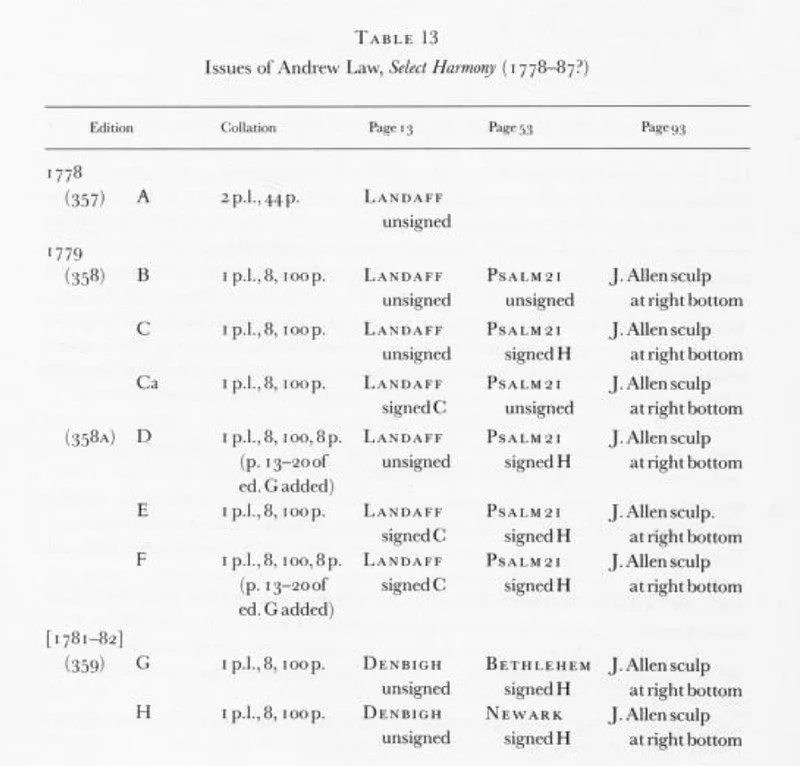
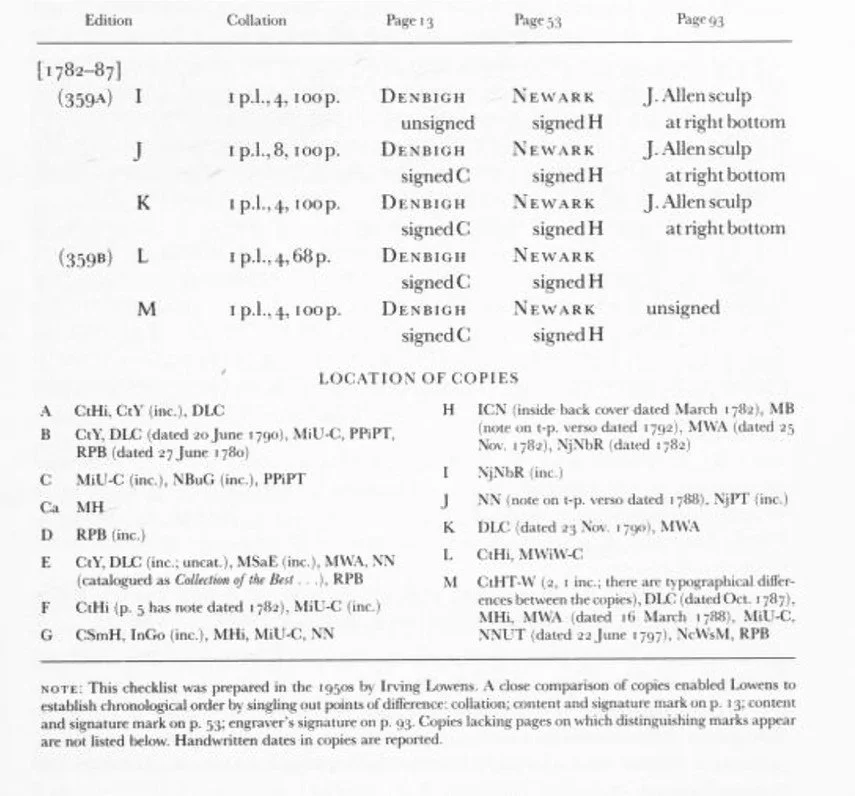
Select Harmony, [complete 1st ed.], 1779
ASMI 358
Select Harmony. Containing in a plain and concise manner, the rules of singing: together with, a collection of psalm tunes, hymns and anthems. By Andrew Law, A.B. Farmington 1779. J. Allen Sculpsit. [In elaborate decorative border.]
1 p.l., 8, 100 p. 13 x 27 cm., p.l., p. 1-100 engraved; t-p., p. 93 signed by Joel Allen.
New Haven Connecticut Journal, 3 March 1779, advertised collection as ready for subscribers. p.l. recto, t-p.; verso blank; p. [1], 'Preface' & 'Advertisement'; p. 2-3, 'Graces or Ornaments of Musick. Tuning the Voice'; p. 3-4, 'General Remarks'; p. 5, 'Composition'; p. 6-7, texts for hymns: LITTLETON, AMSTERDAM, MIDDLETOWN, PROVIDENCE, INFANT SAVIOUR, JUBILEE; P. 8, 'Index' covering p. 5-100; p. 1-4, rudiments; p. 5-100, music. It was the Design of the Editor in this Publication, to furnish Schools with a Set of Psalm-Tunes, Hymns and Anthems, most approved, and best adapted to the Worship of God; that thereby his Glory might be promoted, and his Name exalted.' (Preface in full.) 'He has inserted no Piece without four Parts, and one with five. He has likewise given Credit to all Authors, for their Music, whose Names are known. The Tune Providence, is by Mr. Benjamin West of Providence; the others by Mr. Benjamin West of Northampton in England." (Advertisement in full.) p. 1-44 printed from same plates as 1778 issue (No. 357).
65 compositions, incl. 13 anthems & 1 set-piece, for 4 voices (1 for 5); most w. full text, a few textless. Attribs. to Arnold (9), Ashworth, Babcock, Billings (6), Brownson (2), Bull (4), Carpenter, Deaolph (2), Gillet (4), Knap (3), Stephenson (6), Strong, West [British] (4), West [American] (2), Williams (13), Wood. 18 1st pr. (FARMINGTON, FREEDOM, HARTFORD, JUBILEE, JUDGMENT, MIDDLETOWN, PROVIDENCE, PSALMS 21, 24 or NORWICH, 25, 46, 115, 136, SPRINGFIELD, SUFFIELD, WEATH-ERSFIELD, WORCESTER, WORTHINGTON), also 16 1st Am. pr. (Anthems: O clap your hands, O Lord God of Israel, O Lord our Governor, O sing unto the Lord, The beauty of Israel; BALLDOCK, BURTON, CHESHIRE, KEEN, LEICESTER, LOUGHBOROUGH, MILFORD, ODE ON SPRING, ST. THOMAS'S, SALEM, SOUTHINGTON). 26 American compositions, 39 non-American (24 attrib. Americans, 2 traced [PSALM 33, SUFFIELD]; 36 attrib. non-Americans, 3 traced).
23 Core Repertory (1st pr. HARTFORD, MIDDLE-TOWN, NORWICH, PSALMS 25, 46, & 136, SUFFIELD, WORCESTER; Ist Am. pr. MIL-FORD, ST. THOMAS).
E16318 (MWA). CtY (2), DLC, MH, MSaE (lacks t-p. & front matter), MWA, MiU-C* (2; 1 w. inc. front matter), NBuG (music inc.), NN, PPiPT (2), RPB (2).
NOTE: Tunes first printed in the 1778 issue are also included in the first printing tabulation here because the former issue was incomplete.
The title-page reference to Farmington, Connecticut, gives the residence of Joel Allen, the engraver. Documents in the Law Papers show that Select Harmony was printed in Cheshire, probably by William Law, who also printed his brother's other collections up to 1800. (See Crawford 1968, p. 11-12.)
ASMI 358A
Select Harmony . . . Farmington 1779. J. Allen Sculpsit.
1 p.1., 8, 100, 8 p., the latter numbered 13-20. p.l., p. 1-100, 13-20 engraved.
[1782.] The signature bound at the end of the book is p. 13-20 from the 2d ed. (No. 359). The CtHi copy has the handwritten date [1782] on p. 5. The index does not cover the added signature. Contents same as main entry, except for the added signature of music.
Not in Evans (no copy on Readex). CtHi*, MiU-C (lacks front matter), RPB (lacks t-p. & front matter; handwritten date of 1782).
Select Harmony, [2d ed., 1781-82]
PREFATORY NOTE: On 15 Oct. 1781 Law petitioned the Connecticut legislature, claiming: 'Some person or persons unknown to your Memorialist who are acquainted with the Art of Engraving are making attempts to make a plate in Resemblance of that procured by your Memorialist & to strike of[f] books under the Name of your Memorialist thereby to defeat the Intrest of your Memorialist in his plate & in the Sale of his books. Law asked the legislature for exclusive permission to print a group of tunes and anthems, 'Copies of some of which he purchased of the original Compilers, others he took from Books of Psalmody printed in England which were never printed in America.' The legislature granted his request, and Law became one of the first American citizens to receive copyright protection. (See Lowens 1964, p. 58-67, where Law's petition and the legislature's response, including the list of the fifty-one compositions Law copyrighted, are printed in full.) As Lowens notes (p. 67), the revised Select Harmony described here includes forty-one of the fifty-one copyrighted pieces. The 'pirate' of whom Law complained was apparently Daniel Bayley of Newburyport, Massachusetts. (See Lowens 1964, p. 67-72. See also Bayley, Select Harmony, above, No. 79.)
ASMI 359
Select Harmony. Containing a plain and concise manner, the rules of singing: together with a collection of psalm tunes, hymns and anthems by Andrew Law, A.B. J Allen sculp.
1 p.1., 8, 100 p. p.l., p. 1-100 engraved; p. 13-20 newly engraved in same hand as the rest.
[1781-82.] The legal activity described above shows that Law was at work revising Select Harmony in Oct. 1781. The earliest evidence of its availability is an advertisement in the Hartford Connecticut Courant, 8 Jan. 1782, for: 'Law's Collection of Music, with the addition of Denmark, and a number of other tunes composed by the celebrated Dr. Madan. p.l. recto, t-p.; verso blank; p. [1], 'Preface' & 'Advertisement'; p. 2-3, 'Graces or Ornaments of Music. Tuning the Voice'; p. 3-4, 'General Remarks'; p. 4, 'Composition'; p. 5-7, texts for 8 hymns: AMSTERDAM, MIDDLETOWN, PROVIDENCE, INFANT SAVIOUR, LITTLETON, JUBILEE, FALMOUTH, TRUMPET; P. 8, 'Appendix' [index]; p. 1-4, rudiments; p. 5-100, music. p. 1-12, 21-100 printed from same plates as 1st edition (No. 358).
59 compositions, incl. 13 anthems & 4 set-pieces, for 3 & 4 voices (1 for 5); full text. Attribs. to Arnold (9), Ashworth, Babcock, Billings, Brownson, Bull (4), Carpenter, Deaolph (2), Gillet (4), King, Knap (3), Dr. Madan (7), Stephenson (6), Strong, West [British] (4), West [American] (2), Williams (4), Wood. 18 1st Am. pr. identified (DENBIGH, DENMARK, EASTER, FALMOUTH, GREENWICH, LEEDS, TRUMPET, WAYBRIDGE). 21 American compositions, 38 non-American (19 attrib. Americans, 2 traced [NORWICH, PSALM 33]; 34 attrib. non-Americans, 4 traced).
12 Core Repertory (Ist Am. pr. DENMARK).
Not in Evans (no copy on Readex). CSmH, ICN, InGo (lacks t.p.), MB, MHi, MWA, MIU-C*, NN (2), NjNbR, NjPT (lacks t-p.; front matter inc.).
NOTE: NORWICH, attributed to Brownson in the 1779 edition, is here attributed to 'Unknown.' SUFFIELD, attributed to 'Unknown' in the 1779 edition, is here attributed to King. The tabulation is made with BETHLEHEM, attributed to Billings, on p. 53; however, some copies with the same description have NEWARK, attributed to Dr. Arne, on the same page. See Table 13 below.
ASMI 359A
Select Harmony . . . J Allen sculp.
1 p.l., 4, 100 p. p.l., p. 1-100 engraved.
[1782-87.] Content places issue later than 1781; DLC copy bears handwritten date 'Oct. 1787,' showing that by that time issues with this pagination were in print.p.l. recto, t-p.; verso blank; p. [1], 'Preface'; p. [1]-3, 'Graces or Ornaments of Music', incl. "Tuning the Voice' (p. [1]-2), 'General Remarks' (p. 2-3), 'Composition' (p. 3); p. 4, 'Index'; p. 1-4, rudiments; p. 5-100, music. Engraved portions printed from same plates as main entry, except for p. 53.
Music same as main entry, except on p. 53, where NEWARK, attrib. to Dr. Arne, replaces BETHLEHEM, attrib. to Billings.
E23492 (MWA). CtHT-W (2; 1 lacks t-p.; there are typographical differences between the two copies), DLC (2), MHi, MWA (2), MiU-C*, NNUT, NcWsM, NjNbR (lacks t-p.; front matter & music inc.), RPB.
ASMI 359B
Select Harmony . . . J Allen sculp.
1 p.l., 4, 68 p.1 p.l. & p. 1-68 engraved.
[1782-87.] Cannot be dated conclusively except that it followed Law's reduction of the front matter from 8 to 4 p. The index covers the 100-p. issue. The existence of two copies, together with Law's lifelong practice of selling his publications in separate parts (see No. 357 above; also his The Rudiments of Music and The Art of Singing) suggests that he offered the opportunity to buy Select Harmony in this abbreviated form. Contents the same as No. 359A, except for the lack of the last 32 p. of music. Engraved portions printed from same plates as No. 359A.
Not in Evans (no copy on Readex). CtHi*, MWiW-C.
NOTE: The welter of bibliographical ghosts and mistaken editions lurking in the canon of this, the first copyrighted American tunebook, illustrates the fluid state of copyright procedure in the 1780s and early 1790s. Evans 18553 is an unauthorized 1784 piracy actually published by Daniel Bayley (q.v., No. 79). Evans 19754 claims a 1786 edition, which turns out to be merely a Maryland state copyright of the edition of 1781-82 (No. 359). (See Lowens 1959, p. 152.) Evans 23429 & 24467 claim editions of 1791 and 1792. No evidence of new editions in either of these years has been found; surely the first was Law's federal copyright of the work-a national copyright act had been passed in 1790-but why he obtained another the next year is not known. Finally, Evans 16317, the so-called Collection of the Best and Most Approved Tunes and Anthems is actually Select Harmony (1779; No. 358), mistaken for a separate collection.
In 1812 Law published in Philadelphia Select Harmony, a work sharing nothing beyond the title with the collection described here. (See Crawford 1968, p. 215-17.)
A SELECT NUMBER OF PLAIN TUNES, 1781
ASMI 360
A Select Number of Plain Tunes Adapted to Congregational Worship by Andrew Law A.B. Joel Allen sculpt.
16, [4] p. 15.5 x 9 cm. p. 1-16 engraved by Joel Allen.
[1781.] Evans lists the work as E10662 (1767), E12427 (1772), & E27208 (1794), all with incorrect dates and imprints. The poem, "The American Hero', p. [18-19], is dated Norwich, Oct. 1775. However, the earliest proof of publication is an account sheet in the Law Papers showing that on 27 June 1781 Law received copies of the 'small collection' - A Select Number-from William Law, the printer. (See Crawford 1968, p. 23n.-24n. for dating information and for evidence that William Law printed the work.) p. [1], caption title; p. [1]-16, music; p. [17] blank; p. [18-19], 'The American Hero', poem attributed to Nath[aniel] Niles; p. [20] blank.
54 compositions for 4 voices; textless. No attribs. 1 3 1st pr. identified (NEW ENG-LAND, TURKEY HILLS, UNION), also 4 probable Ist pr. (BUNKER HILL, MORNING HYMN, WALLINGFORD, WESTFIELD) & 14 1st Am. pr. (AYNHOE, BLENDON, BRANSTON, COVENTRY, EATON, ELSTOW, KETTERING, NORTHAMPTON, NORTH-BURY, PSALMS 22, 32, 148, RUGBY, WELLINGBOROUGH). 3 compositions traced to American sources (the 1st prs.), 4 probably American (the probable 1st prs.), 47 traced to non-American sources.
22 Core Repertory.
Evans entries incorrect; MWA copy (inc.), b.w. Watts, Psalms of David, on Readex E17098. CtY (b.w. Watts, Psalms of David, 25th ed., Boston, 1767), CSmH, DLC, ICN, InGo, MB, MWA, MiU-C* (b.w. Watts, Psalms of David, 40th ed., Newburyport: John Mycall, 1781), NN (2), PHi (b.w. Watts, Psalms of David, Philadelphia: R. Aitken, 1781), PPiPT, RPB (b.w. Brady and Tate, New Version, Boston: for Nicholas Bowes, 1774).
ASMI 360A
A Select Number of Plain Tunes . . . Joel Allen sculpt.
16 p. p. 1-16 engraved.
[1781.] Contents same as main entry, except that it lacks the typeset poem. Printed from same plates as main entry.
Not in Evans (no copy on Readex). Ct, CtY, MB, MiU-C, NN, NjPT* (b.w. Watts,
Music same as main entry. Psalms of David, Philadelphia: R. Aitken, 1781), RPJCB.
ASMI 360B
A Select Number of Plain Tunes . . . Joel Allen sculpt.
16, [8] p. p. 1-16 engraved.
[1781] Main portion of the book published [1781]; the rest must have been added later. Contents same as main entry through p. [20]; p. [21], 6 stanzas of poetry for 'The Infant Saviour; A Sapphic Ode. Adapted to the Tune of Bunker-Hill'; p. [22] blank; p. [23], 4 stanzas of poetry for 'A Hymn on Peace; (Worcester)'; p. [24] blank. Engraved portion printed from same plates as main entry.
Music same as main entry.
Not in Evans (no copy on Readex). NjPT* (b.w. Watts, Psalms of David, Philadelphia: R. Aitken, 1781).
NOTE: The Harris Collection (RPB) owns a broadside on which is printed Niles's poem, "The American Hero,' dated October 1775, together with an engraved four-voice setting of the tune BUNKER-HILL. The broadside is reproduced in facsimile in Goldman 1943, p. 92.
ASMI pp. 387-436,