
JAMES LYON
James Lyon (b. Newark, N.J., 1 July 1735; d. Machias, Me., 12 Oct. 1794), a composer and Presbyterian minister, was probably also a singing master. An ode set to music by Lyon was performed at his commencement from the College of New Jersey (Princeton) in 1759. A singing school held in Philadelphia in 1760 was probably taught by him, and in May 1761, an anthem of his was sung at the University of Pennsylvania's commencement cere-mony in Philadelphia. Urania, his only tunebook, appeared in 1761. Granted an A.M. degree by Princeton in September 1762, Lyon was shortly thereafter licensed to preach by the Presbyterian Synod of New Brunswick, New Jersey. He devoted the rest of his life to the church, moving to Nova Scotia in 1764 and accepting in 1772 a pastorate in Machias, Maine, which he held for the rest of his life. He was an active patriot during the American Revolution.
Amerigrove, Baker's, Bio-bib, DAB, Grove, Metcalf, Sonneck-Upton. Also Lyon 1974, p. i-iv; Silverman 1976, p. 42-46; Sonneck 1905.
See also No. 25.
URANIA, 1761-67
The music in all issues of Lyon's Urania is printed from the same engraved plates. Variations in the typeset front matter, however, demonstrate that the work was printed at least six times. The details of these variations are covered in Table 14, and only the two editions with differing pagination are described here.
Urania, [1st ed.], 1761
ASMI 371
Urania, or A Choice Collection of Psalm-Tunes, Anthems, and Hymns, from the Most Approv'd Authors, with some entirely new; in two, three, and four, parts the whole peculiarly adapted to the use of churches, and private families: to which are prefix'd the plainest, & most necessary rules of psalmody. By James Lyon, A.B. Hen[.] Dawkins Fecit-1761. Philad. Price 15f.
1 p.l., 2 p., 3 1., xii, 198 p. 11 x 24 cm. 1 p.l., p. i-xii, 1-198 engraved by Henry Dawkins.
The Pennsylvania Journal, 3 June 1762, advertises Urania as just published. However, a copy in NN was signed by the owner, one of the original subscribers: 'Hetty Chambers... 1761,' confirming the t-p. date. Sonneck 1905, p. 136, suggests that Urania may have been available to subscribers in 1761, but not available to the general public until the next year. p.l. recto, t-p.; verso blank; p. [1]-2, dedication "To The Clergy of every Denomination in America'; 1st 1. recto, 'Index'; verso blank; 2d 1., recto & verso, 3d 1. recto, 'Subscribers Names'; verso blank; p. i-xii, rudiments & instructions; p. 1-198, music. 'Should the following Collection of Tunes be so fortunate as to merit Approbation; To please the Taste of the Public; To assist the private Christian in his daily Devotion; And to improve, in any Degree, an important Part of Divine Service in these Colonies, for which it was designed: I shall think myself happy in being the Editor, notwithstanding the great Expence, Labour, and Anxiety, it has cost me to compleat it.' (Extract from dedication.)
96 compositions, incl. 9 anthems & 3 set-pieces, for 2, 3, & 4 voices; psalm-tunes textless, the rest w. full text. No attribs. 1 6 1st pr. claimed; 10 identified (CHRISTMAS HYMN, JEHOVAH REIGNS, LET THE SHRILL TRUMPET'S, THE LORD DESCENDED, PSALMS 8, 9, 23, 33, 95, WATTS's), also 59 1st Am. pr. (ANGELS HYMN, all 9 pieces labeled 'Anthem,' BEDFORD, COOKFIELD, CRANLEY, DAGENHAM, DARKING, DORCHESTER, HALLELUJAH, ITALIAN, JUDGMENT, KETTERING, KETTLEBY'S, LEATHERED, MORNING HYMN, NEWCASTLE, ORANGE, PALMY'S, PSALMS 4, 5, 12, 15, 40, 43, 50 NEW, 56, 57, 90, 98, 102, 113 NEW, 119 NEW, 122 NEW, 136, 145, 148, 150, PUBLIC WORSHIP, RESURRECTION, RIPON, RYGATE, ST. MATTHEW'S [both], ST. MICHAEL'S, SALISBURY, SKY LARK, WALSALL, WELLS, WHITEFIELD'S, WILLINGTON, WIRKSWORTH). 11 compositions traced to American sources (all ist pr.; also PSALM 100 NEW), 78 to non-American, 7 unidentified [Anthems: O give thanks, O praise the Lord; JUDGMENT, MORNING HYMN, PSALMS 4, 148, WILLINGTON].
27 Core Repertory (1st pr. PSALM 33; 1st Am. pr. ANGELS HYMN, BEDFORD, MORNING HYMN, PSALM 5 [NEWBURY], ST. MICHAEL'S [ROCHESTER], WALSALL, WELLS, WIRKSWORTH [AYLESBURY]).
E8908 (DLC). DLC, NN (music inc.), PHi (music inc.), RPJCB, TxWaB*.
NOTE: Except for PSALM 23, traced by Stevenson 1966 (p. 47 & figs. 3-4) to Francis Hopkinson, the pieces claimed as 1st pr. are believed to be by Lyon himself. Stevenson 1966 also shows that CHRISTMAS HYMN is by Giovanni Palma (p. 46-47 & figs. 5-6) and JEHOVAH REIGNS by William Tuckey (p. 49-50). On the basis of attributions in the second edition of Jocelin's The Chorister's Companion (No. 300), Crawford assigns PSALM 9 and PSALM 33 also to Tuckey (see Lyon 1974, p. xiv & n. 32, p. xx).
Urania, [2d ed., 1767]
ASMI 372
Urania . . . Hen[.] Dawkins Fecit-1761.
1 p.l., 2 p., 1 1., xii, 198 p. p.l., p. i-xii, 1-198 engraved.
[1767.] The Pennsylvania Journal, 26 Nov. 1767, advertised as just published 'a new and neat Edition of "Urania."" Sonneck 1905, p. 137-47, discusses the typographical variations in detail and concludes that the copy listed below represented the edition of 1767.1 p.l. recto, t-p.; verso blank; p. [1]-2, dedication 'To the Clergy of every Denomination in America'; 1. recto, index; verso blank; p. i-xii, rudiments & instructions; p. 1-198, music. Statement same as 1st ed. (No. 371). Engraved portions printed from same plates as 1st ed.
Music same as 1st ed.
E10666 (no copy on Readex). CtY (2 w. front matter inc.; 1 lacks t-p.), MB (music inc.), MHi, MiU-C*, NHi, NjPT, PPIPT, RPB (front matter inc.).
NOTE: Copies with front matter too incomplete to permit identification of the issue are given in Col. VII of the table below; ICN also owns such a copy. Stevenson 1966, p. 52, mentions another copy at the Georgia Historical Society. It was not examined for this bibliography.
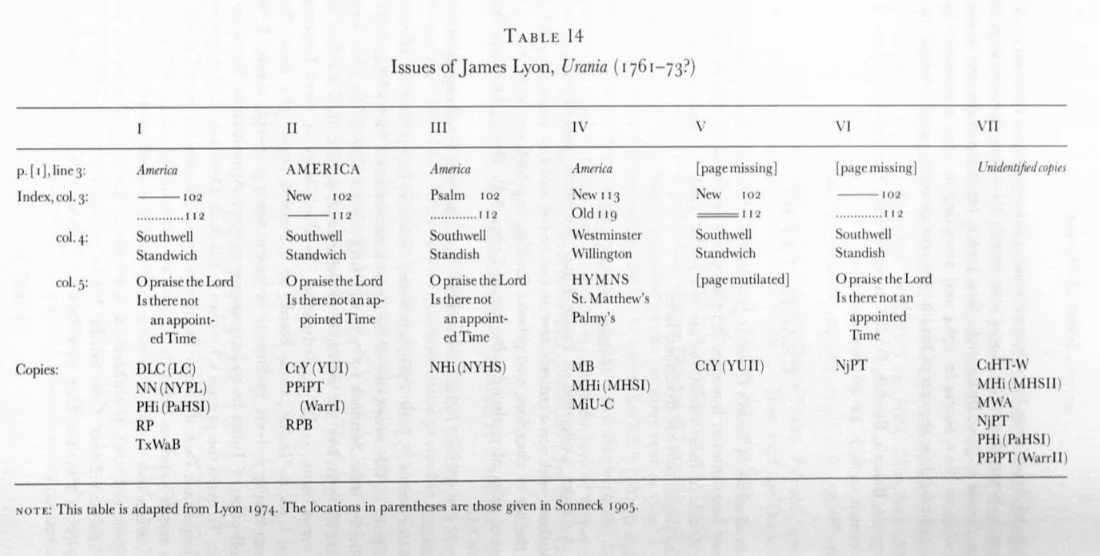
Sonneck 1905, p. 137-47, distinguishes between printings of Urania. In Lyon 1974, Richard Crawford adds a few details to Sonneck's findings (see p. xxiii-xxv), and the table of printings given there is adapted as Table 14 here.
Three points of difference distinguish the various printings:
1. Collation. Complete copies of Urania appeared in two forms: with the list of subscribers and without it. Since the list would be relevant only to the earliest issue, it is assumed that the one containing it (Collation A) is the first, and the one lacking it (Collation B) represents all other issues.
A B
1 p.l., 2 p., 3 1., xii, 198 р. 1 p.l., 2 p., 1 l., xii, 198 р.
p.l. recto, t-p.; verso blank. p.l. recto, t-p.; verso blank.
p. [1]-2, dedication. p. [1]-2, dedication.
1st 1. recto, "The Index'; verso blank. L. recto, "The Index'; verso blank.
p. i-xii, rudiments and instructions p. i-xii, rudiments and instructions.
2dl. recto & verso, 3d 1. recto, 'Subscribers Names'; verso blank.
p. 1-198, music. p. 1-198, music.
2. Location of asterisks. A note in the index reads 'All Tunes marked with an Asterism are New,' and six pieces are so indicated there. In later issues (those with Collation B), each of the six is also marked with an asterisk: on p. 44, 50, 63, 125, 165, and 194. However, asterisks in the first edition (Collation A) are variant. One copy (DLC) carries only four, omitting those on p. 50 and p. 165; the rest have five, lacking the one on p. 50. Sonneck suggests (p. 145) that the omission of the asterisk on p. 165 was probably discovered while the first issue was still in press. The omission on p. 50 was apparently not noticed until the first printing had been completed.
3. Differences in typeset material. On p. [1] the word 'America' in the third line of the dedication is printed in two different ways, as indicated. In the index the tops of the last three columns (cols. 3, 4, and 5) vary in the way Psalm 102 is identified, in the spelling of STANDISH, and in the printing of the anthem title, 'Is there not an appointed time.' In one printing (IV) the third and fourth columns begin with different titles than the correspond-ing columns of the other five.
Table 14 records the differences in typeset material and shows where copies are presently located. State I is the first edition, States II and III are those that Sonneck assigned conjecturally to Philadelphia (1767) and New York (1773). States IV and V are variants for which he suggested no date, and State VI is a variant Sonneck did not discover. Copies listed as unidentified lack the pages that would make identification possible. Parentheses in the table identify copies described by Sonneck. Sonneck gives a more detailed description of the condition of copies he located.
ASMI pp. 444-448