
JOHN NORMAN
John Norman (b. England, ca. 1748; d. Boston, 8 June 1817) was an engraver, printer, publisher, and bookseller. He arrived in Philadelphia from London around 1774, and by 1781 he had moved to Boston, where he spent the rest of his life as a publisher and practitioner of the decorative arts. He never signed a tunebook as compiler, but he was active in sacred music publication, especially between 1781 and 1790, and it is possible that he compiled The Massachusetts Harmony, [1784], Sacred Harmony, [1786-88], and/or The Federal Harmony, [1788], for the three share some of the same engraved plates, and Norman was involved in some aspect of the manufacture or distribution of them all. He was the father of William Norman, also active as a music engraver and publisher. See below for further details.
Bio-bib, DAB, Sonneck-Upton. Also Groce 1957; McKay 1975, p. 141n.; Wolfe 1980, p. 32-33, 235, 240.
Note on John Norman as an Engraver
It is risky to attempt attributions on the basis of internal evidence, for one's view of an artist's or an artisan's style may not be trustworthy. However, certain situations invite speculative attributions: perhaps a style is highly distinctive, or perhaps factors other than style point to a particular attribution. Both of these conditions pertain to publications in which John Norman of Boston, engraver, printer and publisher of sacred music, was involved.
Norman signed only five extant sacred music items as engraver. All were by William Billings:
The Psalm-Singer's Amusement (1781)
The Suffolk Harmony (1786; Norman also printed this work)
Anthem for Easter ([1787])
Anthem Psalm 47 ([1786-90])
Anthem Psalm 127 ([1786-90])
Norman's engraving style in these works shows a number of characteristic traits. Perhaps the most obvious is his stemming of all notes, or almost all notes, on the right-hand side. (Most engravers of the time were more likely to place ascending stems on the right-hand side of the note-head, and descending stems the left-a practice that has since become conventional.) Norman's technique of beaming eighth- or sixteenth-note groups that incor-porate both an ascent and a descent is fairly unusual. Instead of connecting the notes with a straight beam, he was more likely to draw an angled beam:
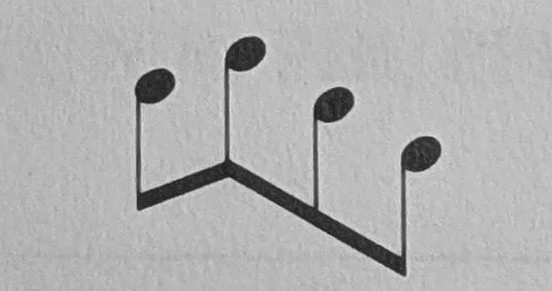
Norman's G-clef (treble clef) signs have a curved line for an axis instead of the usual straight line. His ampersands have a backward lean. His texts are written in a distinctive upright style with long serifs. These details add up to an overall general surface appearance that is quite distinctive.
Four small Boston publications of the decade 1781-90, all unsigned, bear the distinguishing marks of John Norman's engraving style. William Selby's Two Anthems (1782) is the only one that does not have a tie with William Billings; the three that do are Billings's Peace an Anthem (1783), Abraham Wood's A Hymn on Peace (1784), for which Billings was advertised as a seller in May of 1784, and Billings's The Bird and The Lark, two tunes published in four pages in 1790. The stylistic and circumstantial evidence that Norman engraved these works seems sufficient to attribute them to his hand.
Norman's involvement with music went beyond engraving or printing other men's works. In 1784 there appeared The Massachusetts Harmony (No. 376), the work of an anonymous compiler, 'printed for, and sold by John Norman.' Whether or not Norman was the compiler, he was certainly the publisher, and it would seem a natural thing for a publisher who was also an engraver to engrave his own collection. (See John Aitken, William Pirsson, and Israel Terril for examples of men who did both.) However, the style of engraving in The Massachusetts Harmony differs from that found in the items signed by Norman or attributed to him above. It is true that the page size of The Massachusetts Harmony was larger than any of the collections signed by Norman, and that could contribute to the different look of the page. However, the engraver of The Massachusetts Harmony stems notes on both the left and right-hand sides; his eighth-note and sixteenth-note beams are mostly straight rather than angled; his note-heads show a full roundness and are proportionately somewhat larger than Norman's; his texts resemble Norman's in their upright appearance and their long serifs, but they appear neater-more uniform in size, perhaps more evenly spaced and more cleanly executed. Around 1784 Norman also apparently brought out A New Collection of Psalm Tunes (No. 391) suitable for binding with metrical psalters. A year later The Massachusetts Harmony was published with a small addition at the end. Since A New Collection is textless and since it is devoted to pieces moving almost entirely in whole, half-, and quarter-notes, some of the engraving details that might be compared with other collections are absent. Nevertheless, the stemming of notes on both left and right-hand sides of the notehead, and the general appearance of the tune titles point to the same engraver as The Massachusetts Harmony. In addition, when the latter appeared in 1785, the extra pages at the end were engraved by the same hand as the rest of the book.
The Massachusetts Harmony is a particularly intriguing collection because its history is intertwined with that of Sacred Harmony (No. 444) and The Federal Harmony (No. 183ff.), two Boston collections of the 1780s, both linked with Norman. Sacred Harmony (1786-88), issued to compete with Isaiah Thomas's Worcester Collection (1786; see Lowens 1964, p. 76-78), gives neither compiler nor publisher on its title-page, mentioning only C. Cambridge, the printer and seller. Of its 93 pages of music nearly half are printed from engraved plates used earlier for The Massachusetts Harmony. Moreover, while many of the new pages are engraved by the same hand as the latter, other new pages bear the distinguishing traits of John Norman (e.g., p. 48, 54-77, 79-80, 82, and others). Sometimes, as on p. 53 and 54, facing pages differ in style, and there the differences in stemming, beaming, text, and general appearance are striking. Sacred Harmony was engraved by two different hands, one of them John Norman's. In addition, Norman played some role, still undefined but perhaps crucial (compiler? publisher?), in the work's publication.
The title-page of The Federal Harmony lists Norman in various capacities. In the earliest issue (1788), the imprint reads: 'printed for the editor, and sold by John Norman.' That could mean that Norman was both printer and seller, or that he was just the seller. It is not impossible that he was also the editor but wanted to preserve anonymity. The imprint of editions of 1790, 1792, and 1793 reads: 'printed and sold by John Norman, but again no compiler nor publisher is named. The present discussion, however, concerns the engraver, not the compiler. As in Sacred Harmony, the first issue of The Federal Harmony shows important differences between pages, and again the engraving of John Norman and the earlier collaborator can be distinguished. Of the 114 pages of music in The Federal Harmony, roughly three-quarters is printed from plates previously used for The Massachusetts Harmony and Sacred Harmony. (See Table 6, p. 266.) By 1790, when a new issue of The Federal Harmony appeared, the page size was reduced and new plates were engraved, all in the hand of Norman's collaborator. The active life of the earlier plates had come to an end. Plates for later issues of The Federal Harmony were executed by the second engraver, and no sacred music after 1790 is engraved in John Norman's distinctive hand. Who was John Norman's collaborator? While conclusive direct evidence is lacking, all signs point to William Norman, who is identified as the son of John Norman (see Lord n.d.). William Norman's involvement in music can be documented over more than a decade-and-a-half. As early as 1783 he cast music type for a song printed typographically in The Boston Magazine (Oct. 1783); that issue was edited by William Billings; the periodical was printed by John Norman and another associate. (See McKay 1975, Appendix III, figure 8, for Isaiah Thomas's statement identifying William Norman as the type caster.) By the time the latest issue of The Federal Harmony appeared (8th ed., 1794), William Norman was in charge. His name, not his father's, appears on the title-page as printer and seller. In 1799, he printed another work, The Boston Collection, 'selected by a committee from the singing societies of every denomination in Boston. In the meantime, he had also grown active as a publisher of secular music. Sonneck-Upton, p. 586, lists secular publications of Norman's dating from August 1796, through September 1799, including the important eighty-page Musical Repository, issued in four numbers beginning in August 1796. The sacred and secular publications that William Norman issued are all engraved, and all bear the same distinctive look. Moreover, they all display the traits of John Norman's collaborator described above-traits found in The Massachusetts Harmony, the pages of Sacred Harmony and The Federal Harmony (1788) not engraved by John Norman, and the issues of the latter from 1790 on. They also resemble the engraving of Jacob French's The New American Melody (Boston, 1789), another collection 'printed and sold' by John Norman.
William Norman apparently never signed a piece of music as engraver. Yet Silver 1949 lists him as an engraver, and Lord (n.d., mentioned above), notes that he published works with unsigned plates 'believed... done with his own hands. As the son of an active engraver, a proven artisan, a practitioner of the book trade, and a printer and publisher of music in his own right, William Norman is the likely candidate for John Norman's collaborator and associate. McKay 1975, p. 141n., summarizing John Norman's career as a music engraver and publisher, states: 'John Norman seems to have been responsible for the plates of every new engraved collection of sacred music printed in Boston between 1781 and 1794. In light of the new evidence presented here, that statement ought now to begin: 'John and William Norman seem,' and the date 1794 should be changed to 1800.
ASMI pp. 477-480.