
WILLIAM BILLINGS
William Billings (b. Boston, Mass., Oct. 7, 1746; d. there, Sept. 26, 1800) was a composer, singing master, poet, writer, printer, and tanner. He spent his life in Boston and environs, where he was active as a teacher of singing schools from 1769. For most of the decade after 1787 he served as Sealer of Leather for the city of Boston. Other municipal appointments included stints as scavenger (street-cleaner, 1786) and hogreeve (1787-88), charged with keeping the streets free of roving swine. He also printed himself two of the six sacred tunebooks he compiled between 1770 and 1794. Despite these different occupations, he experienced financial difficulty, as testified by a mortgage on his house and a public charity concert on his behalf in 1790. Apparently self-taught as a composer, he was the first American to bring out a collection of his own music (The New-England Psalm-Singer, 1770). His tune-books, especially The Singing Master's Assistant (1778ff.), were plagiarized by other compilers, and many of his compositions won wide popularity through appearances in other men's tunebooks. Recognized by his contemporaries as a composer of uncommon talent, he was often taken during the nineteenth and early twentieth centuries as a symbol of American musical crudeness. Renewed interest in his music and career since the 1930s, however, has led to a heightened appreciation of his skill as a composer and his historical position as an American musician of real significance.
Amerigrove, Baker's, Bio-bib, DAB, Grove, Metcalf, Sonneck-Upton. Also Anderson 1975; Barbour 1960; Billings 1977; Billings 1981; Billings 1986; Kroeger 1982; McKay 1975; Nathan 1976.
AN ANTHEM. PSALM 47, 1786-90?
ASMI 99
An Anthem. Psalm 47. For thanksgiving. by Wm. Billings. J Norman Sc
2 L. 11.5 x 20 cm. Engraved throughout by John Norman.
[1786-90?] Surviving copies are bound in with Billings's The Suffolk Harmony, 1786; John Norman engraved Billings's music during the decade 1781-90 (see note following No. 399).
L. 1 recto, caption title; recto & verso, 1. 2 recto & verso, music.
1 anthem for 4 voices; full text. Attrib. to Billings. Identified as 1st pr. American composition.
Not in Core Repertory.
Not in Evans (no copy on Readex). CtHT-W, MH (both b. w. The Suffolk Harmony, 1786).
NOTE: See Billings's The Suffolk Harmony, 1786 (No. 113) for the specific contents of each volume. Billings 1986 includes the piece in modern scholarly edition.
AN ANTHEM. PSALM 127, 1786-90?
ASMI 100
An Anthem. Psalm 127 composed by Wm. Billings [At foot of p. 1:] J. Norman Sc.
8 p.111.5 x 19 cm. Engraved throughout by John Norman.
[1786-90?] Surviving copies are bound in with Billings's The Suffolk Harmony, 1786; John Norman engraved Billings's music during the decade 1781-90. p. 1, caption title; p. 1-8, music.
1 anthem for 4 voices; full text. Attrib. to Billings. Identified as 1st pr. American composition.
Not in Core Repertory.
Not in Evans (copy in MWA b.w. The Suffolk Harmony on Readex E19512). CtHT-W, DLC, MHI, MWA". All b.w. The Suffolk Harmony, 1786. MiU-C (b.w. Billings, The Singing Master's Assistant, 1778, &, THE BIRD and THE LARK).
NOTE: All copies discovered, except for the MiU-C copy, are bound with Billings, The Suffolk Harmony, 1786, q.v. (No. 113) for the specific contents of each volume. Billings 1986 includes the piece in modern scholarly edition.
AN ANTHEM FOR EASTER, 1787
ASMI 101
The Boston Massachusetts Centinel, 4 April 1787, advertised as just published: 'An Anthem, composed for Easter Sunday, and a Hymn set to Music, for Good Friday. An eight-page signature of tunes containing the Easter Anthem 'The Lord is risen indeed, the tune CRUCIFICTION-labeled 'for good Friday' - and RESURRECTION, another tune for Easter, is bound into several copies of The Suffolk Harmony (No. 113). Its pagination (p. 1-8) marks it as a separate issue, not part of The Suffolk Harmony. It is almost certainly the item advertised.
An Anthem for Easter [.] Words from scripture & Dr. Young[.] Composed by Wm. Billings[.] [At foot of p. 1:] J. Norman Sc.
8 p.11.5 x 20 cm. Engraved throughout by John Norman.
[1787.] Boston Massachusetts Centinel, 4 April 1787, advertises work as just published. p. 1, caption title & engraver's colophon; p. 1-8, music.
3 compositions, incl. 1 anthem, for 4 voices. All attrib. to Billings. 2 1st pr. identified (Anthem, RESURRECTION). All are American. 1 Core Repertory (1st pr. Anthem for Easter).
Not in Evans (MWA copy b.w. The Suffolk Harmony, on Readex E19512). CtHT-W, DLC, MH, MHI, MWA (2; 1 lacks p. 1-2). All b.w. The Suffolk Harmony.
NOTE: See Billings, The Suffolk Harmony (No. 113), for the specific contents of each volume. Billings 1986 includes this item in modern scholarly edition.
ANTHEM FOR EASTER, 1795
ASMI 102
[Anthem for Easter, with an addition. By William Billings. Boston , 1795.]
The Boston Independent Chronicle, 26 Nov. 1795, carries the following advertisement: 'Music. A Peice intitled Easter Anthem, with an addition entirely new inserted in the middle-To be Sold by the Author William Billnigs, At his House near Liberty-Pole, Boston. Price 1/6. Also, a Music Book, entitled The Continental Harmoney, The composition entirely New. Price 6s. Boston, Nov. 26, 1795."
E28301 (no copy on Readex). No copy located.
NOTE: Billings's ANTHEM FOR EASTER with added middle section is printed in No. 509. The Village Harmony, 5th ed. (Exeter, 1800), p. 170-74, and elsewhere. Billings 1986 includes the piece in modern scholarly edition.
THE BIRD and THE LARK, 1790
ASMI 103
The Bird. Words from T & B. Composed by W Billings. [2d title:] The Lark. Words Anon.
2 l. 13.5 x 20.5 cm. Engraved throughout [by John Norman]. See note below, under Norman.
[1790.] Boston Independent Chronicle, 13 May 1790, advertises item as just published. 1st 1. recto, caption title; recto & verso, music; 2d 1. recto, caption title; recto & verso, music.
2 compositions for 4 voices; full text. Attrib. to Billings.2 identified as ist pr. Both are American.
No Core Repertory.
E22362 (no copy on Readex). CHT-W, DLC, MB, MBA, MWA, MiU-C (b.w. Billings, The Singing Master's Assistant, 1778, &, Anthem Psalm 127), N.
NOTE: All copies discovered, except for the MiU-C copy, are bound with either Billings. The Suffolk Harmony, 1786 (No. 113), or The Psalm-Singer's Amusement (No. 410), q.v. for the specific contents of each volume. Billings 1986 includes these pieces in modern scholarly edition. 'T & B' in the caption title refers to Brady and Tate, New Version.
THE CONTINENTAL HARMONY, 1794
ASMI 104
The Continental Harmony, containing, a number of anthems, fuges, and chorusses, in several parts. Never before published. Composed by William Billings, author of various music books.
Psalm lxxxvii. 7. As well the singers as the players on instruments shall be there. Psalm Ixviii. 25. The singers went before, the players on instruments followed after, amongst them were the damsels. Luke xix. 40. I tell you that if these should hold their peace, the stones would immediately cry out. Rev. xix. 3. And again they said Alleluia.
Come let us sing unto the Lord, /And praise his name with one accord, / In this design one chorus raise; / From east to west his praise proclaim, / From pole to pole extol his fame, /The sky shall echo back his praise.
Published according to act of Congress. Printed, typographically, at Boston, By Isaiah Thomas and Ebenezer T. Andrews. Sold at their bookstore, No. 45, Newbury Street; by said Thomas in Worcester, and by the booksellers in Boston, and elsewhere. - 1794.
Front., 199, [2] p. 13.5 x 23 cm. Front, engraved.
The Massachusetts Magazine, Aug. 1792, carried a subscription proposal by a large Committee...selected by the several Musical Societies in Boston and its vicinity' for what was described as 'a Volume of Original American Musick, composed by William Billings, of Boston. The committee explained its own involvement: "The distressed situation of Mr. Billings' family has so sensibly operated on the minds of the committee as to induce their assistance in the intended publication.' It also announced that it would act as a musical intermediary between Billings and the public: "The Inspection and Revision of the whole is submitted by Mr. Billings to the aforesaid committee, many of whom are deemed of approved knowledge in the science of Musick, and nothing will be offered to the publick but what they recommend and approve of. (A facsimile reprint of the proposal, which must have appeared on the endpapers of the Magazine, is in Brooks 1888, p. 263-65). The announcement of poverty in the Billings family was first made publicly on 8 Dec. 1790, when the Columbian Centinel reported: 'A number of benevolent characters are determined to bring forward a Concert of Sacred Musick, for the benefit of Mr. William Billings of this town-whose distress is real, and whose merit in that science, is generally acknowledged. More on the publication of The Continental Harmony is in McKay 1975, p. 164-68 & 167n. An additional note on its content appears in Crawford 1974, p. 52-53. The Columbian Centinel advertised The Continental Harmony as just published in its issue of 1 Feb. 1794; the advertisement was dated Worcester, 17 Dec. 1793. Frontispiece (CONNECTION, a four-voice composition engraved around an axis 'to show that every tune is a Compleat circle'); p. [i], t-p.; p. [ii] blank; p. [iii], Musical Characters'; p. [iv]-xi, 'To the several Teachers of Music, in this and the adjacent States'; p. [xii]-xxxiv, 'A Commentary on the preceding Rules; by way of Dialogue, between Master and Scholar'; p. [35]-199, music; p. [200] blank; p. [201], 'Index.' 'Scholar. Sir, I have heard many dispute about double Bars; for some authors say... you may stop at a double Bar, in psalm tunes, the time of one or two beats, to take breath, if you please; which sometimes occasions as much confusion, as the occurrence of a Hold; for if I am disposed to stop, and another to proceed, I do not see how the time is to be preserved. [New par.] Master. I do not see any more rule for stopping at a double Bar, than at a single Bar, unless there be a rest inserted; because it cannot be done without losing time; and in my definition of a double Bar, instead of saying, that you may stop to take breath, I should have said that you may stop to catch breath; and even that must be done without losing time; but double Bars in Psalm tunes are placed at the end of the lines, for the benefit of the sight, to direct the performer, where to stop, in congregations, where they keep up that absurd practice of reading between the lines, which is so destructive to harmony, and is a work of so much time, that unless the performers have very good memories, they are apt to forget the tune, while the line is reading. I defy the greatest advocates for reading between the lines [i.c., "lining out"], to produce one word of scripture for it, and I will leave it to all judicious people, whether it is founded on reason; and certainly, whatever is founded on neither reason, nor religion, had better be omitted. The practice of retailing the psalm line by line, was introduced so long ago as when very few people had the knowledge of reading. at this time when every man is capable of reading for himself; and when we consider the confusion that is caused in the music, by reading the lines, and the destruction it occasions to the sense of the psalm, I can see no reason for keeping up so absurd a practice.' (From p. xvii-xviii.) 'It is an old maxim, and I think a very just one, viz, that variety is always pleasing, and it is well known that there is more variety in one piece of fuging music, than in twenty pieces of plain song, for while the tones do most sweetly coincide and agree, the words are seemingly engaged in a musica[1] warfare; and excuse the paradox if I further add, that each part seems determined by dint of harmony and strength of accent, to drown his competitor in an ocean of harmony, and while each part is thus mutually striving for mastery, and sweetly contending for victory, the audience are most luxuriously entertained, and exceedingly delighted; in the mean time, their minds are surprizingly agitated, and extremely fluctuated; sometimes declaring in favour of one part, and sometimes another. Now the solemn bass demands their attention, now the manly tenor, now the lofty counter, now the volatile treble, now here, now there, now here again. O inchanting! O ecstatic! Push on, push on ye sons of harmony, and
Discharge your deep mouth'd canon, full fraught with Diapasons; / May you with Maestoso, rush on to Choro-Grando, / And then with Vigoroso, let fly your Diapentes / About our nervous system.'
(From p. xxviii, n.) 'Scholar. Sir, I should be glad to know whether you have any particular rule for introducing discords, in musical composition; I think you say that you have not tied yourself to any rules laid down by others, and I want to know whether you have formed a set of rules in your own mind, by which you are governed in some measure. [New par.] Master, Musical composition is a sort of something, which is much better felt than described, (at least by me) for if I was to attempt it, I should not know where to begin or where to leave off; therefore considering myself so unable to perform it, I shall not undertake the task; but in answer to your question, although I am not confined to rules prescribed by others, yet I come as near as I possibly can to a set of rules which I have carved out for myself; but when fancy gets upon the wing, she seems to despise all form, and scorns to be confined or limited by any formal prescriptions whatsoever; for the first part is nothing more than a flight of fancy, the other parts are forced to comply and conform to that, by partaking of the same air, or, at least, as much of it as they can get: But by reason of this restraint, the last parts are seldom so good as the first; for the second part is subservient to the first, the third part must conform to first and second, and the fourth part must conform to the other three; therefore the grand difficulty in composition, is to preserve the air through each part separately, and yet cause them to harmonize with each other at the same time.' (From p. xxxi.) (The quotations are extracts from the Commentary.)
51 compositions [composition in front. counted], incl. 17 anthems & 1 set-piece, for 4 voices; full text (1 textless). T-p. attribs, all to Billings. 46 1st pr. identified (all except Anthem: UNIVERSAL PRAISE; CONNECTION, CREATION, REVELATION, ST. TТном-AS). All are American.
No Core Repertory.
E26673 (MWA). CCC, CSmH, CtHC, CtHT-W (b.w. Mann, The Northampton Col-lection, 1802), CtY (2), DLC, ICN, InGo, MB, MBC, MH, MHi, MSAE, MWA, MIU-C (2), NHi, NN (2), NNUT, NRU-Mus, NjPT (music inc.), PPiPT (2), RPB.
NOTE: A facsimile reprint, with an introduction by Hans Nathan, has been issued (Cambridge, Mass., 1961).
MUSIC IN MINIATURE, 1779
ASMI 105
Music in Miniature, containing a collection of psalm tunes of various metres. Set in score by W. Billings. Printed & sold by the author at his house in Boston. NE. 1779[.] Engrav'd by B. Johnston.
32 p. 14.5 x 9 cm. Engraved throughout by Benjamin Johnston. p. no. 27 printed backwards.
P. [1], t-p.; p. 2, 'Index'; p. 3-32, music.
74 compositions for 4 voices; textless. Attribs. to Billings (63), Wood.31 1st pr. claimed; 31 identified (EUROPE not a 1st pr.; ROYALSTON is 1st pr.). 64 compositions by Americans, 10 by non-Americans (64 attrib. Americans; 10 traced to non-Americans).
15 Core Repertory.
E16205 (MWA). CtY (music inc.), DLC, MB (2), MWA, RPB.
NOTE: Billings 1977 includes part of Music in Miniature in modern scholarly edition. Billings 1986 includes the presumed Billings arrangements of the 10 non-American tunes in modern scholarly edition.
Music in Miniature is the first of Billings's works that he is known to have printed himself. A notebook in the hand of Solomon Howe, q.v., records, on the same page as another note dated 30 May 1778: 'Wm. Billings Dr. [debtor] for a Press 5 P[ounds],' suggesting that he acquired the press for Billings in 1778.
THE NEW-ENGLAND PSALM-SINGER, 1770
ASMI 106
The New-England Psalm-Singer: or, American Chorister. Containing a number of psalm-tunes, anthems and canons. In four and five parts. (Never before published.) Composed by William Billings, a native of Boston, in New England.
Matthew xxi. 16. Out of the mouth of babes and sucklings thou hast perfected praise.
James v. 13.-Is any merry? Let him sing psalms.
O praise the Lord with one consent, and in this grand design, / Let Britain and the colonies, unanimously join.
Boston: New-England. Printed by Edes and Gill. And to be sold by them at their printing-office in Queen-Street; by Deacon Elliot, under Liberty-tree; by Josiah Flagg, in Fish-Street; by Gillam Bass, the corner of Ann-Street, and by the author. (Price eight shillings, L.M.)
Front., 10, [1], 8, [1], 9-22, 109. [2] p. 16 x 21.5 cm. Front., p. 1-8 (2d group), 1-109 engraved. Frontispiece signed by Paul Revere. However, the calligraphy and note shapes of the rest are different from the frontispiece, resembling instead No. 190, Josiah Flagg, Sixteen Anthems (Boston, [1766]), 'engraved and printed by Josiah Flagg,' according to its title-page. Flagg's connection with The New-England Psalm-Singer is a matter of record. He is named on the title-page as a seller, and he advertised a music pen in its pages. Both physical and circumstantial evidence argue that he engraved the music. Brigham 1954 contends that Revere engraved the music as well as the frontispiece, but the style is so different from No. 189, Flagg's Collection of the Best Psalm Tunes (Boston, 1764), which Revere did engrave, that Brigham's argument is unconvincing. See McKay 1975, p. 44, п.
[1770.] Preface dated Boston, 7 Oct. 1770. Advertised in Boston Gazette, to Dec. 1770. Frontispiece; p. [1], t-p.; p. 2, 'Preface,' 'Advertisement'; p. 3-9, 'An Essay on the Nature and Properties of Sound'; p. 10, 'On Music. From a Miscellany of the Rev. Dr. Byles': p. [11] blank; p. 1-8, rudiments; blank p.; p. 9-21, 'An Introduction to the Rules of Musick'; p. 21, 'Advertisement. To the generous Subscribers for this Book.'; p. 22, 'New-England Hymn, by the Rev. Dr. Byles'; p. 1-108, music; p. 109, additional instructions; p. [110], 'An Hymn compos'd by the Rev. Mr. Whitefield'; p. [111], 'An Alphabetical List of the Tunes, Anthems, and Canons, contained in this Book. 'Altho' this Composition hath cost me much Time and Pains; yet I little thought of exposing it to public View: But being repeatedly importuned by my Friends, I was at last prevailed upon to commit it to the Press. And such as it is I now offer it to the Public, from whom, should it meet with a favourable Reception, it would compensate for all the Trouble I have been at, and the Time I have spent in the Prosecution of it. Perhaps there may appear in the Eyes of the Accurate much Incorrectness that I was not able to discern; therefore would beg the Critic to be tender, and rectify those Errors which through Inexperience may happen to have escaped the Notice of a Youth, in the Course of so large a Volume. [New par.] I would here take Occasion to return my Thanks to those Gentlemen who have put so much Confidence in this Performance, as to promote and encourage it by Subscription, before they could have an Opportunity of examining it. And I would acknowledge myself in a particular Manner obligated to that Gentleman who has honored me and this Book with his learned PhilosophicalEssay on Sound; yet at the same Time I can't but be sorry that I am not allowed to give the Public the Satisfaction of knowing his Name: For somewhat contrary to Nature, Modesty in this Gentleman, has so far gained the Ascendency over Ambition, that the World must remain deprived of the Knowledge of him, 'till his Name shall shine on the Page of some future Work.... [New par.] Authors in general, upon Subjects of this Nature, abound mostly in Tunes of common Metre; but in this Respect, I have deviated from them, endeavouring to have a Sufficiency in each Measure. In the Composition I have been as plain and simple as possible; and yet have tried to the utmost of my Power to preserve the modern Air and Manner of Singing. And should it upon Proof be found equal to the Attempt, I hope it will be as well an Inducement to the unskill'd in the Art to prosecute the Study of it, as an Entertainment to the more experienced in it.' (Extract from Preface.) 'If this Work should meet with Encouragement, it may be an Inducement to the Author to publish another Volume, which he has in Possession, consisting chiefly of Anthems, Fuges and Chorus's, of his own Composition.' (Advertisement in full.) Perhaps it may be expected by some, that I should say something concerning Rules for Composition; to these 1 answer that Nature is the best Dictator, for all the hard dry studied Rules that ever was prescribed, will not enable any Person to form an Air any more than the bare Knowledge of the four and twenty Letters, and strict Grammatical Rules will qualify a Scholar for composing a Piece of Poetry, or properly adjusting a Tragedy, without a Genius. It must be Nature, Nature must lay the Foundation, Nature must inspire the Thought. But perhaps some may think I mean and intend to throw Art intirely out of the Question, I answer by no Means, for the more Art is display'd, the more Nature is decorated. And in some sorts of Composition, there is dry Study requir'd, and Art very requisite. For instance, in a Fage, where the Parts come in after each other, with the same Notes; but even there, Art is subservient to Genius, for fancy goes first, and strikes out the Work roughly, and Art comes after, and polishes it over. But to return to my Text; I have read several Author's Rules on Composition, and find the strictest of them make some Exceptions, as thus, they say that two Eighths or two Fifths may not be taken together rising or falling, unless one be Major and the other Minor; but rather than spoil the Air, they will allow that Breach to be made, and this allowance gives great Latitude to young Composers, for they may always make that Plea, and say, if I am not allow'd to transgress the Rules of Composition, I shall certainly spoil the Air, and Cross the Strain, that fancy dictated: And indeed this is without dispute, a very just Plea, for I am sure I have often and sensibly felt the disagreeable and slavish Effects of such a restraint as is here pointed out, and so I believe has every Composer of Poetry, as well as Musick, for I presume there are as strict Rules for Poetry, as for Musick. But as I have often heard of a Poetical Licence, I don't see why with the same Propriety there may not be a Musical Licence, for Poetry and Music are in close Connection, and nearly allied, besides they are often assistants to each other; and like true friends often hide each others failings: For I have known a Piece of Poetry that had neither "Rhimenor Reason" [fn.: 'A simple Fellow bro't a Piece of Prose to Sir Thomas Moore for his Inspection; Sir Thomas told him to put it into Rhime, accordingly he did; upon which Sir Thomas said to him, now it is Rhime, but before it was neither Rhime nor Reason."] in it, pass for tolerable good Sense, because it happened to be set to an excellent Piece of Musick, and to get respect rather for its good fortune in falling into such respectable Company than for any Merit in itself; so likewise I have known and heard a very indifferent Tune often sung, and much caress'd, only because it was set to a fine Piece of Poetry, without which recommendation, perhaps it would not be sung twice over by one Person, and would be deem'd to be dearly bo't only at the expence of Breath requisite to perform it-for my own Part, as I don't think myself confin'd to any Rules for Composition laid down by any that went before me, neither should I think (were I to pretend to lay down Rules) that any who came after me were any ways obligated to adhere to them, any further than they should think proper. So in fact, I think it is best for every Composer to be his own Carver. Therefore, upon this Consideration, for me to dictate, or pretend to prescribe Rules of this Nature for others, would not only be very unnecessary, but also a great Piece of Vanity. (Billings's advice "To all Musical Practitioners, p. 19-20, in full.) "The Author having to his great Loss deferred the Publication of these Sheets for Eighteen Months, to have them put upon American Paper, hopes the Delay will be pardoned; and the good Ladies, Heads of the Families, into whose Hands they may fall, will zealously endeavour to furnish the Paper Mills with all the Fragments of Linnen they can possibly afford: Paper being the Vehicle of Literature, and Literature the Spring and Security of human Happiness." (Advertisement, p. 21, in full
127 compositions, incl. 4 anthems, 1 set-piece, & 4 canons (1 in front.), for 4 voices, a few for 5; some w. full text or partial text, most textless. T-p. attribs. all to Billings. T-p. claims all as 1st pr.; 127 1st pr. identified. All are American. 4 Core Repertory (1st pr. AMHERST, BROOKFIELD, CHESTER, LEBAΝΟΝ).
E11572 (MWA). CSmH, CtHT-W, CtY (lacks t-p.), DLC (2), MB, MH-AH (very inc.), MHi (card: 'two imperfect copies go to make up one complete copy'), MWA", MIU-C (2; 1 w. music inc.), NN (front matter & music inc.), NjPT (music inc.), RPJCB.
NOTE: Billings 1981 presents The New-England Psalm-Singer in modern scholarly edition.
PEACE, AN ANTHEM, 1783
ASMI 107
Peace an Anthem[.] Words from sundry scriptures and elsewhere[.] [At the foot of 1. 13:] Wm. Billings Author
14 numbered 1., printed on rectos only. 16.5 x 23 cm. Engraved throughout [by John Norman). See note below, under Norman.
[1783.] The Articles of Peace with Britain were ratified 15 April 1783; the only surviving opy has handwritten on the flyleaf 'Ladd's, Newport, August, 1783. l. 1, caption title;1. 1-14, music.
1 anthem for 4 voices w. instruments; full text. Attrib. to Billings. Identified as 1st pr. American composition. Not in Core Repertory.
Not in Evans (no copy on Readex). RPB.
NOTE: Billings 1986 includes the piece in modern scholarly edition.
THE PSALM-SINGER'S AMUSEMENT, 1781
ASMI 108
The Psalm-Singer's Amusement[.] Containing a number of fuging pieces and anthems composed by William Billings[,] author of the Singing Masters Assistant[.] Printed and sold by the author at his house near the White Horse. Boston 1781[.] I Norman sculp. [Illustrated t-p.]
103, [1] p. 10.5 x 18.5 cm. Engraved throughout by John Norman.
Boston Independent Chronicle, 15 Nov. 1781, advertises work as just published. p. [1], t-p.; p. 2, 'Advertisement'; p. 3-103, music; p. [104], "Index. As this Book is not designed for Learners, I thought it not essential to write an Introduction; but would refer the young Beginner, to my former Publication, entitled, "The Singing Masters Assistant," which I have lately reprinted. [New par.] NB. This work is a Part of the Book of Anthems, which I have so long promised; my Reasons for not publishing the whole in one Volumn, must be obvious to all who consider the present extravagant Price of Copper-Plate & Paper,the Copper in special is so scarce, that I don't think it possible, to procure enough to contain the Whole, at any Price; besides if I was able to publish the Whole, but few would become Purchasers, & I believe, that the most will be of my Opinion, when I inform them, the Book could not be afforded for less than Ten Dollars. However, I hope that notwithstanding the present Difficulties, I shall shortly be able to publish the Remainder at a much lower Price. (Advertisement in full.) Karl Kroeger writes, in his introduction to Billings 1986: "Billings's plates themselves appear to have been reused from those employed in the 17605 by Daniel Bayley and Thomas Johnston for some of their musical publications. A number of the pages in The Psalm-Singer's Amusement contain faint impressions of notes, flats, staves, and page borders, which apparently remained on the plates when the earlier notation was hammered out. [Kroeger's fn.: For example, see pp. 25, 28, 29, 32, 47, 56, 66, 100, and 101 for musical notation. Pages 28, 56 and 66 have diamond-shaped note heads clearly visible at the bottom of the page while pp. 29 and 101 have oval-shaped notes. Thus Billings, who claimed to have delayed publishing this work because copper-plate was so scarce and expensive[,] ended up reusing plates that had first been engraved well before the war.]
While it is not possible to identify precisely the compositions over which Billings's music was engraved, it seems likely that the plates had been used previously by Bayley for his A New and Compleat Introduction [Nos. 70-73] and The Psalm-Singer's Assistant [No. 77] and for Johnston's edition of Thomas Walter's The Grounds and Rules [No. 523]. Though Kroeger does not mention it, the 1766 edition of Bayley's A New and Complete Introduction (No. 72) was also engraved and printed by Johnston.]. [Kroeger's fn.: Several pages show the remains of heavy border markings (see pp. 20, 34, 35, 36, 39, 40, 52, 68, and 69.)] Kroeger goes on to note that Thomas Johnston's son, Benjamin, engraved the plates for Billings's Music in Miniature and may have been Billings's source for these older plates. See p. xvi-xvii.
24 compositions, incl. 6 anthems & 5 set-pieces, for 4 voices; full text. T-p. attribs. all to Billings. 21 1st pr. identified (all except FRAMINGHAM, MANCHESTER, WAREHAM). All are American.
No Core Repertory.
E17104 (MWA), Copies in CCC (b.w. Billings, The Singing Master's Assistant, 3d ed., & Billings, The Suffolk Harmony), CSmH, CtHC (music inc., b.w. Billings, The Singing Master's Assistant, unidentified ed.), CtY, DLC, ICN, MB, MBC, MBHM, MHi (3; 1 b.w. Billings, -, unidentified ed.), MWA (2; 1 The Singing Master's Assistant, 3d ed., 1781; b. w. b. w. Billings, The Singing Master's Assistant, 4th ed. &, The Suffolk Harmony), MIU-C, N, NBuG, NN (2; 1 w. music inc.), NRU-Mus, NeWsM (pages from Billings, Music in Miniature, pasted to inside of front and back covers), NJPT, PPIPT, RPB.
NOTE: See under title (No. 410) for an edition using the same plates but not compiled by Billings.
A facsimile reprint has been issued (New York, 1974). Billings 1986 includes The Psalm-Singer's Amusement in modern scholarly edition.
THE SINGING MASTER'S ASSISTANT, 1778-89
Billings's The Singing Master's Assistant went through four editions. The music in all is identical, being printed from the same engraved plates. The third and fourth editions are identified on their title-pages; the first and second, however, present complications: 1. The title-page dated 1778 appears on two different printings; 2. One issue lacks a title-page date; 3. No extant copies are designated as second edition.
The history of the publication seems to indicate two 1778 issues. Billings tried unsuccessfully to copyright The Singing Master's Assistant in June 1778, and his petition suggests that the work was already in print. A newspaper advertisement of Dec. 1778, however, lists it as just published. Minor typographical variations distinguish two printings of front matter in copies with a 1778 title-page date.
The issue of The Singing Master's Assistant lacking both title-page date and edition number is claimed here as the second edition, though Billings did not so identify it. Surely it appeared after 1778 or it would have carried the same date as the two issues known to have appeared in that year. Moreover, since both the third and fourth editions are identified, the issue without edition number must have preceded them and Billings's decision to number editions. Following Evans, the second edition is assigned to 1779-80.
Singing Masters Assistant, 1 ed 1778 (ASMI 109A) b/w The Bird and The Lark (ASMI 103), and An Anthem, Psalm 127 (ASMI 100).
The Singing Master's Assistant, [1st ed.], 1778
ASMI 109 A
The Singing Master's Assistant, or Key to Practical Music. Being an abridgement from the New-England Psalm-Singer; together with several other tunes, never before published. Composed by William Billings, author of the New-England Psalm-Singer.
1 Chron. 15.22. And Chenaniah chief of the Levites was for song: he instructed about the song, because he was skilful.
Ezra 7.24. It shall not be lawful to impose toll, tribute, or custom upon singers. Nehemiah 11.23. A certain portion should be for the singers, due for every day.
Prov. 17. 22. A merry heart doeth good like a medicine.
Majestic God our muse inspire, and fill us with seraphic fire; / Augment, our swells our tones refine, performance our's, the glory Thine.
Boston: (New-England.) Printed by Draper and Folsom. 1778.
32, 104 p. 12 x 19 cm. p. 1-104 engraved; p. 104 signed by Benjamin Pierpont, Jr., Roxbury, 1778.
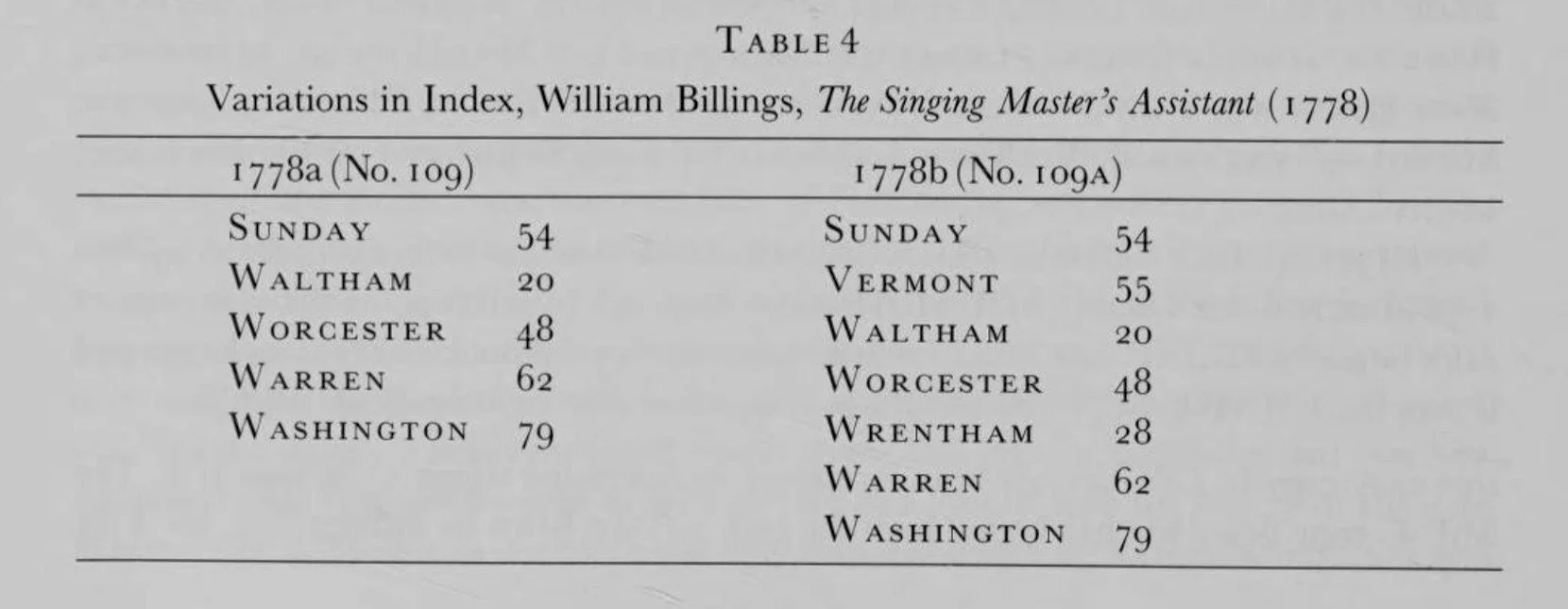
On 12 June 1778 Billings petitioned the General Court of Massachusetts for copyright to The Singing Master's Assistant, explaining that he had 'been at great Labour & Expence, in composing, & printing' his work, and that he feared 'that some avaricious Person, or Persons, will, in a Piratical manner, intercept & copy said Composition to the great Prejudice of your Petitioner.' (See McKay 1975, p. 227.) Table 4 below shows the typographical distinc-tions between this and the other printing of 1778.1 p. [1], t-p.; p. [2], 'The Preface'; p. [3], 'Advertisement'; p. [4]-17, "To the several Teachers of Music, in this, and the adjacent States'; p. 17-22, 'An Historical Account of G. Gamut, as related by herself, taken in short hand by the Author'; p. [23]-27, 'A Musical Dictionary'; p. [28]-29, To the Goddess of Discord: p. [30], 'An Alphabetical list of Tunes, and Anthems, contained in this Book'; p. [31]-32, "An Encomium on Music'; p. 32, 'A Morning Hymn'; p. 1-102, music; p. 103-4, Musical Characters'; p. 104, engraver's colophon. Kind Reader, No doubt you (do, or ought to) remember, that about eight years ago, I published a Book entitled, The New-England Psalm-Singer, &c. And truely a most masterly and inimitable Performance, I then thought it to be. Oh! how did my foolish heart throb & beat with tumultuous joy! With what impatience did I wait on the Book-Binder, while stitching the sheets and puting on the covers, with what extacy, did I snatch the yet unfinished Book out of his hands, and pressing it to my bosom, with rapturous delight, how lavish was I, in encomiums on this infant production of my own Numb-Skull? Welcome; thrice welcome; thou legitimate offspring of my brain, go forth my little Book, go forth and immortalize the name of your Author; may your sale be rapid and may you speedily run through ten thousand Editions, may you be a welcome guest in all companies and what will add tenfold to thy dignity, may you find your way into the Libraries of the Learned. Thou art my Reuben, my first-born, the beginning of my strength, the excellency of my dignity, and the excellency of my power. But to my great mortification, I soon discovered it was Reuben in the sequel, and Reuben all over, for unstable as water, it did not excel: But since I have began to play the Critic, I will go through with my Criticisms, and endeavour to point out its beauties as well as deformities, and it must be acknowledged, that many of the pieces are not so ostentatious, as to sound forth their own praises; for it has been judiciously observed, that the oftener they are sounded, the more they are abased. After impartial examination, I have discovered that many of the pieces in that Book were never worth my printing, or your inspection; therefore in order to make you ample amends for my former intrusion, I have selected and corrected some of the Tunes which were most approved of in that book, and have added several new pieces which I think to be very good ones; for if I thought otherwise, I should not have presented them to you. But however, I am not so tenacious of my own opinion, as to desire you to take my word for it; but rather advise you all to purchase a Book and satisfy yourselves in that particular, and then, I make no doubt, but you will readily concur with me in this sentiment, viz. that the Singing-Master's Assistant, is a much better Book, than the New-England Psalm-Singer. And now Reader I have no more to say or even desire but your compliance with the following ADVERTISEMENT. [New page] ADVERTISEMENT[.] Many of my Musical friends in the Country, have taken Copies from this work, and perhaps with some variation; therefore, I should esteem it as a pecular mark of their favour, if they would kindly submit all former Copies to this Publication, which has been corrected and amended by their sincere friend and well wisher, The Author. P.S. I have been very careful, to give credit for words, and where no credit is given, the words are written by the Author.... [New par.] By way of Apology, I take this Method to acquaint the Public, that the Book of Anthems which I promised them was just upon the point of publication, when hostilities commenced between Britain and the Colonies; which Unhappy War was the sole motive, that induced me to "hang my harp upon the willows" and suppress the publication; but relying so far upon their Candour, as to suppose myself already forgiven, I here renew my former promise of publishing, as soon as our political affairs have assumed a still brighter aspect. (Preface & Advertisement in full.) "To the Goddess of Discord. DREAD SOVEREIGN, I have been sagacious enough of late, to discover that some evil-minded persons have insinuated to your highness, that I am utterly unmindful of your Ladyship's importance; and that my time, as well as my talents, was wholly taken up in paying my divoto to your most implacable enemy and strenuous opposer, viz. the Goddess of Concord, which representation is as false as it is ill na-natured [sic]; for your Ladyship may believe me without hesitation, when I assure you on the word of an honest man, that knowing your Ladyship to be of a very captious disposition; I have always been very careful of trespassing on your grounds for fear of incuring your displeasure, so far as to exite you to take vengeance (which is well known to be your darling artribute [sic]). [New par.] I have likwise been informed, that some of my most implacable enemy's are some of your Majesty's privy council, and that your Majesty's Secretary at war, viz. Lord Jargon, was about to send some of your other Lords in waiting, viz. Lord second, Lord 7th, Lord gth, alias Lord 2d, junior, with some others, to beat a tattoo upon the drum of my ear, with so great a number of contra-vibrations without the intervention of a single coincidence, and with so much Forte as to dislocate my auditory; upon which information I called a court of Harmony, the result of which was, to repel force by force, and we had even proceeded as far as to order Lord Consonance, our Secretary at peace to furnish our life guard with an infinite number of coincidences, without the intervention of one contravibration; and although we have the majority on our side, yet we held it in scorn to take any advantage from our numbers, therefore we had selected an equal number of those who had attained unto the first three, viz. Lord Unison, Lord Diapente, Lord Octave, alias Lord Unison, jun'r, and for their Aid de camps, we had chosen two twin brothers, viz. Major and Minor Trio, together with Major Sixth, &c[.] we had proceeded thus far when in turning over a very antient history I met with the following passage, viz, "by wise council thou shalt make thy war, and in multitude of counsellors there is safety." Upon reading this passage I was resolved to enlarge the council, therefore we made choice of king Solomon, the son of David (but as he nor his father was never known to traverse your territories I suppose you have no knowledge of them). The result of our second council was to lay aside this enterprize and proceed in a very different manner, for by consulting this great councellor we were convinced "that wisdom is better than weapons of war." [New par.] Therefore it was resolved, that I singly should begin the attack in the common form of dedications, and besiege you with flattery, and if that should fail, as we have brib'd over a number of your nobility, we are determined to turn their force against you, and then we assure ourselves of success; but perhaps 1 trespass on your patience in this ambiguous preamble: Know then dread Sovereign that I have composed the following peice, out of such materials as your kingdom is made up of, and, without vanity, I believe you will readily grant that it is the best peice that ever was composed: this I chearfully offer at your shrine; and I must take the liberty to tell your Majesty, that I expect this one piece will fully compensate for my former delinquency and remissness to you ward; and that you will not be so unreasonable as to insist on another oblation from me, neither through time nor eternity; and let me tell you, that in this offering I followed the example of our native indians, who sacrifice to the angry God much oftener than to the good-natured one; not from a principle of love, but of fear, for although you could never excite my love, you have frequently caused me to fear and tremble; and 1 solemnly declare that I dread your extempore speeches more than I do the threats and menaces of all the crowned heads in Europe; and now madam, after this candid and honest confession, I must insist on your signing the following Receipt which for your honour and my security I shall always carry about me. [New par.] A RECEIPT. Received of the Author, a piece of Jargon, it being the best peice ever composed, in full of all accounts from the beginning of time, to and through the endless ages of eternity. I say received by me, Goddess of Discord. [New par.] Given from our inharmonical Cavern, in the Land of Chaos; from the year of our existence, (which began at Adam's fall) Five Thousand Seven Hundred and Eighty Two. DEMON DREAD, Speaker. Attest, Haman Horror, Secretary. [New par.] And now Madam Crossgrain after informing you, that this receipt shall be my discharge, I shall be so condescending as to acquaint your uglyship, that I take great pleasure in subscribing myself your most inveterate, most implacable, most irreconcilable enemy. The Author. [New par.] In order to do this peice [JARGON, P. 102] ample justice, the Concert must be made of vocal and instrumental Music. Let it be performed in the following manner, viz. Let an ass bray the Bass, let the fileing of a saw carry the Tenor, let a hog who is extream hungry squeal the Counter, and let a cart-wheel, which is heavy loaded, and that has been long without grease, squeek the Treble; and if the Concert should appear to be too feeble you may add the cracking of a crow, the howling of a dog, the squalling of a cat, and what would grace the Concert yet more would be the rubing of a wet finger upon a window glass; this last mentioned instrument no sooner salutes the drum of the ear, but it instantly conveys the sensation to the teeth; and if all these in conjunction should not reach the cause you may add this most inharmonical of all sounds, "pay me that thou owest."" (Address to Goddess of Discord in full.)
71 compositions, incl. 8 anthems & 1 set-piece, for 4 voices; full text. T-p. attribs. all to Billings. 47 1st pr. identified (all except AFRICA, AMERICA, AMHERST, BOSTON, BROOKFIELD, CAMBRIDGE, CHESTER, DORCHESTER, DUXBOROUGH, EXETER, HEBRON, HOLLIS STREET, LEBANON, MARBLEHEAD, MARSHFIELD, MEDFIELD, NEW HINGHAM, NEW NORTH, NEW SOUTH, PRINCE TOWN, PUMPILY, SAPPHO, SUFFOLK, WALTHAM). All are American.
6 Core Repertory (1st pr. MAJESTY, MARYLAND).
E43416 (DLC). CSmH, DLC, ICN, MB, MBAt (lacks all before p. 9; dated 29 Nov. 1778 in early owner's hand), MH, MHi (lacks p. 103-04), MSaE (t-p. mutilated so imprint can't be seen), MiU-C (see below for description of copy), NBuG, NN (2; 1 lacks t-p. and is very inc.), NNUT, NJPT (bottom of t-p. cropped so date can't be seen), RPJCB.
NOTE: A copy in CtY has not been examined to determine which 1778 issue it is. The MiU-C copy described has bound in at the end: 1. THE BIRD by Billings (11., see THE BIRD and THE LARK; No. 103); 2. Anthem Psalm 127 by Billings (8 p.; No. 100); 3. THE LARK by Billings (11.); 4. 26 p. of manuscript music, including 18 pieces also found in the Waterhouse Manuscript, described and reproduced in Crawford 1974. Pieces the two manuscripts have in common are: ALBANY/Wm. B., BENNINGTON, BRATTLE STREET /Wm. B., CONGRESS, GERMANTOWN/W.B., HACKERS HALL/Wm. B., HOLLISTON, MALDEN/W.B., MAXWELL, MORRISTON, MORPHEUS/Wm. Billings, NEW HAVEN, NEW KITTERY, NEW NORTH, PLYMOUTH/W.B., RAYNHAM/W.B., VICTORY/W.B., and WEYMOUTH / W.B. Among the 10 pieces in the Clements manuscript attrib. to W.B. or Wm. B. or Wm. Billings are two, GERMANTOWN and HACKERS HALL, that were apparently never published; they occur in no American imprint in the period covered by this bibliography.
Billings 1977 presents The Singing Master's Assistant in modern scholarly edition.
A notebook in the hand of Solomon Howe, q.v., records: 1778 May the 30: I came to Mr. Wm. Billings and June 11 went away again, in which time I worked for him a quarter of a month. 1778 June 11: received of Wm. Billings 6 P[ounds] Lawful Money. 1778 17 of June: in the Morn I came again to Mr. William Billings to work. Perhaps Howe's work for Billings was connected with The Singing Master's Assistant (Notebook, Howe Papers).
The Singing Master's Assistant 1778. ASMI 109B
The Singing Master's Assistant 1778. Boston: (New-England.) Printed by Draper and Folsom.
ASMI 109B
32, 104 р.р. 1-104 engraved.
Boston Independent Ledger, 7 Dec. 1778, advertises work as just published. Contents same as main entry. Music printed from same plates as main entry.
Music same as main entry.
Not in Evans (no copy on Readex). DLC, ICN, MB.
NOTE: Many typographical variations distinguish the two 1778 issues; only one obvious difference is singled out here. Table 4 reproduces a selected portion of the index, p. [30], which shows variation. The version listed as 1778b is a corrected index and thus is assumed to be later than 1778a, which omits VERMONT and WRENTHAM, both of which appear in the book.
The Singing Master's Assistant, [2d ed., 1779-80)
ASMI 110
The Singing Master's Assistant... Boston: (New-England.) Printed by Draper and Folsom.
32, 104 p. p. 1-104 engraved.
[1779-80.] The t-p. is undated. Evans 16206 describes a copy with the t-p. designation The Second Edition. Boston: (New England.) Printed by Draper and Folsom. 1779' but locates no copy, nor has a diligent search turned up any. The suspicion here is that this undated issue is Billings's 2d ed. Surely it appeared between the first (Dec. 1778) and the third (1781). Contents same as ist ed. (No. 109). p. 1-104 printed from same plates as 1st ed.
Music same as 1st ed.
E16206 (no copy on Readex). However, E15744 reproduces on Microprint the MWA copy, wrongly calling it the 1st ed., 1778. ICN, MWA".
NOTE: An incomplete copy in MB, lacking all before p. 15, may also be this issue.
The Singing Master's Assistant, 3d ed., 1781
ASMI 111
The Singing Master's Assistant... Composed by William Billings, author of the New-Eng-land Psalm-Singer. (The third edition). Commonwealth of Massachusetts: Boston: printed by Draper and Folsom. MDCCLXXXI.
32, 104 p.p.1-104 engraved.
Contents same as 1st ed. (No. 109). p. 1-104 printed from same plates as 1st ed.
Music same as 1st ed.
E43943 (MWA). CCC (b.w. Billings, The Psalm-Singer's Amusement & - The Suffolk Harmony), CSmH, CtY, ICN (lacks all before p. 7), MB, MH (front matter inc.), MHi (2; 1 b.w. Billings, The Psalm-Singer's Amusement, 1781, The Suffolk Harmony, 1786 & An Anthem for Easter), MSAE, MWA, MiU-C*, N (2; 1 lacks t-p. and front matter), RPJCB (front matter inc.).
NOTE: NCWSM owns two copies lacking title-pages (1 also lacks p. 5-6; the other lacks all before p. 23, and its music is inc.). They may be incomplete copies of the 3d edition. An incomplete copy in CtHC is also unidentified as to its edition.
The Singing Master's Assistant, 4th ed., [1786-89]
ASMI 112
The Singing Master's Assistant. Composed by William Billings, author of the New-Eng-land Psalm-Singer. (The fourth edition.)... E. Russell, pr. next Lib. Pole.
15, [1], 104 p. p. 1-104 engraved.
[1786-89.] Evans, VII, 417, locates Ezekiel Russell, printer and bookseller, 'At his Office near (next) Liberty-Pole (stump), 1786-1789. p. [1], t-p.; p. [2]-11, "To the several Teachers of Musick, in this and the adjacent States'; p. 11-15, 'A Musical Creed; In Imitation of St. Athanasius'; p. [16], 'An Alphabetical List of Tunes and Anthems, contained in this Book'; p. 1-102, music, p. 103-4, 'Musical Characters'; p. 104, engraver's colophon. Who-soever will be harmonical, before all things it is necessary that he hold the Aretinian Scale, which Scale except every one do keep whole and entire, without doubt he shall jar exceedingly: And the Aretinian Scale is this, that we believe in one Gamut in Affinity, and one Scale in Unity, neither confounding the Cliffs, nor destroying the Gamut: For there is one Cliff of the F, and another of the C, and another of the G; but the Majesty of the F, and of the C, and of the G is equal: Such is the F, such is the C, and such is the G; the F comprehensible, the C comprehensible, and the G comprehensible: For the Scale is not originated from the Cliffs, but the Cliffs from the Scale: So that there are not three Scales, but one Scale: For there is one Part of the Bass, another of the Tenor, another of the Counter, and another of the Treble. And yet there are not four Systems, but one System: For the Grandeur of the Bass, the Majesty of the Tinor, the Glory of the Counter, and the Sweetness of the Treble are equal; and yet there are not four Equalities, but one Equality: For as the Bass is connected with the Tenor, so is the Tenor with the Counter, and the Counter with the Treble; and yet there are not four Connexions, but one Connexion, and in this Connexion none is before or after, none is greater or lesser than another; but the whole four Parts are coexisting and coequal; so that in all things the Affinity in Unity and Unity in Affinity is preserved: He, therefore, that will be musical must strictly observe this Connexion. [fn.: I hope no pious Episcopalian will so far misconstrue my intention, as to suppose this is intended as a burlesque upon their form of Devotion: I was pleased with the stile, and wrote this by way of Imitation.]... [p. 14] And, by this same mode of reasoning, we are taught that Three Times Eight is Twenty-two, and Four Times Eight is Twenty-nine: Also, we are ready to believe that this method of calculation will be very mysterious to all who are not adepts in the Theory of Musick. (Extract from Musical Creed.) p. 1-104 printed from same plates as 1st ed. (No. 109).
Music same as 1st ed.
Not in Evans (no copy on Readex). DLC, MWA (b.w. Billings, The Psalm-Singer's Amusement, 1781, The Suffolk Harmony, 1786, An Anthem for Easter & Anthem Ps. 127).
NOTE: 'The Creed, of St. Athanasius,' which Billings is here parodying, is printed on p. 141-43 of The Heidelbergh Catechism in [New York, Reformed Protestant Dutch Church,] The Psalms of David (New York, 1767), No. 398 below.
THE SUFFOLK HARMONY, 1786
Most extant copies of The Suffolk Harmony have bound in at the end one or more among four smaller items: ANTHEM PSALM 47 (No. 99), ANTHEM PSALM 127 (No. 100), AN ANTHEM FOR EASTER (NO. 101), and THE BIRD and THE LARK (No. 103). Since these all carry the composer's name and have separate pagination (or none at all), they were clearly separate issues, rather than parts of The Suffolk Harmony. Each is treated separately. And The Suffolk Harmony is described here as it was first published. The content of the various bindings is shown by the note at the end of this entry.
ASMI 113
The Suffolk Harmony, consisting of psalm tunes, fuges and anthems composed by William Billings: author of the Singing Masters Assistaft. Boston: engraved and printed by J. Norman, for the author, and sold at his house near the Liberty-Pole. MDCCLXXXVI
1 p.l., 56 p.11 x 20 cm. p. 1-56 engraved by John Norman.
Boston Independent Chronicle, 8 June 1786, advertises work as just published.p.l. recto, t-p.; verso, 'Shiloh. for Christmas by Wm. Billings, poem; p. 1-56, music.
32 compositions, incl. 2 anthems & 1 set-piece for 4 voices; full text. T-p. attribs, all to Billings. 26 1st pr. identified (all except HARTFORD, KITTERY, MADRID, MENDOм, NORTHBOROUGH, RICHMOND). All are American. Core Repertory (1st pr. JORDAN).
E19512 (MWA copy on Readex, b.w. An Anthem Psalm 127 & An Anthem for Easter). RPJCB. All other copies are b.w. additional items, as noted below.
NOTE: The various bindings of The Suffolk Harmony include the following:
—with An Anthem for Easter. MWA
—with THE BIRD and THE LARK. MB, MBAI, N
—with An Anthem for Easter & An Anthem Psalm 47. ΜΗ
—with An Anthem for Easter & An Anthem Ps. 127. DLC
—with An Anthem for Easter, An Anthem Ps. 47, An Anthem Ps. 127 & THE BIRDand THE LARK. CHT-W
—with An Anthem for Easter, An Anthem Ps. 127, The Singing Master's Assistant, 3d ed., 1781, & The Psalm-Singer's Amusement, 1781. CCC, MHi
—with An Anthem for Easter, An Anthem Ps. 127, The Singing Master's Assistant, 4th ed., & The Psalm-Singer's —Amusement, 1781. MWA (copy of The Suffolk Harmony on Readex as E19512).
—with THE BIRD and THE LARK, & Howe, Worshipper's Assistant, 1804 (p. 1-8). MIU-C
Billings 1986 includes The Suffolk Harmony in modern scholarly edition.
UNIVERSAL PRAISE, 1793
ASMI 114
Universal Praise: an anthem, for Thanksgiving Day, taken from Psalm 149, and elsewhere. By William Billings.
8 p.13 x 21 cm.
[1793.] Boston Columbian Centinel, 16 Oct. 1793, advertises that the publishers, Thomas and Andrews, would have this item for sale 'tomorrow afternoon. p. [1], caption title; p. [1]-8, music.
1 anthem for 4 voices; full text. Attrib. to Billings. Identified as ist pr. American composition. Not in Core Repertory.
Not in Evans (no copy on Readex). Northboro, Mass., Historical Society.
NOTE: This item appeared as p. 97-104 in No. 104, Billings's The Continental Harmony (Boston: Thomas and Andrews, 1794), where the printing is identical with this separate issue, except for the page numbers and a different caption on the first page. Apparently the publishers had extra copies of this part of the book run off for the Thanksgiving season.
ASMI pp 169 - 188