
American Sacred Music Imprints (ASMI) is a primary work of reference for New England tunebooks. For that reason, the digital files presented in this section bear the ASMI numbers. We want to give easily accessible visuals to written research.
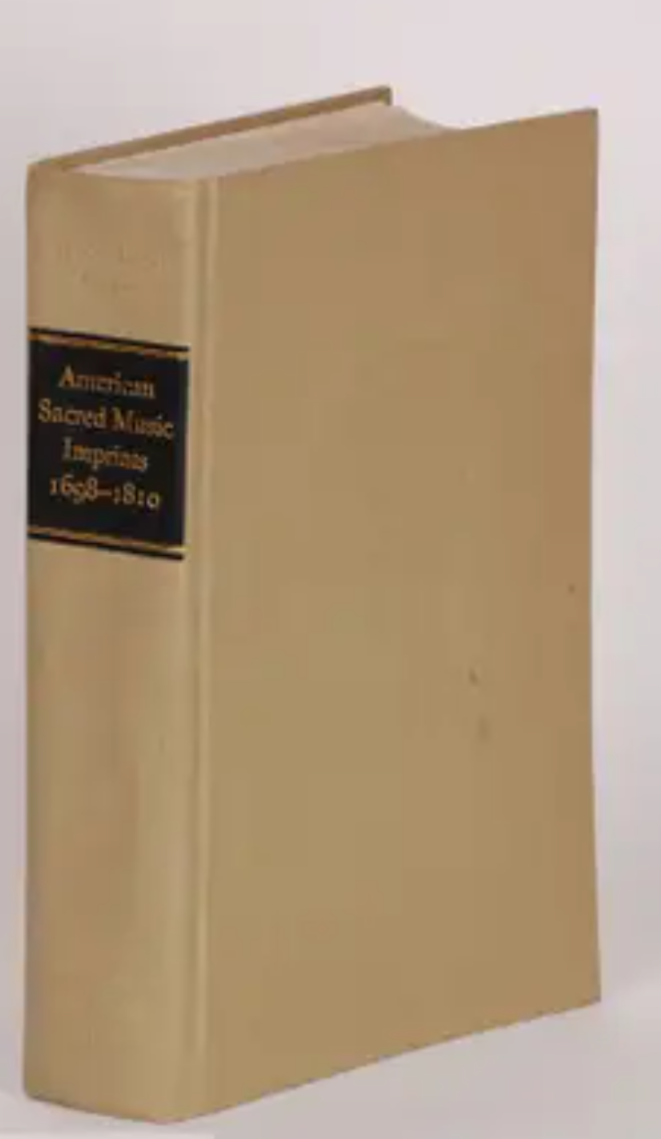
American Sacred Music Imprints, 1698 to 1810: a Bibliography, by Alan Perdue Britton and Irving Lowens and completed by Richard Crawford.
Published by the American Antiquarian Society, 1990
JEREMIAH INGALLS
Jeremiah Ingalls (b. Andover, Mass., 1 March 1764; d. Hancock, Vt., 6 April 1838) was a composer, singing master, cooper, farmer, and tavern keeper. Ingalls settled in Newbury, Vermont, in 1791 or before. In 1794 he was chosen chorister at the Newbury Congregational Church, where he introduced the 'bass viol' (cello), which he played himself, into use in public worship. He built a tavern in Newbury in 1800 and served as a deacon in the church from 1803 until 1810, when the church excommunicated him. Moving with his family to a farm near Rochester in the Green mountains, he remained active in music, organizing a choir in the church in Rochester. Ingalls composed occasional music as well as sacred pieces and is most of all remembered for publishing folk hymns-his own harmonizations of folk tunes set to the hymn texts sung at revivals by Baptists and other evangelical Protestants.
Bio-bib, Metcalf. Also Jackson 1943, p. 69-73; Klocko 1978; Wells 1902, p. 580-82.
THE CHRISTIAN HARMONY, 1805
281 The Christian Harmony; or, Songster's Companion. By Jeremiah Ingalls.
Praise ye the Lord. Sing unto the Lord a new song, and His praise in the congregation of saints. For the Lord taketh pleasure in His people: He will beautify the meek with salvation ..... Psalm clxix.
Published according to act of Congress. Exeter, Newhampshire: printed by Henry Ranlet, for the compiler. 1805.
199, [1] p. 113 x 23 cm.
Preface dated Newbury, Vt., Nov. 1804. Boston Democrat, 9 March 1805, advertises work as just published. 1 p. 1, t-p.; p. 2], 'Advertisement' & 'Preface'; p. [3]-8, 'A Plain and Concise Introduction to Music'; p. [9-199, music; p. 200], 'Index.' 'This Book contains the Grounds of Music made easy to the learner, and a pleasing variety of Hymns and Spiritual Songs, with Music appropriate; some being wholly, and some in part, the original composition of the Author, and others selected from various authors, (which are credited where they are known.) The whole designed for the Use of Christians of all denominations, and adapted to the various occasions of Religious Worship.' (Advertisement in full.) 'Considering the multiplicity of apologies usually made, when productions of this nature are brought forward, the Author would inform the public that he has none to make; but with diffidence would submit this to their candor, and should it meet with their patronage, his most sanguine expectations will be answered.' (Extract from Preface.)
137 compositions, incl. 4 set-pieces, 117 for 3 voices, 20 for 4; full text, many pieces with additional stanzas. Attrib. to Billings. 114 1st pr. identified (all except the 8 1st Am. pr. and AMERICA, BENEVOLENCE, CRUCIFIXION, DELIGHT, EMMANUEL, EVENING HYMN, JERUSALEM, LIVONIA, NORTHFIELD, ODE TO SCIENCE, PILGRIM'S FAREWELL, SALISBURY, THE HEAVENLY ODE, THE TRUE PENITENT, VERONA), also 8 1st Am. pr. (BACKSLIDERS, BUILTH, CHIPPING, CHRISTMAS, GUERNSEY, LANDSDON, MARLBOROUGH, ST. PAUL'S). 122 American compositions, I I non-American, 4 unidentified [CHRISTIAN SONG, FREE GRACE, LIVONIA, LOVE TO JESUS] (I attrib. American, 15 traced to American sources; 107 assumed to be American [see NOTE]; 11 traced to non-American sources [the 8 Ist Am. pr. & ST. CLEMENTS, WALSAL, WEDNESBURY]). ↑ 1 Core Repertory (JERUSALEM is NEW JERUSALEM).
S8680 (MWA). CLU, ICN, MB (very inc.), MWA*, NN (inc.), NjR (lacks all after p. 192), Vt.
NOTE: Ingalls claims an unspecified number of pieces as 'wholly, and some in part' his own compositions. In the latter, he apparently took traditional songs and dance tunes, attached sacred words, added voices to provide harmony, and thus transformed them into folk hymns-sacred words sung to tunes originally secular. Probably most of the traditional tunes originated outside America, but such compositions are here assigned to American provenance and labeled 'Ist pr.' because they are in fact 'new' polyphonic pieces.
A facsimile reprint, with an introduction by David Klocko, has been issued (New York, 1981).
ASMI, pp. 346-347